[ISW] 러시아 점령 업데이트, 2026년 4월 9일

“`html

핵심 요약:

  • 러시아는 러시아 입양 데이터베이스에 추방된 우크라이나 어린이들의 프로필을 계속 게시하고 있습니다.
  • 체첸 공화국은 의료적 필요성을 가장하여 우크라이나 어린이들의 추방을 용이하게 할 수 있습니다.
  • 러시아 연방 보안 기관과 청소년 군사-애국 단체는 우크라이나 청소년을 러시아 군대 및 보안 기관에서 복무하도록 준비시키기 위한 전술 훈련 캠프를 개최했습니다.
  • 러시아 점령 당국은 점령된 우크라이나의 주거 및 상업용 부동산을 압수, 국유화 및 재분배하려는 노력을 계속하고 있습니다.
  • 러시아 당국은 점령된 크림반도의 여성들을 대상으로 조직적인 박해를 강화하고 있습니다.
  • 러시아의 국영 은행들은 점령된 우크라이나에서 은행 서비스와 일상적인 교환 수단의 소유권을 계속해서 통합하고 있습니다.
  • 러시아 관리들은 점령된 우크라이나에서 대규모 주택 건설 프로젝트를 계속 추진하고 있으며, 이는 부분적으로 러시아 시민들을 재정착시켜 점령 지역의 인구를 늘리려는 노력을 지원하기 위한 것으로 보입니다.

관련 최신 자료 및 링크:

참고: 제시된 링크는 해당 내용과 관련된 최신 정보의 예시이며, 실제 내용과 일치하는지, 최신 정보인지는 링크 접속 시점에서 다시 한번 확인하는 것이 좋습니다. 또한, 정보는 지속적으로 업데이트되므로, 관련된 최신 뉴스 기사, 보고서, 연구 등을 추가적으로 검색하는 것을 권장합니다.

“`

[원문]

Russia continues to publish the profiles of deported Ukrainian children on Russian adoption databases.

April 9, 2025

Data Cutoff: April 8, 2:00 PM ET

Karolina Hird, Jakub Kostka, Lauren Thacker, Anjou Kang-Stryker, and Nikolai Sundstrom

TOPLINES

Russia continues to publish the profiles of deported Ukrainian children on Russian adoption databases. Radio Free Europe/Radio Liberty television channel, Current Time, and international war crimes investigation initiative The Reckoning Project published a joint investigation on April 7 detailing the case of 48 Ukrainian children whom Russia deported from the Kherson Regional Orphanage between September and October 2022. The investigation found that while Ukraine has been able to repatriate 10 of the 48 children, most of the children remain in foster families in Russian-occupied Ukraine after Russian officials transferred them to the Yolochka orphanage in occupied Simferopol, Crimea. ISW previously reported on the fostering and adoption of children from the Kherson Regional Orphanage via Yolochka, which was implicated in neglect of children under its care before the full-scale invasion in 2022. Four of the children notably had their profiles listed on the Russian federal adoption database as of March 2026. The investigation noted that the adoption profiles do not list that the children are from Ukraine. Russia has been placing Ukrainian children on federal and regional adoption databases since at least 2016, after its first invasion of Crimea and Donbas in clear violation of international humanitarian and human rights law.

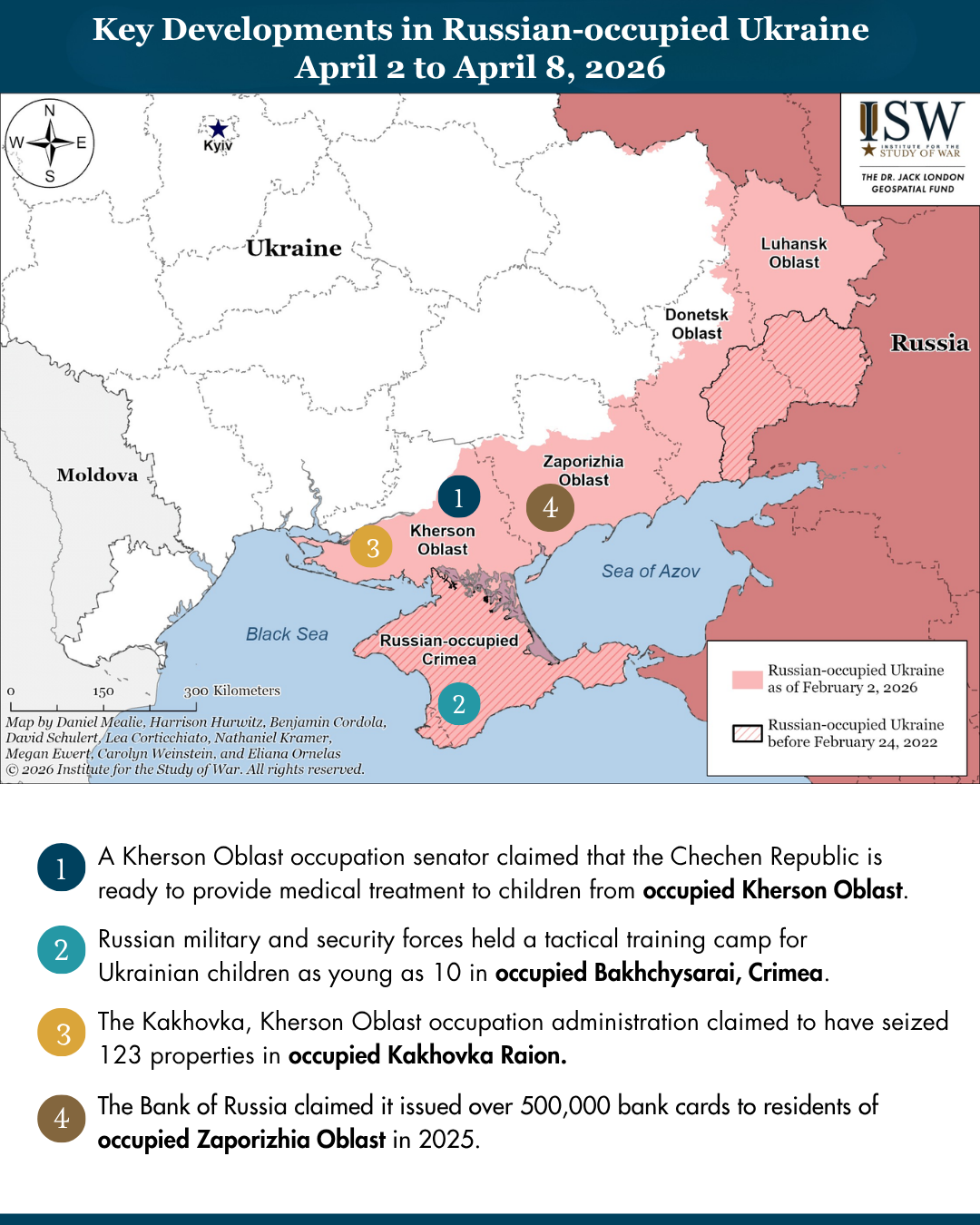
The Chechen Republic may be facilitating the deportation of Ukrainian children under the guise of medical necessity.  Kherson Oblast occupation senator Igor Kastyukevich reported on April 4 that the Grozny-based Chechen Clinical Hospital is prepared to treat children from occupied Kherson Oblast with maxillofacial injuries and pathologies. Kastyukevich personally thanked Chechen Republic Head Ramzan Kadyrov for his support of children from occupied Kherson Oblast and noted that the Kherson Oblast occupation Ministry of Health will organize the transfer of children to Chechnya for maxillofacial treatment. While children from occupied Kherson Oblast may indeed receive needed medical care in Chechnya, Russia still appears to be operating outside the bounds of its international humanitarian and human rights requirements when it comes to using medical care as a pretext for the deportation of Ukrainian children to Russia. Russian officials should first and foremost facilitate the treatment of vulnerable children in Ukraine or a neutral third-party state, but Russia has a documented history of using medical or psychological interventions as a justification for deporting Ukrainian children to Russia, many of whom do not return to occupied Ukraine after treatment. A December 2024 investigation by the Yale Humanitarian Research Lab found that the Russian medical system was complicit in performing medical examinations on deported children before placing them up for adoption in Russia.

KEY TAKEAWAYS

  • Russia continues to publish the profiles of deported Ukrainian children on Russian adoption databases.

  • The Chechen Republic may be facilitating the deportation of Ukrainian children under the guise of medical necessity. 

  • Russian federal security agencies and youth military-patriotic organizations held a tactical training camp to prepare Ukrainian youth for service in the Russian military and security apparatus.

  • Russian occupation officials continue efforts to seize, nationalize, and redistribute residential and commercial properties in occupied Ukraine.

  • Russian authorities are escalating systematic persecutions against women in occupied Crimea.

  • Russia’s majority state-owned banks continue to consolidate their ownership of banking services and means of everyday exchange in occupied Ukraine.

  • Russian officials continue to pursue housing projects en masse in occupied Ukraine, likely in part to support efforts to increase the population of occupied areas with resettled Russian citizens from Russia.

EMAIL SUBSCRIPTION OPTIONS

ISW offers customizable email subscription options. Click below to learn more and customize your preferences.

ISW is powered by the support of individuals like you.

Help us stay independent and impactful.

Website | Jobs | Internships

Follow ISW on social media:

FacebookXYouTube | InstagramLinkedIn | Threads | Bluesky

© 2026 Institute for the Study of War and AEI’s Critical Threats Project. All rights reserved.

Donate online or by sending a check to the Institute for the Study of War at 1400 16th Street NW, Suite #515, Washington, DC 20036. Please consider including the Institute for the Study of War in your estate plans.

ISW is a tax-exempt organization under section 501(c)(3) of the Internal Revenue Code. Donations are tax-deductible to the extent permitted by law.

ISW is a non-partisan, non-profit, public policy research organization. ISW advances an informed understanding of military affairs through reliable research, trusted analysis, and innovative education. We are committed to improving the nation’s ability to execute military operations and respond to emerging threats in order to achieve US strategic objectives.

댓글 달기

이메일 주소는 공개되지 않습니다. 필수 필드는 *로 표시됩니다

위로 스크롤