|
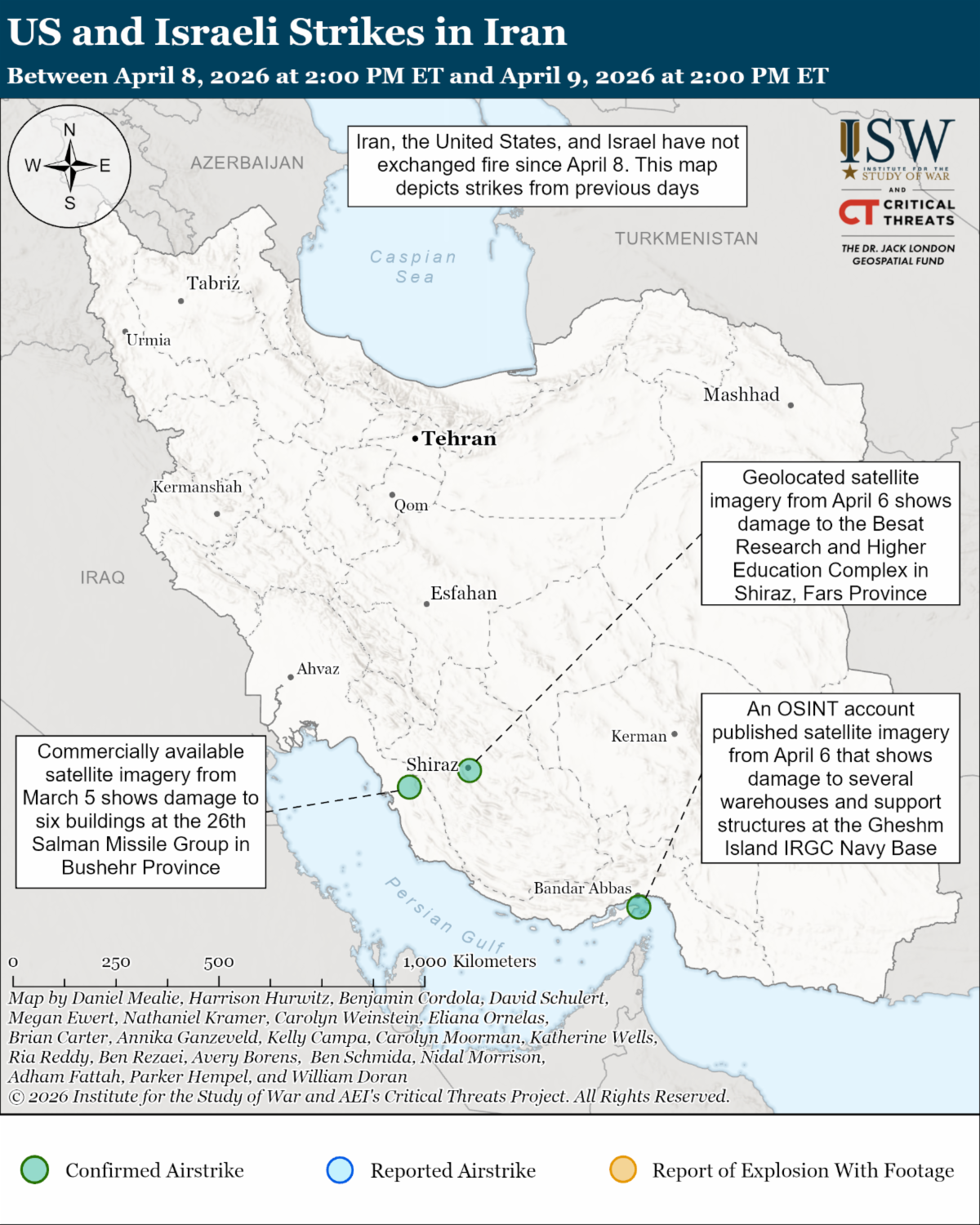
Iran, the United States, and Israel have not exchanged fire since ISW-CTP’s last data cutoff on April 8. Gulf states continue to report drone attacks against them, however. Bahrain’s Defense Ministry stated on April 9 that it has intercepted seven Iranian drones since April 8. The Kuwaiti Armed Forces announced on April 9 that an unspecified number of drones entered Kuwaiti airspace and that one of these drones targeted a Kuwaiti National Guard site.
Iran is taking several steps to try to exert control over maritime traffic through the Strait of Hormuz, which have the net effect of keeping oil prices high. Iran likely aims to use high oil prices to exert economic pressure on the United States and extract concessions from the United States during negotiations. An unnamed senior Iranian source told Russian state media on April 9 that Iran will not allow more than 15 vessels per day to transit through the Strait of Hormuz during the ceasefire. The Iranian Ports and Maritime Organization published a graphic on April 8 instructing ships to follow designated entry and exit routes in coordination with the Islamic Revolutionary Guards Corps (IRGC) Navy to transit the strait. These routes move international maritime traffic into Iranian-controlled waters. The graphic warns that ships risk hitting mines outside of these routes. Unspecified US officials previously told Western media on March 23 that there are at least a dozen Iranian mines in the strait. Iranian Supreme Leader Mojtaba Khamenei released a statement on April 9 in which he said that Iran will “take the management” of the Strait of Hormuz to a “new phase. This statement is consistent with other Iranian officials’ statements in recent weeks that Iran intends to use the strait as a point of leverage even after the war ends. Commercial maritime tracking data showed that three cargo ships and one oil tanker entered the strait, while six cargo ships and four oil tankers exited the strait between 2:00 PM ET on April 8 and 2:00 PM ET on April 9.
The US Government stated on April 8 that Iran submitted a “new” and “modified” proposal to the United States that will serve as the basis for the US-Iran talks. US President Donald Trump stated on April 7 that this proposal is a “workable basis on which to negotiate.” Iranian media previously published a version of its 10-point proposal, which included long-standing and maximalist Iranian demands. The proposal called for guarantees against future strikes on Iran, Iranian control of the Strait of Hormuz, recognition of Iran’s right to uranium enrichment, and the lifting of all US primary and secondary sanctions. It also demanded the termination of United Nations and International Atomic Energy Agency resolutions against Iran, the withdrawal of US forces from the region, war reparations, and a ceasefire across all fronts, including Lebanon. Unspecified mediators told The Wall Street Journal on April 8 that Iran has softened several of its demands, including its demands related to nuclear enrichment, the withdrawal of US forces from the Middle East, and war reparations. The Wall Street Journal also highlighted disagreements over the scope of the ceasefire, noting that the United States does not consider Lebanon part of the agreement despite Iran including it in its proposal. Iranian President Masoud Pezeshkian stated on April 9 that Israeli strikes on Lebanon render negotiations “meaningless.” Iranian Parliament Speaker Mohammad Bagher Ghalibaf separately insisted that Lebanon is part of the ceasefire framework.
|