|
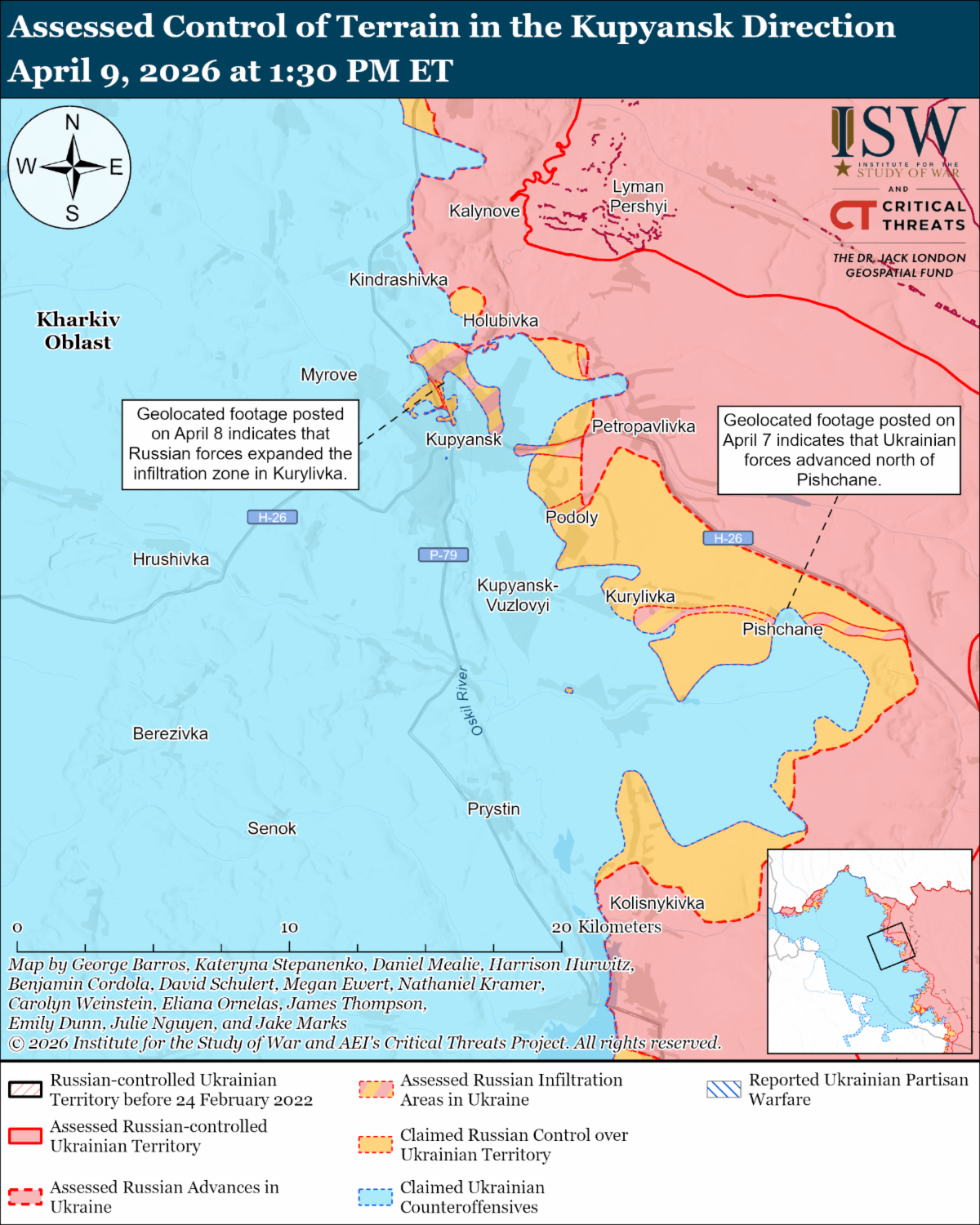
Russian and Ukrainian reporting appears to confirm battlefield reporting that Ukrainian forces have achieved a drone advantage over Russian forces on the battlefield. Ukraine’s drone advantage is likely contributing to the stalling of Russian advances and recent Ukrainian counterattacks. Ukraine has markedly increased its mid-range strike campaign against Russian logistics, military equipment, and manpower since late 2025 and particularly in early 2026, which has impeded Russian advances across the theater and is likely also interfering with the Russian spring-summer 2026 offensive. ISW has observed geolocated evidence that Ukrainian forces conducted 41 mid-range strikes in January 2026, 61 in February 2026, and 115 in March 2026. These Ukrainian strikes have largely targeted Russian forces and assets in eastern and southern Ukraine, including near occupied Donetsk City, degrading Russian preparations for offensive operations in recent weeks and months.
Ukrainian forces’ increasing strikes against Russian air defense systems and drone interception rates have facilitated recent Ukrainian battlefield successes. Ukrainian forces in Winter 2025-2026 and Spring 2026 have made their most significant gains on the battlefield since Ukraine’s incursion into Kursk Oblast in August 2024 and have liberated the most territory in Ukraine itself since the 2023 counteroffensive. Ukrainian Unmanned Systems Forces (USF) Commander Major Robert “Magyar” Brovdi reported on April 9 that USF forces have destroyed nine Russian air defense systems in occupied Ukraine since April 1. Ukrainian USF forces have increasingly intercepted Russian drones since late February and March 2026, intercepting a total of 2,975 in January, 3,679 in February, and 7,674 in March 2026. Interceptor drones have important tactical battlefield implications as Russian forces rely on drones to disrupt Ukrainian defenses, which, in turn, enables Russian advances and prevents Ukrainian advances. Ukraine’s increasing interceptions of Russian drones are therefore contributing to slowing Russian advances and permitting Ukrainian counterattacks. Ukraine’s defensive successes, drone adaptations, and mid-range strike campaign are creating compounding effects that are degrading Russian frontline forces.
Unverified reporting suggests that the Kremlin privately acknowledges Ukraine’s upper hand in drone operations on the battlefield and defense industrial base (DIB) production. A Russian milblogger citing unspecified sources reported on April 9 that Russian Defense Minister Andrey Belousov told Russian President Vladimir Putin that Ukraine has a “significant” technological advantage in drone warfare on the frontlines. Belousov allegedly stated that the situation is “critical” for Russian forces as Ukraine both has numerical superiority in drones and has developed a new “generation of equipment.” Belousov allegedly told Putin that Ukraine was using “more sophisticated systems” that Russian forces are “largely unprepared” to counter. The sources claimed that Belousov highlighted several issues, including that new Ukrainian drones operate “around the clock,” that the drones are “virtually inaudible” until the moment they strike, and that Russian conventional defense methods such as standard detectors and electronic warfare (EW) are ineffective against the drones. Belousov allegedly stated that Russia needs to focus on developing its own next-generation systems and that current drone models purchased through external channels and foreign procurement are no longer adequately effective on the frontlines. Putin reportedly identified developing drone technology domestically as a priority going forward. ISW cannot verify the authenticity of this report.
|