|
The Iranian delegation arrived in Islamabad on April 10 ahead of planned negotiations on April 11. US Vice President JD Vance departed for Pakistan on April 10, operating under strict guidance from President Donald Trump. Jared Kushner and US Special Envoy to the Middle East Steve Witkoff are also part of the US negotiating team, which also reportedly includes officials from the Pentagon, National Security Council, and State Department. CBS reported that the negotiating teams are expected to remain in Pakistan even if Vance departs. A Pakistani source familiar with April 11 talks told Reuters that “everything is on track,” citing de‑escalation in Lebanon as a “good sign,” and confirmed that advance teams from both Iran and the United States are already in place in Islamabad.
It will remain difficult to determine whether the Middle East ceasefire conditions are being upheld, given the lack of mutually agreed-upon, written ceasefire documents available to the public. Iranian officials are using this ambiguity to frame the United States and its partners as aggressors who are attempting to collapse the ceasefire, which is far from clear. Iranian officials, including Iranian Parliament Speaker Mohammad Bagher Ghalibaf and Foreign Affairs Minister Abbas Araghchi, who are leading the Iranian negotiating delegation, insist that Lebanon must be included in the ceasefire and that Iran will be able to restrict shipping in the Strait of Hormuz as part of the ceasefire. Ghalibaf wrote on X on April 10 that two ”mutually agreed“ measures — a ceasefire in Lebanon and the release of Iran’s blocked assets — must be implemented before negotiations begin. There is zero public evidence that any of these measures were ever included in the ceasefire by either party. It is additionally unclear whether the ceasefire extends to Iraq, for example, where Iranian-backed groups ambushed US diplomats on April 8. President Masoud Pezeshkian told Turkish President Recep Tayyib Erdogan during a phone call on April 9 that the ceasefire depends on US commitments, while Araghchi separately stressed Lebanon’s centrality to the ceasefire in a call with Iran’s ambassador in Beirut.
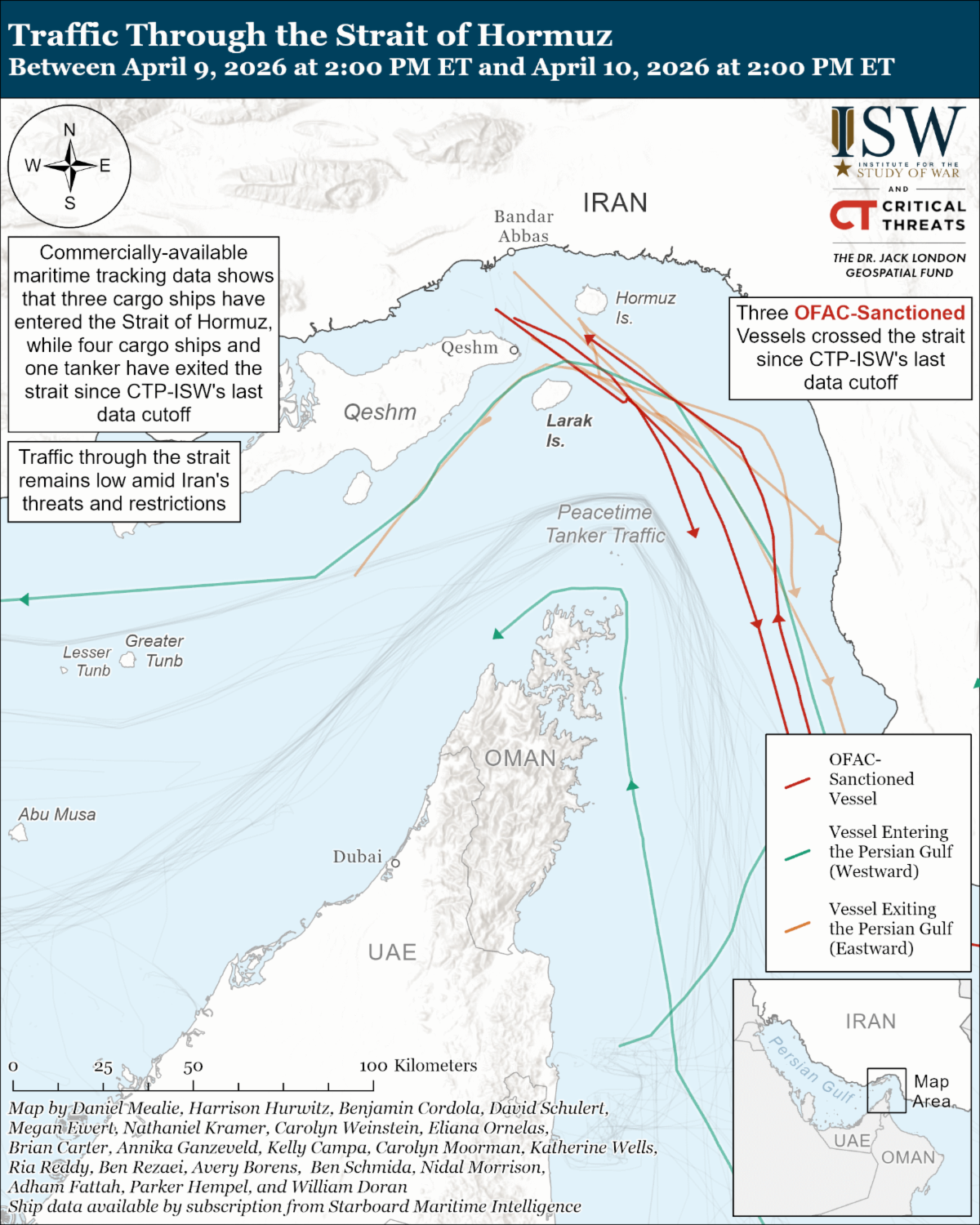
Iranian media reported on April 10 that Iranian parliamentarians are preparing to vote on a strategic Strait of Hormuz plan that would prohibit ”hostile” shipping (which would include US, Israel, and other vessels), require transit fees in rials, and mandate use of the term “Persian Gulf." This plan would force crews or countries to negotiate for safe passage through the international waterway, which would have economic impacts because it implies that Iran’s conditions in these negotiations could change at any time and for any reason. An Iranian analyst close to the regime argued that the US-Iran War has reshaped Iran’s security doctrine and deterrence posture, referring to Iran’s control of the Strait. An agreement that allows Iran to restrict shipping in the Strait, tax it, or otherwise threaten international shipping and keep energy prices high for the consumer. Some shipping firms are calling on tankers not to pay Iran‘s toll, as it is a violation of freedom of navigation. Even without a formal toll system, Iran is aware that it can coerce other powers in the future by threatening shipping through the strait.
|