[ISW] 이란 업데이트 특별 보고서, 2026년 4월 15일

“`html

주요 내용 요약:

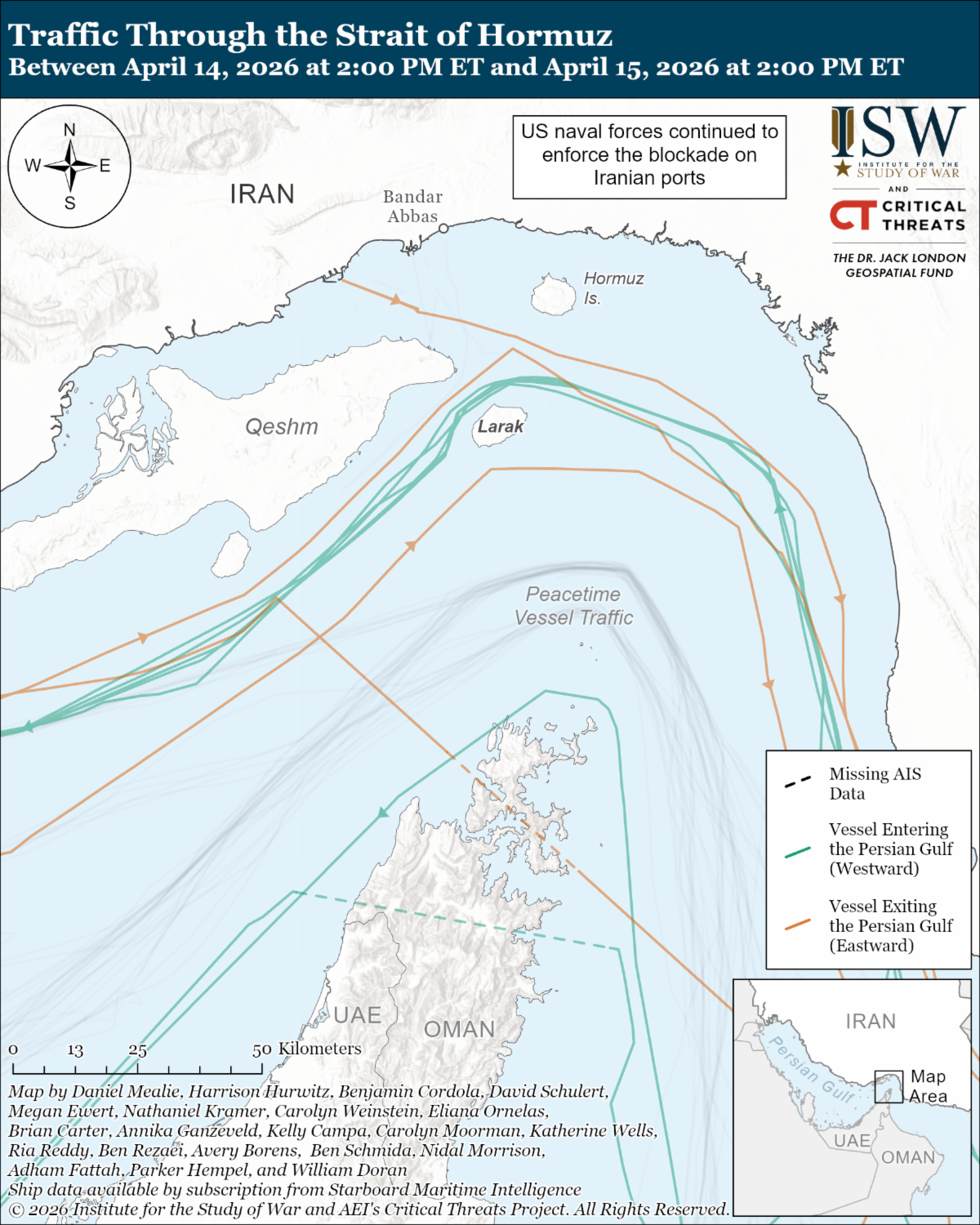
  • 미 해군, 이란 항구 봉쇄 지속: 미 해군이 이란 항구에 대한 봉쇄를 계속 시행하고 있습니다. 미 중부 사령부(CENTCOM)는 4월 15일, 봉쇄 시행 초기 48시간 동안 이란 항구를 침범한 선박이 없다고 보고했습니다.
  • 미국의 추가 협상 조건: 미국은 추가 협상을 위한 두 가지 선행 조건을 제시했습니다. 첫째, 이란이 호르무즈 해협을 완전히 “재개방”해야 하며, 둘째, 이란 협상 대표단이 최종 합의를 “전적으로 권한”을 가져야 한다는 것입니다. 이 두 번째 조건은 정권 내부 갈등 보고와 함께 나왔으며, 미국이 단일 통일된 권한이 아닌 강경파와 실용주의자들로 분열된 협의회와 협상하고 있다는 ISW-CTP의 평가를 뒷받침합니다.
  • 이란 관리들의 입장 차이: 일부 이란 관리들은 미국과의 협상에서 이란의 핵 프로그램에 대한 타협 의지를 서로 다른 수준으로 시사했습니다. 이러한 발언은 적어도 어느 정도까지는 이란의 협상 입장에 대한 내부적인 의견 불일치를 반영합니다.
  • 이스라엘, 농축 우라늄 제거를 조건으로: 이스라엘 국방부 장관 이스라엘 카츠는 4월 14일, 미국과 이스라엘이 이란으로부터 농축 우라늄을 제거하는 것을 미국-이스라엘 캠페인 종료를 위한 “중요 조건”으로 결정했다고 밝혔습니다.
  • 미 재무부, 제재 시행: 미국 재무부는 4월 15일, 이란의 석유 밀수 및 관련 금융 네트워크와 관련된 3명의 개인, 17개 회사, 9척의 선박 등 총 29개 대상을 제재했습니다. 이는 이란에 대한 미국의 광범위한 경제 압박 캠페인의 일환입니다.
  • 파키스탄의 휴전 연장 노력: 파키스탄은 미국과 이란에 휴전을 45일 연장할 것을 촉구하고 있습니다. 그러나 도널드 트럼프 미국 대통령은 4월 14일 ABC 뉴스에 출연하여 4월 22일에 종료되는 휴전을 연장하는 것을 고려하지 않고 있다고 밝혔습니다.
  • 이란의 탄도 미사일 전력 재정비: 이란은 현재의 휴전을 이용하여 미사일 기지 입구를 다시 열려는 시도를 통해 전술적 수준에서 탄도 미사일 전력 프로그램을 재정비하고 있습니다.
  • 이란의 중국 정찰 위성 활용: 이란은 2024년 중화인민공화국(PRC)으로부터 구매한 첨단 정찰 위성을 활용하여 전쟁 중 중동 지역 내 미군 자산 및 기지를 겨냥한 것으로 알려졌습니다.
  • 이스라엘 안보 내각 회의: 이스라엘 안보 내각은 4월 15일, 미국 주도 하에 이스라엘과 레바논 간의 최근 직접 회담을 배경으로 레바논에서의 가능한 휴전을 논의하기 위한 회의를 가졌습니다. 하지만 이 글을 쓰는 시점까지 이스라엘 관리들은 안보 내각 회의의 결과를 발표하지 않았습니다.

최신 자료 및 관련 링크:

아래는 위 내용과 관련된 최신 정보와 추가적인 맥락을 제공하는 자료들입니다. 링크의 내용은 수시로 변경될 수 있으므로, 해당 정보가 최신인지 직접 확인해 보시기 바랍니다.

주의: 위에 제시된 링크의 내용이 완전히 일치하는지, 최신 정보를 포함하고 있는지 직접 확인하시기 바랍니다. 특히 국제 정세는 유동적이므로, 정보의 정확성을 위해 신뢰할 수 있는 언론 매체 및 연구 기관의 자료를 참고하는 것이 중요합니다.

“`

[원문]

US naval forces continued to enforce the blockade on Iranian ports. US Central Command (CENTCOM) reported on April 15 that no vessels had breached the blockade on Iranian ports in the first 48 hours.

April 15, 2026

Data Cutoff: 2:00 PM ET

Ria Reddy, Ben Rezaei, Benjamin Schmida, Parker Hempel, Nidal Morrison, Adham Fattah, Carolyn Moorman, Katherine Wells, and Brian Carter

As the Middle East crisis evolves, ISW urgently needs your support.

Help us stay independent and impactful.

TOPLINES

US naval forces continued to enforce the blockade on Iranian ports. US Central Command (CENTCOM) reported on April 15 that no vessels had breached the blockade on Iranian ports during the first 48 hours of enforcement. CENTCOM stated that nine vessels complied with the US direction to turn around and return to Iranian ports or coastal areas. CENTCOM added that US forces have halted economic maritime trade to and from Iran and are prepared to act against any vessels attempting to violate the blockade. Additional CENTCOM reporting indicates that the US forces redirected at least one Iranian-flagged cargo vessel after it departed Bandar Abbas, Hormozgan Province.

The United States has reportedly set two preconditions for another round of negotiations: first, Iran must fully “reopen” the Strait of Hormuz, and second, the Iranian negotiating delegation must have “full authority” to finalize a deal. Iran has not conducted any kinetic activity targeting international shipping since April 7. Iran does not need to conduct attacks against vessels to maintain the threat to international shipping, however. The decision for vessels to transit the strait is for the shipping companies, which will likely be hesitant to move vessels through the Strait until Iran provides reassurance that it does not pose a threat to their vessels and cargo.

The second precondition, which demands that Iran‘s delegation have “full authority“ from Iran’s senior leadership (including the Islamic Revolutionary Guards Corps (IRGC)) to finalize a deal, corroborates ISW-CTP’s assessment that the United States is negotiating with a divided council of hardliners and pragmatists rather than a singular, unified authority. US Vice President JD Vance stated on April 14 that he believed that the Iranian negotiators in Islamabad wanted to make a deal, which implies that he assesses that the hardliners in Tehran were responsible for Iran’s reticence to make a deal. Anti-regime media separately reported on April 14 that Iranian Supreme National Security Council (SNSC) Secretary General Mohammad Bagher Zolghadr was furious when Iranian Foreign Affairs Minister Abbas Araghchi allegedly appeared open to compromising on halting Iranian funding for the Axis of Resistance at the US-Iran negotiations in Islamabad on April 11. Zolghadr then reportedly briefed Araghchi’s “deviation” to senior leadership, including by sending messages to IRGC officials and Supreme Leader Mojtaba Khamenei’s close affiliate Hossein Taeb, which resulted in the leadership ordering the delegation to leave after 21 hours of negotiations. Zolghadr was one of the founding members of the IRGC Quds Force and helped establish some of the groups that now comprise the Axis of Resistance. Unspecified mediators speaking to the Wall Street Journal on April 15 confirmed that Zolghadr has been “highly influential” in Iranian decision-making in US-Iran negotiations. These reports follow previous anti-regime media reports on April 10 that IRGC Commander and key decisionmaker Major General Ahmad Vahidi pushed to get Zolghadr on the Iranian delegation to Islamabad, but the delegation leaders Araghchi and Parliament Speaker Mohammad Bagher Ghalibaf pushed back due to Zolghadr’s lack of diplomatic experience. The senior leadership’s response to withdraw the delegation after Araghchi’s reported openness to discussing Iran’s support for the Axis of Resistance shows how unwilling the hardliners are to compromise on Iranian positions and how much sway they have over Iranian decision-making.

KEY TAKEAWAYS

  • US naval forces continued to enforce the blockade on Iranian ports. US Central Command (CENTCOM) reported on April 15 that no vessels had breached the blockade on Iranian ports during the first 48 hours of enforcement.

  • The United States has reportedly set two preconditions for another round of negotiations: first, Iran must fully “reopen” the Strait of Hormuz, and second, the Iranian negotiating delegation must have “full authority” to finalize a deal. The second precondition comes amid reports of intra-regime conflict and corroborates ISW-CTP’s assessment that the United States is negotiating with a divided council of hardliners and pragmatists rather than a singular, unified authority.

  • Some Iranian officials have signaled different levels of willingness to compromise on Iran’s nuclear program in negotiations with the United States. These statements, at least to some extent, reflect internal disagreement over Iran’s negotiating position.

  • Israeli Defense Minister Israel Katz stated on April 14 that the United States and Israel have decided that removing the enriched uranium from Iran is a “threshold condition” for ending the US-Israeli campaign.

  • The US Treasury sanctioned 29 targets, including three individuals, 17 companies, and nine vessels on April 15, which are tied to Iranian oil smuggling and associated financing networks as part of the United States’ broader economic pressure campaign on Iran.

  • Pakistan is reportedly pushing the United States and Iran to extend the ceasefire by 45 days. US President Donald Trump told ABC News on April 14 that he is not considering extending the ceasefire that ends on April 22.

  • Iran is exploiting the current ceasefire to reorganize and regenerate its ballistic missile forces program on the tactical level by attempting to reopen tunnel entrances at missile bases.

  • Iran reportedly utilized an advanced reconnaissance satellite purchased from the People’s Republic of China (PRC) in 2024 to target US military assets and bases across the Middle East during the war.


  • The Israeli Security Cabinet reportedly held a meeting on April 15 to discuss a possible ceasefire in Lebanon, amid recent direct talks between Israel and Lebanon under US auspices. Israeli officials have not announced the outcome of the security cabinet meeting at the time of this writing, however.

EMAIL SUBSCRIPTION OPTIONS

ISW offers customizable email subscription options. Click below to learn more and customize your preferences.

Website | Jobs | Internships

Follow ISW on social media:

FacebookXYouTube | InstagramLinkedIn | Threads | Bluesky

© 2026 Institute for the Study of War and AEI’s Critical Threats Project. All rights reserved.

Donate online or by sending a check to the Institute for the Study of War at 1400 16th Street NW, Suite #515, Washington, DC 20036. Please consider including the Institute for the Study of War in your estate plans.

ISW is a tax-exempt organization under section 501(c)(3) of the Internal Revenue Code. Donations are tax-deductible to the extent permitted by law.

ISW is a non-partisan, non-profit, public policy research organization. ISW advances an informed understanding of military affairs through reliable research, trusted analysis, and innovative education. We are committed to improving the nation’s ability to execute military operations and respond to emerging threats in order to achieve US strategic objectives.

댓글 달기

이메일 주소는 공개되지 않습니다. 필수 필드는 *로 표시됩니다

위로 스크롤