|
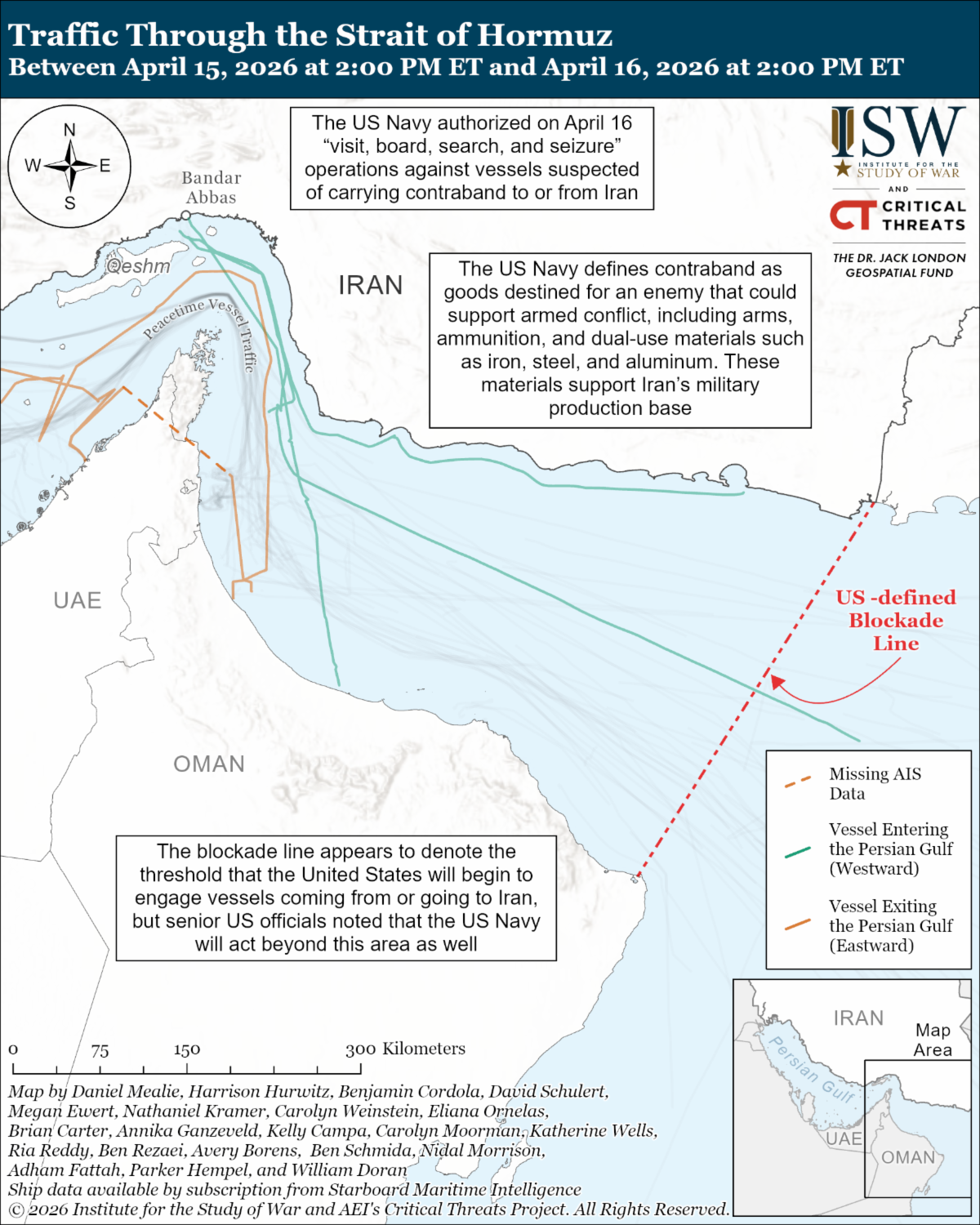
Iran is leveraging its position over the Strait of Hormuz to extract concessions while maintaining its claim to control access to the waterway. Reuters reported on April 15 that Iran has proposed allowing ships to transit through the Omani side of the Strait of Hormuz without interference if the United States agrees to conditions that prevent renewed conflict and meet Iranian demands. Iran has linked increased maritime access to broader negotiations, including demands to unfreeze Iranian funds, and a permanent end to US and Israeli strikes both in this war and for posterity. The implication of Iran’s “concession” is that it could threaten ships to discourage them from transiting the Omani side of the Strait unless the United States grants Iran significant concessions. Agreeing to Iranian demands along these lines would show Iran that it can coerce the United States using the Strait of Hormuz both now and in the future.
The main sticking point in current US-Iran negotiations is reportedly Iran’s enrichment of uranium and its highly enriched uranium stockpile. The United States has proposed a 20-year pause to enrichment, while the Iranians offered a 3- to 5-year pause, according to Iranian sources speaking to Reuters. The United States wants Iran to remove all of the highly enriched uranium from Iran, whereas Iran has proposed down-blending it or only moving part of its highly enriched uranium to another country, but not all of it, according to Iranian sources speaking to Western media in recent days. Iran could still enrich the remaining stockpile relatively quickly if it retained some highly enriched uranium, and it could use a 5-year pause to improve centrifuges and build or repair them. A Western diplomat told Reuters on April 16 that the nuclear issue “remains a core obstacle.” An unspecified source also told Reuters that a Pakistani mediator had made a breakthrough on “sticky issues,” but the negotiating parties have not resolved issues over Iran’s nuclear program. An Iranian source told Reuters on April 16 that Iran is not ready to send all of its highly enriched uranium stockpile abroad, but it could send “part of it” to a third-party country. The source claimed that Iran needed to retain some of the stockpile because Iran needs the remaining stockpile for medical purposes at a research reactor in Tehran. This research reactor runs on only a few tens of kilograms (kg) of 20 percent enriched uranium instead of 10,000kg of Iran’s total enriched uranium stockpile, according to nuclear expert David Albright. Only a small portion—roughly 400kg—of the 10,000kg Albright references is highly enriched uranium (60%). US objectives appear to remain at zero enrichment on Iranian soil, however. Israeli Prime Minister Netanyahu stated on April 15 that Israeli and US objectives in Iran are identical and include the removal of Iranian highly enriched uranium, the “dismantling” of Iran’s nuclear enrichment capabilities, and “reinstating” a nuclear deal.
Iran appears not to have compromised on its stance over the Strait of Hormuz and its nuclear program, despite Iranian sources attempting to illustrate that Iran has compromised and the two sides have made progress in negotiations, however. Islamic Revolutionary Guards Corps (IRGC) affiliated media on April 16 denied all recent Reuters reporting citing Iranian sources. The same IRGC-affiliated outlet had cast doubt on progress in future US-Iran talks, due to Iran‘s distrust of the United States and US “excessive demands” earlier on April 16. These conflicting reports on Iranian stances in these negotiations corroborate CTP-ISW’s continued observation that the Iranian negotiating council is not unified. This disunity will make it harder for Iran to make decisions and implement decisions throughout this negotiating process.
|