|
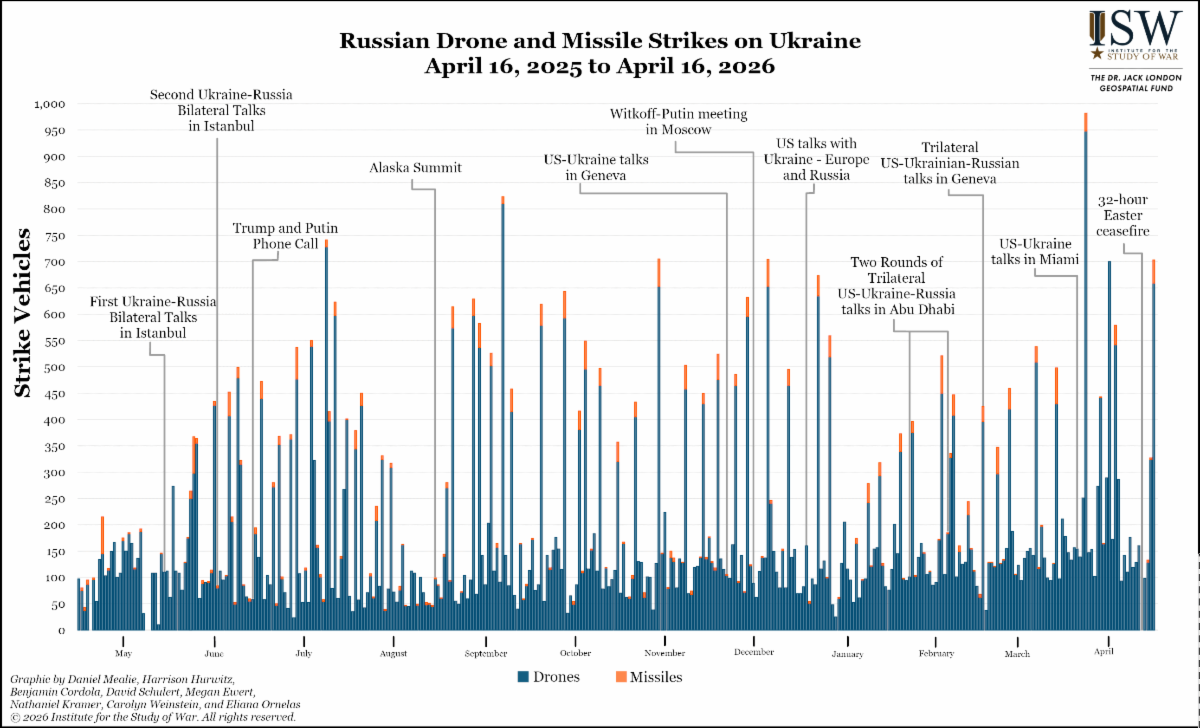
Russian forces conducted the sixth largest series of drone and missile strikes throughout the day on April 15 and overnight into April 16, using over 700 strike vehicles, killing at least 17 and injuring at least 100 civilians. The Ukrainian Air Force reported on April 16 that Russian forces launched two waves of strikes against Ukraine from 0700 local time on April 15 to 0700 local time on April 16, including 19 Iskander-M/S-400 ballistic missiles, 20 Kh-101 cruise missiles, five Iskander-K missiles, and 659 Shahed-type, Gerbera-type, and Italmas-type drones, of which Ukrainian forces downed 19 Kh-101s, eight Iskander-M/S-400 ballistic missiles, four Iskander-Ks, and 636 long-range drones. The Ukrainian Air Force noted that 12 missiles and 20 drones struck 26 locations and that debris from downed drones and missiles damaged another 25 locations. The Ukrainian Air Force reported that Russian forces launched all 20 Kh-101 cruise missiles, one Iskander-K cruise missile, and 361 of the Shahed-type, Gerbera-type, and Italmas-type drones (of which about 200 where Shaheds) from 0900 to 2200 local time on April 15, of which Ukrainian forces downed 19 Kh-101s, the Iskander-K missile, and 349 long-range drones. Ukrainian officials reported strikes against Ukrainian energy and civilian infrastructure and residential areas, inflicting especially high damage and casualties in Kyiv, Dnipro, Odesa, and Kharkiv cities. Russian strikes against Kyiv City alone killed at least four and injured at least 54. Russian forces have launched seven strike series consisting of 700 or more drones and missiles, three series of which Russian forces launched within the past month.
Russian forces also conducted a double-tap strike against first responders responding to Russian strikes in Kyiv City. Kyiv City officials reported that a Russian ballistic missile struck an area Kyiv City’s Obolonskyi Raion where three Ukrainian medics and three police officers were responding to a previous Russian strike, injuring at least two medics and at least one law enforcement officer.
Russian forces leveraged a new strike tactic allowing Russia to threaten more areas of Ukraine for longer periods of time and disproportionately affect civilian areas — tactics first debuted during the largest Russian strikes series of the war thus far on March 23 to 24. Ukrainian Air Force Spokesperson Colonel Yuriy Ihnat noted that Russian forces timed the waves of strikes such that the first wave of drones overnight acted almost as “combat reconnaissance” ahead of the two main waves of strikes. Ihnat noted that Russian forces used cruise missiles in the first wave and ballistic missiles in the second wave. Russian forces most likely intended to exhaust Ukrainian air defenses with long-range drones and cruise missiles, for both of which Ukrainian forces have high interception rates, ahead of ballistic missile strikes, which Ukrainian forces struggle to intercept. Ukraine relies on US-provided Patriot air defense systems and interceptors to down Russian ballistic missiles, underscoring Ukraine’s urgent need for both Patriot interceptors in particular and a well-rounded air defense umbrella. Russia likely seeks to take advantage of a global shortage of Patriot interceptors and the current war in the Middle East to escalate its strike campaign against Ukraine.
|