[ISW] 이란 업데이트, 2025년 8월 27일

“`html

핵심 내용 요약

핵심 내용 요약

  • 스냅백 제재 (Snapback Sanctions): 영국, 독일, 프랑스 (E3)는 8월 28일부터
    공동포괄적행동계획(JCPOA)의 스냅백 프로세스를 시작할 것으로 보인다.
    이 메커니즘은 이란에 대해 유엔 안전 보장 이사회 결의안 6개를 다시 적용하며,
    이란으로의 재래식 무기 이전 금지, 이란의 미사일 프로그램에 대한 국제적 지원 금지,
    농축 관련 활동 금지, 핵탄두 탑재 가능 미사일 시험 및 개발 금지 등을 포함한다.
  • 이란 내 핵 사찰: 강경파 이란 의원들은 국제원자력기구(IAEA) 사찰단의 이란 복귀를 비판하며,
    이는 IAEA와의 협력을 제한하기 위해 의회가 통과시킨 최근 법률을 훼손한다고 주장했다.
    이란은 E3의 국제적 압력을 완화하기 위해 제한적인 협력을 보여주기 위해 IAEA 사찰단의 복귀를 허용했을 수 있다.
  • 이라크 내 이란의 영향력: 이라크 총리 모하메드 시아 알 수다니는 8월 27일,
    법안을 철회하지 않으면 이라크를 제재하겠다는 미국의 위협으로 인해
    국민동원청(Popular Mobilization Authority) 법안을 의회에서 철회했다.
    이 법안은 이란이 지원하는 국민동원군(PMF)의 주요 구조를 공식화하여 이라크의 정치 및 안보 분야에서 이란의 영향력을 증가시킬 가능성이 높았다.

최신 자료 및 관련 링크

“`

**설명:**

1. **언어:** HTML 문서의 언어를 한국어(ko)로 설정했습니다.
2. **핵심 내용 요약:** 원문의 핵심 내용을 한국어로 번역하여 `

  • ` 태그로 각 항목을 구분했습니다.
    3. **최신 자료 및 관련 링크:** 관련 정보를 얻을 수 있는 링크와 간략한 설명을 추가했습니다. 링크의 내용은 예시이며, 관련 정보를 얻을 수 있는 다른 신뢰할 수 있는 출처를 활용하는 것이 좋습니다.
    4. **번역:** 영어 용어를 한국어로 번역하고, 필요한 경우 괄호 안에 원어를 표기했습니다.
    5. **HTML 구조:** 읽기 쉽고 접근성이 좋은 HTML 구조를 사용했습니다.
    6. **링크 확인:** 링크는 예시이며, 실제 작동하는 링크로 교체하거나, 해당 주제에 대한 최신 정보를 제공하는 링크로 업데이트해야 합니다. 링크의 내용이 관련성이 있는지 반드시 확인해야 합니다.
    7. **최신성:** 뉴스 기사, 보고서 등, 최신 정보를 제공하는 자료를 활용하여, 현재 상황을 정확하게 반영할 수 있도록 해야 합니다.

    **주의:**

    * 이 정보는 일반적인 정보 제공을 목적으로 하며, 특정 상황에 대한 조언으로 해석되어서는 안 됩니다.
    * 관련 링크는 예시이며, 반드시 최신 정보와 신뢰할 수 있는 출처를 확인해야 합니다.
    * 이란 핵 문제와 관련된 상황은 빠르게 변동될 수 있으므로, 항상 최신 정보를 주시해야 합니다.

    [원문]

    The E3 will reportedly initiate the snapback process as soon as August 28, according to three European diplomats

    August 27, 2025

    Information Cutoff: 2:00 pm ET

    Ben Rezaei, Ria Reddy, Nidal Morrison, Avery Borens, Adham Fattah, Ben Schmida, Kelly Campa, Henry Jenks, and Annika Ganzeveld

    TOPLINES

    The E3 (the United Kingdom, Germany, and France) will reportedly initiate the Joint Comprehensive Plan of Action (JCPOA) snapback process as soon as August 28, according to three European diplomats and one Western diplomat. The JCPOA snapback mechanism allows JCPOA signatories to reimpose UN Security Council (UNSC) sanctions on Iran in the event of “significant non-performance” of JCPOA commitments. The snapback mechanism is currently set to expire on October 18, 2025. The E3 imposed a deadline of August 31 on Iran to make meaningful progress toward a nuclear deal, such as by renewing cooperation with the International Atomic Energy Agency (IAEA) and resuming negotiations with the United States. The E3 offered to postpone the expiration of the snapback mechanism to allow Iran more time to negotiate with the United States. Iran reportedly failed to make “sufficiently tangible commitments” during the most recent Iran-E3 meeting in Geneva on August 26. Another source stated that Iran offered “very little to work with” to secure an extension.

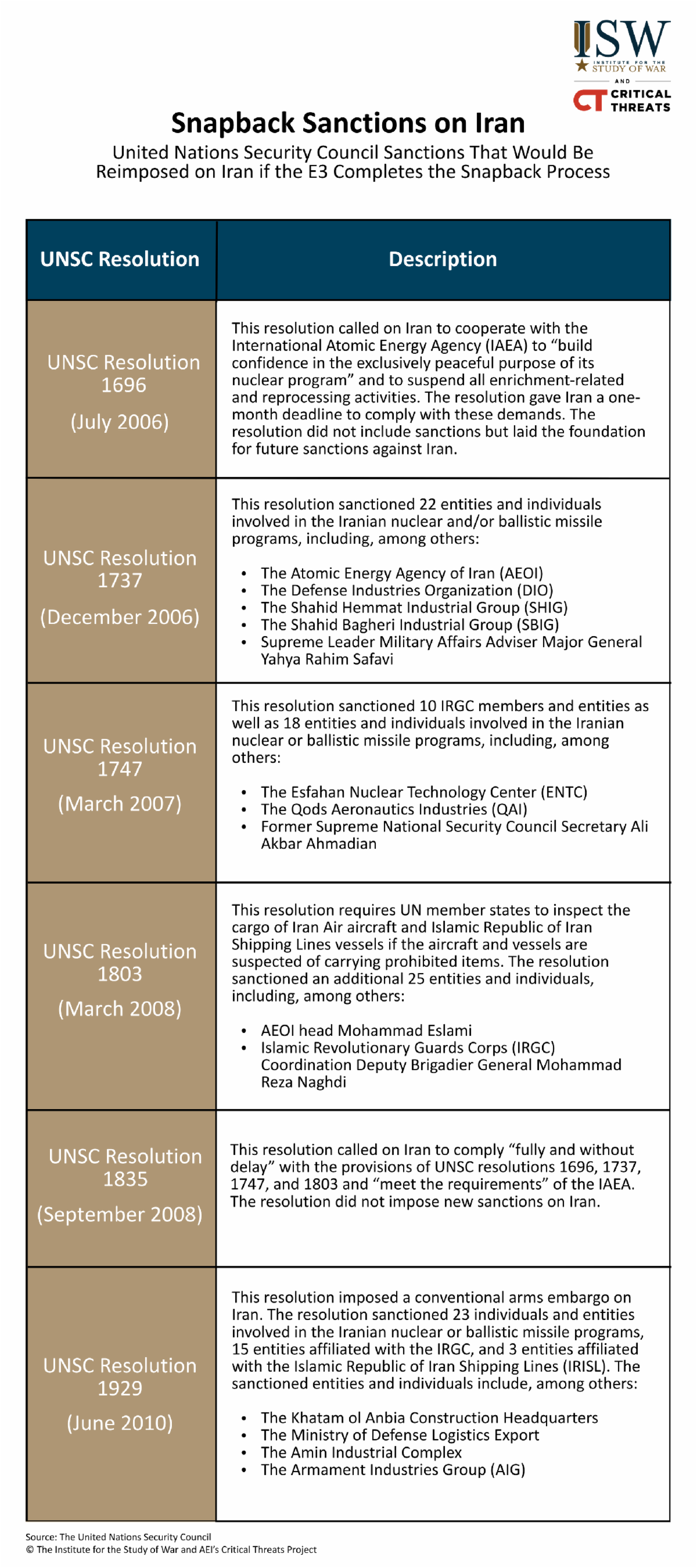
    It is unclear if the E3 will initiate the dispute resolution process outlined in the JCPOA or directly refer Iran’s non-compliance to the UNSC. The dispute resolution process can take up to 35 days and involves a series of steps that aim to resolve non-compliance issues. The E3 can choose to engage in the dispute resolution process and then refer the issue to the UNSC if it believes that Iran continues to show "significant non-performance." The E3 can, conversely, bypass the dispute resolution process and directly refer the non-compliance issue to the UNSC. The E3 would be required to include a description of "the good-faith efforts the [E3] made to exhaust the dispute resolution process" when they refer Iran’s non-compliance to the UNSC. The JCPOA gives the UNSC 30 days to pass a resolution to extend sanctions relief for Iran, but UNSC permanent members (the United States, the United Kingdom, France, China, and Russia) can veto such a resolution. The E3 is reportedly hopeful that Iran will make unspecified commitments regarding its nuclear program within 30 days that will allow the E3 to avoid reimposing UNSC sanctions on Iran. The snapback mechanism would reimpose six UNSC resolutions on Iran, including bans on the transfer of conventional arms to and from Iran, international support for Iran’s missile program, enrichment-related activities, and the testing and development of nuclear-capable missiles.

    Hardline Iranian parliamentarians criticized the return of International Atomic Energy Agency (IAEA) inspectors to Iran and argued that their return undermines a recent law that parliament passed to restrict cooperation with the agency. These criticisms arose after IAEA Director General Rafael Grossi announced on August 26 that IAEA inspectors would soon resume inspections in Iran. Atomic Energy Organization of Iran (AEOI) Spokesperson Behrouz Kamalvandi stated on August 27 that IAEA inspectors will supervise the fuel replacement at the Bushehr Nuclear Power Plant (BNPP) to ensure that electricity is produced in a timely manner. The Iranian parliament passed a bill on June 25 to suspend all cooperation with the IAEA.

    KEY TAKEAWAYS

    • Snapback Sanctions: The E3 (the United Kingdom, Germany, and France) will reportedly initiate the Joint Comprehensive Plan of Action (JCPOA) snapback process as soon as August 28, according to three European diplomats and one Western diplomat. The snapback mechanism would reimpose six UNSC resolutions on Iran, including bans on the transfer of conventional arms to and from Iran, international support for Iran’s missile program, enrichment-related activities, and the testing and development of nuclear-capable missiles.

    • Nuclear Inspections in Iran: Hardline Iranian parliamentarians criticized the return of International Atomic Energy Agency (IAEA) inspectors to Iran and argued that their return undermines a recent law that parliament passed to restrict cooperation with the agency. Iran may have allowed IAEA inspectors to return to Iran to show limited cooperation and ease international pressure from the E3.

    • Iranian Influence in Iraq: Iraqi Prime Minister Mohammad Shia al Sudani withdrew the Popular Mobilization Authority bill from parliament on August 27, reportedly due to US threats to sanction Iraq if he did not withdraw the bill. The Popular Mobilization Authority bill would likely increase Iran’s influence in the Iraqi political and security spheres by formalizing key structures of the Iranian-backed Popular Mobilization Forces (PMF).

    NEW EMAIL SUBSCRIPTION OPTIONS

    ISW has launched newly customizable email subscription options. Existing subscribers have been auto enrolled in all lists. Click below to learn more about these options and customize your preferences.

    ISW is powered by the support of individuals like you.

    Help us stay independent and impactful.

    Website | Jobs & Internships

    Follow ISW on social media:

    FacebookXYouTube | InstagramLinkedIn | Threads | Bluesky

    © 2025, Institute for the Study of War

    Donate online or by sending a check to the Institute for the Study of War at 1400 16th Street NW, Suite #515, Washington, DC 20036. Please consider including the Institute for the Study of War in your estate plans.

    ISW is a tax-exempt organization under section 501(c)(3) of the Internal Revenue Code. Donations are tax-deductible to the extent permitted by law.

    ISW is a non-partisan, non-profit, public policy research organization. ISW advances an informed understanding of military affairs through reliable research, trusted analysis, and innovative education. We are committed to improving the nation’s ability to execute military operations and respond to emerging threats in order to achieve US strategic objectives.

  • 댓글 달기

    이메일 주소는 공개되지 않습니다. 필수 필드는 *로 표시됩니다

    위로 스크롤