|
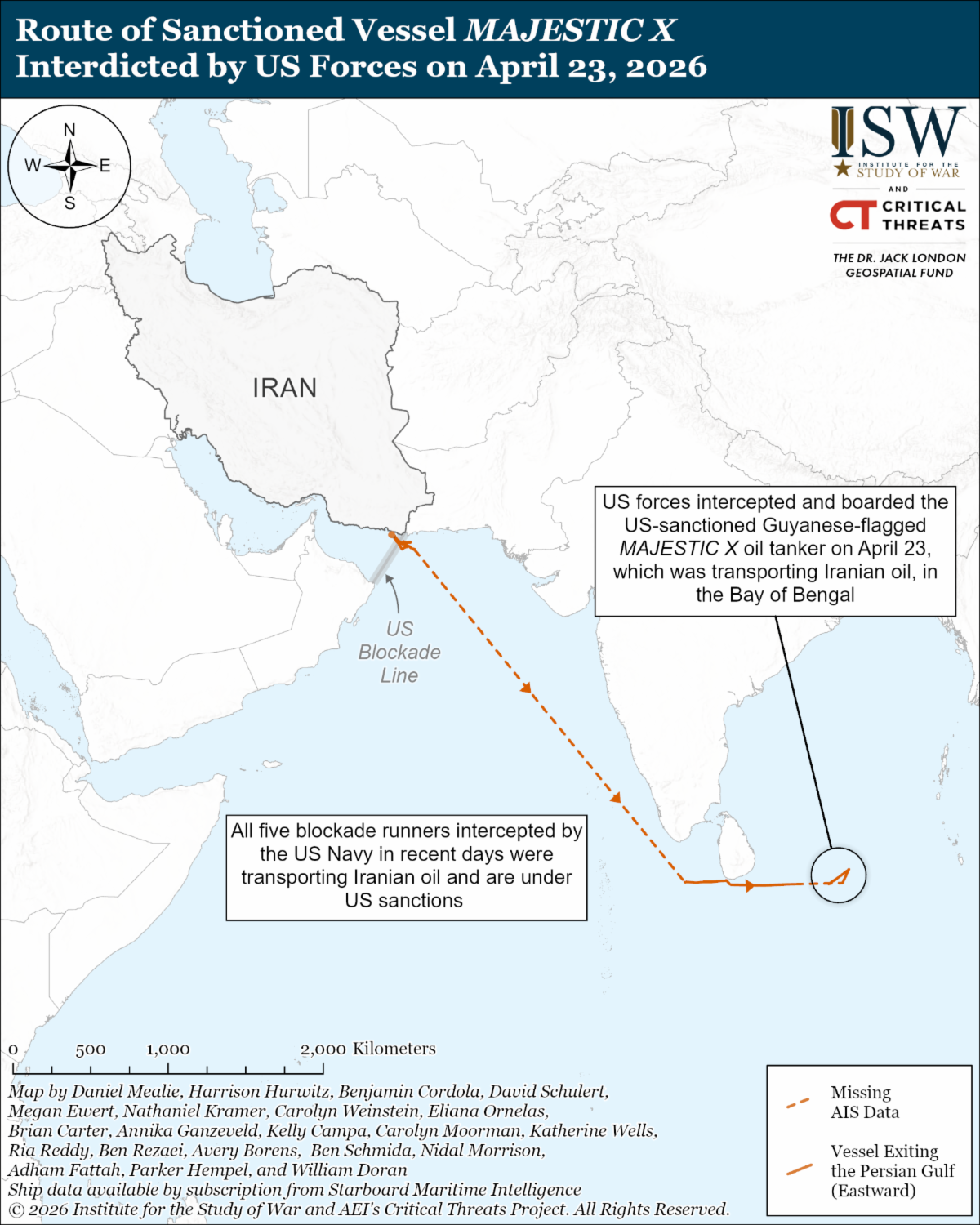
US President Donald Trump’s messages have appeared to elicit a choreographed response by the Iranian regime that is directed both to regime factions and to the United States. The choreographed response was an attempt to portray unity between the “moderate” and “hardliner” factions in the regime by stating the same message affirming belief in the Islamic Revolution’s core values. Trump stated on Truth Social on April 23 that Iran is “having a hard time figuring out who their leader is.” Trump highlighted infighting between the regime’s “moderate” and “hardliner” factions, adding that the United States will maintain the blockade on Iranian ships and ports until the regime is “able to make a deal.”
The heads of Iran’s three branches of government–Iranian President Masoud Pezeshkian, Judiciary Chief Gholam Hossein Mohseni Ejei, and Parliament Speaker Mohammad Bagher Ghalibaf–issued a series of statements aimed at defending themselves from accusations of “moderation” in the Islamic Revolutionary context. Pezeshkian, Ejei, and Ghalibaf published nearly identical messages on X on April 23 in which they emphasized their allegiance to the principles of the Islamic Revolution. All three leaders rejected that the regime contains “hardline” and “moderate” factions and circulated the slogan “One God, one nation, one leader, and one path—the path of victory for Iran.” Ejei published the statement first, followed by Pezeshkian and Ghalibaf. Ejei, while a hardliner historically, allied with the pragmatic Iranian leaders during efforts to end the 12-Day War. Iranian Foreign Affairs Minister Abbas Araghchi, who, along with Ghalibaf, has been leading Iran’s negotiating delegation, posted a similar message on X in which he emphasized the regime’s unity. Senior IRGC commanders such as Vahidi and SNSC Secretary Mohammad Bagher Zolghadr did not circulate similar statements, but other IRGC-affiliated figures did several hours after Pezeshkian, Ejei, and Ghalibaf’s messages (see more below).
The publication of these messages and the context of the events surrounding them indicate that Pezeshkian, Ghalibaf, Ejei, and Araghchi likely sought to defend themselves from accusations of moderation, which Vahidi could use to challenge their commitment to the revolution. Araghchi, Ghalibaf, and Pezeshkian have adopted a more pragmatic approach toward the United States in negotiations, a stance that Vahidi and those close to him likely view as a diversion from the ideals of the Islamic Revolution. Vahidi attempted to insert Zolghadr into the first round of negotiations with the United States in Pakistan despite the protests of Araghchi and Ghalibaf. Vahidi almost certainly did this to ensure that someone from his inner circle could keep tabs on whether Araghchi or Ghalibaf tried to negotiate outside of Vahidi’s red lines, which include maintaining support for the Axis of Resistance, recognizing Iran’s “right” to enrich uranium, and preserving Iran’s “control” over the Strait of Hormuz. US officials told Axios on April 20 that the US negotiating delegation thought it was “negotiating with the right people“ in Islamabad on April 11 and 12, but that the IRGC effectively told the Iranian negotiating delegation upon their return to Tehran that the negotiating team ”[does not] speak for” the IRGC. Ghalibaf publicly defended the approach of negotiating with the United States in a speech on April 18 and criticized hardline officials–including SNSC member Saeed Jalili and hardline parliamentarian Amirhossein Sabeti–for their opposition to negotiations during a meeting with advisers. ISW-CTP previously assessed that Ghalibaf’s criticism was likely implicitly aimed at Vahidi because Vahidi also opposes negotiating with the United States.
|