|
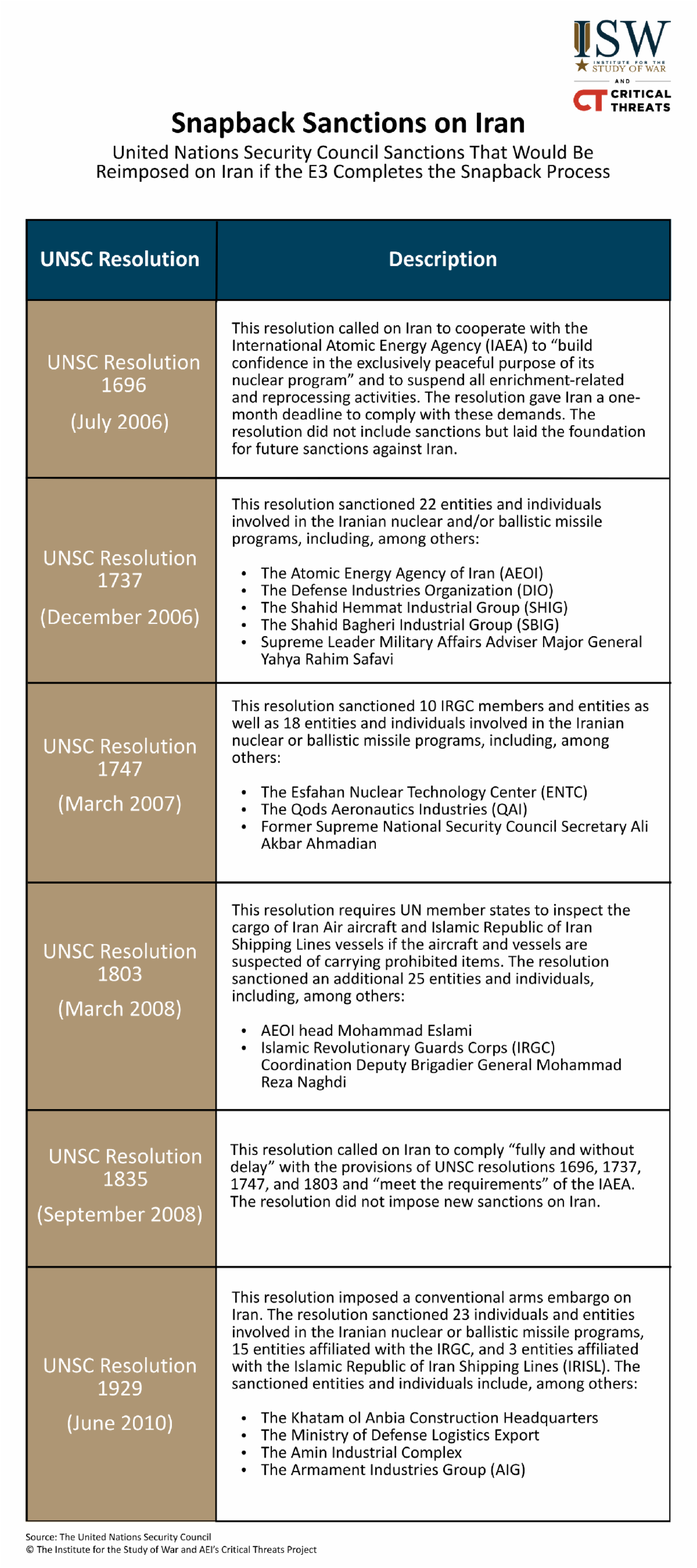
The E3 (the United Kingdom, France, and Germany) initiated the Joint Comprehensive Plan of Action (JCPOA) snapback process on August 28. The JCPOA snapback mechanism allows JCPOA signatories to reimpose UN Security Council (UNSC) sanctions on Iran in the event of “significant non-performance” of JCPOA commitments. The JCPOA gives the UNSC 10 days to initiate a resolution to continue providing sanction relief to Iran after an E3 member notifies the UNSC of Iran’s ”significant non-performance.” All prior UN sanctions would return 30 days after the initial referral to the UNSC if the resolution does not pass or a permanent member vetoes it. The snapback mechanism is currently set to expire on October 18, 2025. The triggering of snapback sanctions comes after Iran failed to meet the E3’s conditions for extending the mechanism’s deadline by the end of August. The E3 previously set an August 31 deadline for Iran to show real progress toward a nuclear deal by renewing cooperation with the International Atomic Energy Agency (IAEA) and restarting negotiations with the United States. Iranian negotiators met with the E3 in Geneva on August 26 but failed to "put tangible, detailed deliverables on the table,” which prompted the E3 to move forward with the snapback process before the snapback mechanism‘s expiration. The snapback mechanism would reimpose six UNSC resolutions on Iran, which would impose restrictions on Iran’s conventional arms trade, missile program, uranium enrichment activities, and development of nuclear-capable missiles.
Iran has demolished buildings at the Mojdeh site (Lavisan-2) at Shahid Rajaei University in Lavisan, Tehran Province, which Israel damaged during the 12-day Israel-Iran War. The Institute for Science and International Security assessed on August 27 that Iran is likely trying to conceal undeclared nuclear weapons research and development activities at this site. Israel damaged at least four buildings at the Mojdeh site between June 14 and 20 during the war. Satellite imagery from August 20 shows that Iran has demolished two of the damaged buildings, including a building affiliated with the Iranian Organization of Defensive Innovation and Research‘s (SPND) Shahid Karimi Group that is involved in explosives research. The Mojdeh site previously housed the SPND headquarters, which played a leading role in the Iranian nuclear weapons research program before 2003. Shahid Rajaei University is affiliated with Iran’s nuclear program, and some US officials believe that the university has been involved in nuclear warhead design research.
The IAEA reported on August 27 that there is no evidence Iran has moved its stockpile of highly-enriched uranium (HEU) stored underground at the Esfahan Nuclear Technology Center (ENTC) since the US strikes on June 21, using satellite imagery. IAEA Director General Rafael Grossi stated on August 27 that “there is nothing to contradict the notion that the material is where it [previously] was.“ Grossi confirmed on June 23 that US and Israeli airstrikes damaged tunnel entrances used for storing enriched material at the ENTC. The Institute for Science and International Security similarly reported, citing satellite imagery, that Iran ”backfilled” these entrances ahead of US strikes likely to try to contain an explosion or prevent the dispersion of hazardous material. Iran cannot currently access the ENTC and, therefore, likely cannot conduct a conclusive damage assessment or extract materials. Senior Israeli intelligence officials said that any Iranian attempts to recover the material would "almost certainly" be detected. The US strikes also destroyed components of Iran’s nuclear program that would be necessary for further enrichment and weaponization to create a deliverable nuclear weapon.
|