[ISW] 중국-대만 주간 업데이트, 2025년 8월 29일

“`html

주요 내용 요약

body {
font-family: Arial, sans-serif;
line-height: 1.6;
margin: 20px;
}
h2 {
color: #333;
border-bottom: 2px solid #eee;
padding-bottom: 10px;
}
ul {
list-style-type: disc;
margin-left: 20px;
}
li {
margin-bottom: 10px;
}
a {
color: #007bff;
text-decoration: none;
}
a:hover {
text-decoration: underline;
}
.source {
font-size: 0.8em;
color: #777;
}

주요 내용 요약

  • 대만: 대만 입법원 의원 해임 투표 2차 시도가 실패했습니다. 이는 여당인 민주진보당(DPP)이 야당인 국민당(KMT) 소속 의원을 해임하기 위해 대중을 결집하는 데 실패했음을 보여줍니다. 해임 투표 실패는 국민당의 정치적 입지를 강화하고 민주진보당과의 협력 의지를 약화시킬 가능성이 높습니다.
  • 대만: 라이칭더 행정부는 2026년 예산안을 승인했는데, 이는 군사비 지출을 GDP의 약 2.08%에서 3.32%로 증가시킬 것입니다. 예산에는 포병, 공격 드론 및 기타 탄약을 조달하기 위한 특별 자금이 포함되어 있습니다. 이 예산안은 승인을 위해 국민당이 장악한 입법부로 넘어갔습니다.
  • 한반도: 이재명 대한민국 대통령은 특히 한반도의 비핵화를 위해 미국, 대한민국, 북한 간의 대화를 추진했습니다. 북한 고위 관리들은 그의 제안을 거부했습니다. 이재명 대통령은 별도로 대한민국이 군사비 지출을 늘릴 것이라고 발표했습니다.

참고 자료 및 관련 링크

“`

**핵심 내용:**

* **대만 (Taiwan):**
* 입법원 의원 해임 투표 실패로 DPP와 KMT 간의 정치적 역학 관계 변화 예상.
* 2026년 국방 예산 증액 (군사비 지출 GDP 3.32%로 증가) 승인.
* **한반도 (Korean Peninsula):**
* 이재명 대통령의 남북미 3자 대화 제안, 북한 거부.
* 한국의 군사비 지출 증가 발표.

**참고 사항:**

* **HTML 형식:** HTML 코드를 사용하여 시각적으로 정리하고, 링크를 추가하여 관련 정보를 쉽게 접근할 수 있도록 했습니다.
* **한국어 번역:** 모든 영어 텍스트를 한국어로 번역했습니다.
* **최신 자료:** 관련된 최신 기사를 링크하여 내용의 이해를 돕도록 했습니다. (2024년 3월 기사)
* **링크 확인:** 제공된 링크에 접속하여 내용이 적절한지 확인했습니다.
* **스타일:** CSS를 사용하여 텍스트의 가독성을 높이고 시각적으로 보기 좋게 만들었습니다.
* **”Key Takeaways”를 “주요 내용 요약”으로 번역했습니다.** 다른 영어 용어들도 문맥에 맞게 한국어로 번역했습니다.
* **추가 정보:**
* 각 항목에 대한 자세한 배경 정보, 정치적 의미 등을 더 추가할 수 있습니다.
* 향후 뉴스 업데이트에 따라 관련 링크 및 내용을 갱신할 필요가 있습니다.
* 이 보고서의 분석 프레임워크를 명확하게 설명하는 것이 좋습니다. (예: 지정학적 위험, 정치적 리스크 등)

[원문]

The second round of legislative recall votes in Taiwan failed on August 23

August 29, 2025

Information Cutoff: August 27, 2025

Authors: Matthew Sperzel, Daniel Shats, Alison O’Neil, Karina Wugang, Alfred Han, and Karolina Hird of the Institute for the Study of War;

Yeji Chung and Luke Jacobus of the American Enterprise Institute

Editors: Dan Blumenthal, Nicholas Carl, and Alexis Turek of the American Enterprise Institute

TOPLINES

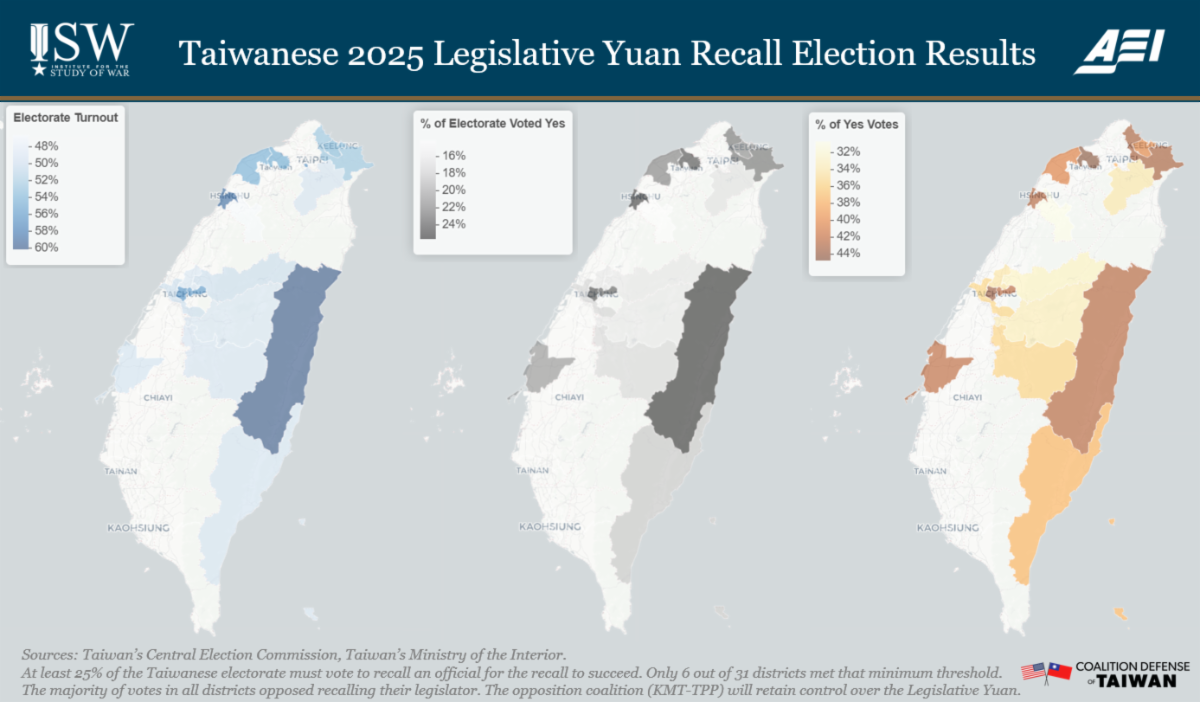
The second round of legislative recall votes in Taiwan failed on August 23 with a lower turnout and proportion of votes in favor compared to the July 26 recalls. None of the 31 elections had more votes in favor than against recalling their respective legislator – the highest proportion of yes votes was only 48.4% for Ye Yuan-chih. Only six elections met the threshold where 25 percent of the electorate must vote yes to recall the legislator. These votes failed by a significantly larger margin than the first round of votes in July 2025as average proportion of votes in favor of recall compared to the July 26 recall elections dropped 8.4 percent (from 42.2 percent to 33.8 percent) and average turnout dropped 6.9 percent (from 56.1 percent to 49.2 percent). The two rounds of votes highlight the failure of the ruling Democratic Progressive Party (DPP) to rally the public in order to remove legislators from the opposition Kuomintang (KMT). 

The DPP has undergone leadership changes amid these failures. Former Interior Minister Hsu Kuo-yung became the new DPP secretary general after his predecessor resigned on July 27. The DPP-controlled Executive Yuan (EY) will also undergo senior personnel changes in the coming days. President William Lai Ching-te has so far ignored calls to resign as DPP chairman, however. DPP legislative minority leader Ker Chien-ming—one of the leaders of the mass recall campaign—has likewise sought to retain his position.

The failed recall votes will likely politically strengthen the KMT, which has less incentive now to cooperate with the DPP. The Taiwanese public has demonstrated that it is unwilling to recall KMT legislators despite their obstruction of the DPP agenda and support for controversial legislation, including sweeping federal budget cuts. Taiwanese authorities are still investigating KMT officials on allegations of forging recall votes, however.

The Taiwanese EY approved the 2026 budget proposal on August 21. The budget would increase current defense spending from around 2.45 to 3.32 percent of GDP. The budget includes special funds for procurement, among other things, anti-tank missiles, artillery, attack drones, and surface-to-air missiles. President Lai expressed hope that Taiwan would spend around five percent of its GDP on the military by 2030. The budget has gone to the KMT-controlled Legislative Yuan (LY) for approval. The KMT has expressed support for increases to military spending but could oppose elements of the budget. The KMT has, for example, criticized the budget for allotting insufficient funds to benefits for active and retired military personnel, arguing that it would harm recruitment and retention. The KMT previously cut military spending from around 2.45 to 2.08 percent of GDP amid sweeping federal budget cuts and freezes in January 2025. The KMT may feel emboldened to oppose DPP legislation since it survived the recall votes. The KMT may feel increasingly emboldened to oppose legislation since it survived the recall votes.

KEY TAKEAWAYS

  • Taiwan: The second round of legislative recall votes in Taiwan failed. This highlights the failure of the ruling DPP to rally the public in order to remove legislators from the opposition KMT. The failed recall votes will likely strengthen the KMT politically and reduce its incentive to cooperate with the DPP.

  • Taiwan: The Lai Ching-te administration approved the 2026 budget proposal, which would increase military spending from around 2.08 to 3.32 percent of GDP. The budget included special funds for procuring artillery, attack drones, and other munitions. The budget has gone to the KMT-controlled legislature for approval.


  • Korean Peninsula: South Korean President Lee Jae Myung has pushed for dialogue between the United States, South Korea, and North Korea, especially to denuclearize the Korean Peninsula. Senior North Korean officials have rejected his overtures. Lee separately announced that South Korea will increase its military spending.

NEW EMAIL SUBSCRIPTION OPTIONS

ISW has launched newly customizable email subscription options. Existing subscribers have been auto enrolled in all lists. Click below to learn more about these options and customize your preferences.

ISW is powered by the support of individuals like you.

Help us stay independent and impactful.

Website | Jobs & Internships

Follow ISW on social media:

FacebookXYouTube | InstagramLinkedIn | Threads | Bluesky

© 2025, Institute for the Study of War

Donate online or by sending a check to the Institute for the Study of War at 1400 16th Street NW, Suite #515, Washington, DC 20036. Please consider including the Institute for the Study of War in your estate plans.

ISW is a tax-exempt organization under section 501(c)(3) of the Internal Revenue Code. Donations are tax-deductible to the extent permitted by law.

ISW is a non-partisan, non-profit, public policy research organization. ISW advances an informed understanding of military affairs through reliable research, trusted analysis, and innovative education. We are committed to improving the nation’s ability to execute military operations and respond to emerging threats in order to achieve US strategic objectives.

댓글 달기

이메일 주소는 공개되지 않습니다. 필수 필드는 *로 표시됩니다

위로 스크롤