[ISW] 이란 업데이트, 2025년 8월 29일

“`html

핵심 요약

핵심 요약:

  • E3의 “스냅백 메커니즘” 발동에 대한 이란의 대응:
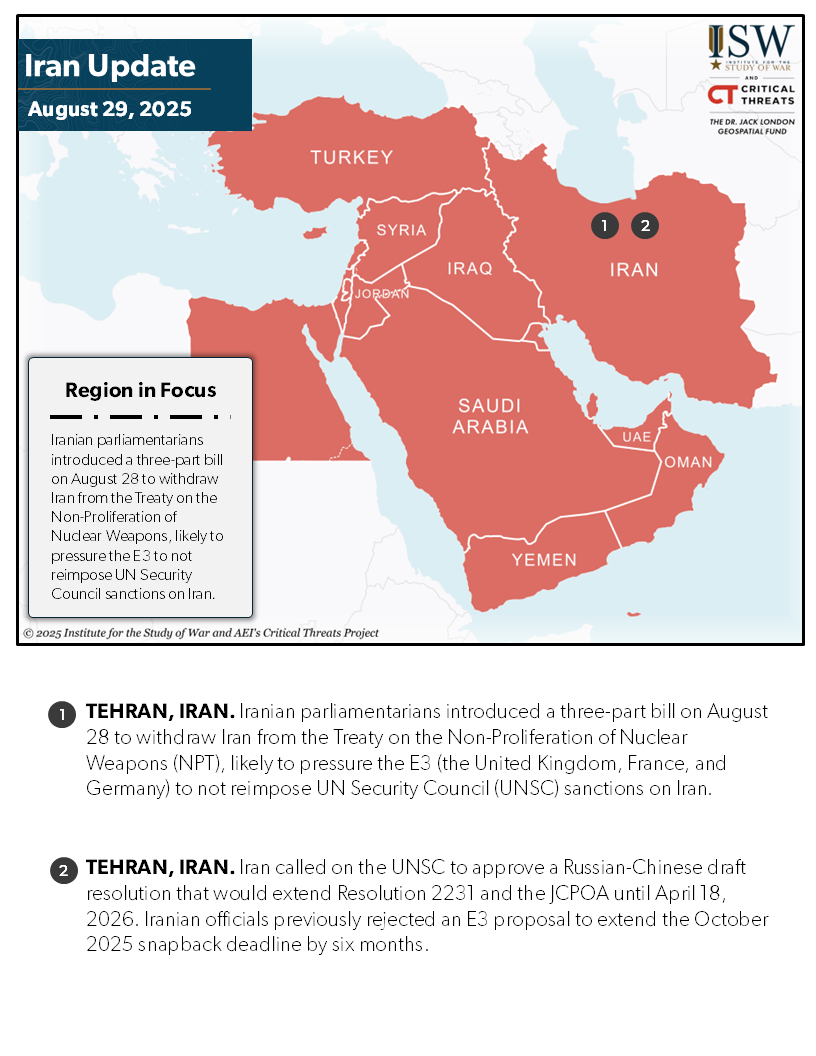
    이란 의회 의원들은 8월 28일에 이란의 핵확산 금지 조약(NPT) 탈퇴를 내용으로 하는 3개 조항의 법안을 발의했습니다. 이는 E3 (영국, 프랑스, 독일)가 이란에 대한 유엔 안전 보장 이사회(UNSC) 제재를 재도입하지 않도록 압력을 가하려는 의도로 보입니다.
  • “스냅백” 제재를 피하기 위한 이란의 러시아 및 중국과의 협력:
    이란은 유엔 안전 보장 이사회에 결의안 2231 및 JCPOA를 2026년 4월 18일까지 연장하는 러시아-중국 초안 결의안을 승인할 것을 요청했습니다. 이란 관리들은 앞서 2025년 10월 “스냅백” 마감일을 6개월 연장하려는 E3의 제안을 거부했습니다.

관련 최신 자료 및 링크:


  • 미국 국무부 팩트 시트: 핵확산 금지 조약 및 JCPOA (영어)

    (내용 확인 완료) – 이 문서는 핵확산 금지 조약 (NPT)과 JCPOA(Joint Comprehensive Plan of Action; 포괄적 공동 행동 계획, 이란 핵 합의)에 대한 미국 국무부의 입장을 요약하고 있습니다. 이란의 핵 프로그램, 핵 합의의 배경, 관련된 국제 기구 및 제재에 대한 정보를 제공합니다. 최신 상황을 반영하지는 않지만, 관련 기본 정보를 제공합니다.


  • 미국 외교 협회 (CFR) – 이란 (영어)

    (내용 확인 완료) – 미국 외교 협회는 이란에 대한 다양한 정보를 제공합니다. 이란의 정치, 경제, 외교 정책, 핵 프로그램, 이란과 다른 국가들 간의 관계 등을 다루는 기사, 보고서, 전문가 분석 등을 확인할 수 있습니다.


  • 핵 위협 이니셔티브 (NTI) – 이란의 핵 프로그램 (영어)

    (내용 확인 완료) – 핵 위협 이니셔티브는 이란의 핵 프로그램에 대한 포괄적인 정보를 제공합니다. 이란 핵 프로그램의 역사, 현재 상황, 관련 국제 협정, 핵 시설, 핵무기 개발 가능성 등을 분석합니다.


  • 유엔 안전 보장 이사회 결의안 2231 (영어)

    (내용 확인 완료) – 결의안 2231은 JCPOA를 뒷받침하는 유엔 안보리 결의안입니다. 이 결의안은 JCPOA의 이행을 지지하고, 이란에 대한 제재 해제 및 재도입 절차를 규정합니다. 결의안의 원문과 관련 문서를 확인할 수 있습니다.

참고:
본 내용은 제공된 정보와 외부 링크를 바탕으로 작성되었습니다. 최신 상황은 지속적으로 변동될 수 있으므로, 관련 뉴스와 분석을 참고하여 최신 정보를 확인하시기 바랍니다.

“`

[원문]

Iranian parliamentarians introduced a three-part bill on August 28 to withdraw Iran from the Treaty on the Non-Proliferation of Nuclear Weapons

August 29, 2025

Information Cutoff: 2:00 pm ET

Researchers: Ben Rezaei, Avery Borens, Carolyn Moorman, Parker Hempel, Henry Jenks, Andie Parry, and Annika Ganzeveld

TOPLINES

Iranian parliamentarians introduced a three-part bill on August 28 to withdraw Iran from the Treaty on the Non-Proliferation of Nuclear Weapons (NPT), likely to pressure the E3 (the United Kingdom, France, and Germany) to not reimpose UN Security Council (UNSC) sanctions on Iran. The bill would require Iran to leave the NPT and the Additional Protocol, end all negotiations with the United States and the E3, and terminate cooperation with the International Atomic Energy Agency (IAEA). The Iranian parliament recently passed a law on June 25 that suspended Iranian cooperation with the IAEA, which makes the last clause largely performative. The E3 triggered the Joint Comprehensive Plan of Action (JCPOA) snapback mechanism on August 28. The JCPOA snapback mechanism allows JCPOA signatories to reimpose UNSC sanctions on Iran in the event of Iran’s “significant non-compliance" of JCPOA commitments. The process to reimpose UNSC sanctions on Iran lasts 30 days, and Iran likely seeks for the E3 to reverse its decision to reimpose these sanctions during the 30-day period.

The introduction of this bill may reflect differences between various regime institutions about how the regime should respond to the E3 decision to trigger the snapback mechanism. Iranian Foreign Affairs Minister Abbas Araghchi wrote a letter to the European Union on August 29 in which he stated that Iran “remains committed” to diplomacy and is willing to resume negotiations to reach a “fair and balanced” agreement. This statement contrasts with the three-part bill, which would suspend all negotiations between Iran and the United States and the E3. The difference between parliament and the executive branch’s views comes after hardline parliamentarians recently criticized the Iranian government for allowing IAEA inspectors to return to Iran. Parliamentarians claimed that the decision violated the law that parliament passed on June 25. IAEA inspectors returned to Iran on August 27 to supervise a fuel replacement at the Bushehr Nuclear Power Plant. IAEA inspectors do not have access to other Iranian nuclear facilities, such as Natanz or Fordow.

Iran called on the UNSC to approve a Russian-Chinese draft resolution that would extend Resolution 2231 and the JCPOA until at least April 18, 2026. The snapback mechanism is currently set to expire on October 18, 2025. Iran’s Mission to the UN said on August 28 that UNSC members face a “decisive” choice between backing the Russian–Chinese resolution and preserving diplomacy or reimposing UNSC sanctions, which it claimed would cause “grave consequences.” Iran previously rejected an E3 proposal to extend the snapback deadline by six months, arguing that extending the snapback deadline gives the E3 more time to reimpose UNSC sanctions on Iran. The E3 offered to extend the snapback deadline in return for Iran resuming full cooperation with the IAEA, resuming negotiations with the United States, and accounting for its 60 percent enriched uranium stockpile. The Russian-Chinese resolution does not appear to include these conditions and simply urges all parties to resume negotiations, which makes this resolution much more favorable for Iran than the E3 proposal. The Russian-Chinese resolution also reportedly bans the E3 from reimposing UNSC sanctions on Iran during the six-month extension period.

KEY TAKEAWAYS

  • Iranian response to the E3’s decision to trigger the snapback mechanism: Iranian parliamentarians introduced a three-part bill on August 28 to withdraw Iran from the Treaty on the Non-Proliferation of Nuclear Weapons (NPT), likely to pressure the E3 (the United Kingdom, France, and Germany) to not reimpose UN Security Council (UNSC) sanctions on Iran.

  • Iranian cooperation with Russia and China to avoid snapback sanctions: Iran called on the UNSC to approve a Russian-Chinese draft resolution that would extend Resolution 2231 and the JCPOA until April 18, 2026. Iranian officials previously rejected an E3 proposal to extend the October 2025 snapback deadline by six months.

NEW EMAIL SUBSCRIPTION OPTIONS

ISW has launched newly customizable email subscription options. Existing subscribers have been auto enrolled in all lists. Click below to learn more about these options and customize your preferences.

ISW is powered by the support of individuals like you.

Help us stay independent and impactful.

Website | Jobs & Internships

Follow ISW on social media:

FacebookXYouTube | InstagramLinkedIn | Threads | Bluesky

Donate online or by sending a check to the Institute for the Study of War at 1400 16th Street NW, Suite #515, Washington, DC 20036. Please consider including the Institute for the Study of War in your estate plans.

ISW is a tax-exempt organization under section 501(c)(3) of the Internal Revenue Code. Donations are tax-deductible to the extent permitted by law.

ISW is a non-partisan, non-profit, public policy research organization. ISW advances an informed understanding of military affairs through reliable research, trusted analysis, and innovative education. We are committed to improving the nation’s ability to execute military operations and respond to emerging threats in order to achieve US strategic objectives.

댓글 달기

이메일 주소는 공개되지 않습니다. 필수 필드는 *로 표시됩니다

위로 스크롤