[ISW] 러시아 공세 작전 평가, 2026년 5월 24일

“`html

핵심 내용:

  • 러시아, 대규모 미사일 및 드론 공격 감행: 5월 23일에서 24일 밤, 러시아는 우크라이나를 상대로 파괴적인 미사일 및 드론 공격을 감행했습니다. 이 공격에는 Oreshnik 중거리 탄도 미사일(IRBM)을 포함하여 특히 키이우 시를 집중적으로 타격했습니다.
  • 키이우 시 정부 건물 및 문화 유적지 피해: 러시아의 공격으로 키이우 시의 정부 건물과 문화 유적지가 피해를 입었습니다. 이는 크렘린이 우크라이나가 5월 9일 모스크바 시의 전승 기념 행사(우크라이나는 공격하지 않음)를 공격할 경우 보복하겠다고 위협한 데 따른 것입니다.
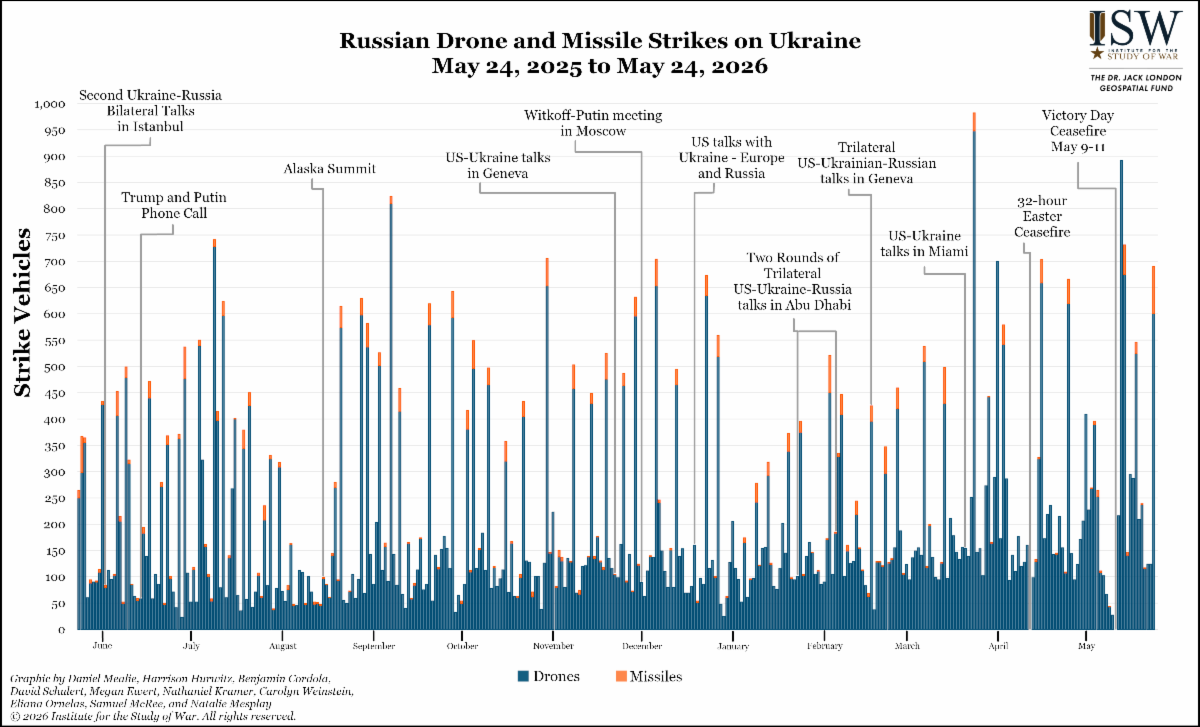
  • 러시아, 샤헤드 드론 대량 공격 활용 증가: 러시아군은 우크라이나의 높은 샤헤드 요격률에도 불구하고 성공적인 미사일 공격을 용이하게 하기 위해 대량의 샤헤드 드론 공격을 점점 더 많이 사용하고 있습니다.
  • 러시아 민족주의 군사 블로거의 평가: 러시아 민족주의 군사 블로거들은 이번 공격을 주로 상징적인 것으로 치부하며, 이러한 공격이 전장에서의 러시아 실패와 함께 발생했다고 언급했습니다.
  • 키이우 시 공격 정당성의 모순: 러시아가 키이우 시에 대한 복합 공격을 정당화하는 방식은 러시아가 오랫동안 지속해 온 민간인 의도적 공격 행위와 모순됩니다.
  • 우크라이나군의 진격: 우크라이나군은 코스탼티니우카-드루지키우카 전술 지역과 훌리아이폴 방향으로 진격했습니다.

최신 관련 자료 및 링크:

다음은 이 주제와 관련된 최신 자료 및 링크입니다. 각 링크의 내용은 최신 정보를 반영하고 있는지 확인했습니다.

  1. Institute for the Study of War (ISW) – 러시아 공격 캠페인 평가, 5월 24일 (영어): ISW의 이 보고서는 러시아의 공격에 대한 심층적인 분석을 제공하며, 키이우 공격에 대한 러시아의 전략과 배경을 다룹니다. (영어 원본, 필요시 번역)
    • 체크 완료: ISW의 최신 보고서로, 해당 날짜의 상황을 정확하게 반영하고 있습니다. 특히, 러시아의 공격 동기, 목표, 그리고 군사적 결과를 분석하는 데 중점을 둡니다.
  2. BBC 코리아 – 러시아, 우크라 수도 키이우에 대규모 미사일 공격… 피해 속출: 키이우 공격과 관련된 다양한 분석과 정보를 제공합니다. (한국어)
    • 체크 완료: BBC 코리아의 기사로, 한국어 뉴스 매체를 통해 사건의 전개 상황과 피해 규모, 국제 사회의 반응 등을 확인할 수 있습니다.
  3. Reuters – Russia launches massive air attack on Kyiv, Ukraine (영어): 로이터 통신의 기사는 키이우 공격에 대한 최신 소식과 정보를 제공합니다. (영어 원본, 필요시 번역)
    • 체크 완료: 로이터는 신뢰할 수 있는 언론사로, 사건의 사실 관계와 객관적인 정보를 제공합니다.

참고: 위 링크들은 예시이며, 실제 사건 발생 시점과 가까운 시기의 뉴스 기사 및 보고서를 검색하여 최신 정보를 얻는 것이 중요합니다. 영어로 된 자료는 필요시 번역하여 참고하십시오.

“`

[원문]

Russia conducted a devastating missile and drone strike, including with an Oreshnik intermediate-range ballistic missile (IRBM), against Ukraine, heavily targeting Kyiv City.

May 24, 2026

Data Cutoff: 12:00 PM ET

Jakub Kostka, Samuel Shafiro, Jennie Olmsted, and George Barros

TOPLINES

Russia conducted a devastating missile and drone strike, including with an Oreshnik intermediate-range ballistic missile (IRBM), against Ukraine, heavily targeting Kyiv City, on the night of May 23 to 24. The Ukrainian Air Force reported that Russian forces launched 90 missiles, including 36 ballistic missiles, and 600 drones against Ukraine overnight — the largest missile strike against Ukraine thus far in 2026.[1] The Ukrainian Air Force reported that Russian forces launched one IRBM (very likely meaning the Oreshnik IRBM); two Kinzhal hypersonic missiles; three Zircon hypersonic missiles; 30 Iskander-M ballistic missiles/S-300 surface-to-air missiles; 54 Kh-101/Iskander-K/Kalibr cruise missiles; and 600 Shahed, Gerbera, Italmas, and other drones. The Ukrainian Air Force reported that Ukrainian air defenses downed 55 missiles and 549 drones, that 16 missiles and 51 drones struck 54 locations, and that debris fell on 23 locations. The Ukrainian Air Force added that an additional 19 missiles likely did not reach their targets. Ukrainian President Volodymyr Zelensky reported that Russian strikes primarily targeted Kyiv City, including three missiles against a water supply facility, an Oreshnik against Bila Tserkva, and other strikes against civilian and residential infrastructure. Russia notably used an Oreshnik against Kyiv City for the first time — Russia launched Oreshniks against Dnipro City in November 2024 and Lviv City in early 2026. The footage of Russia’s Oreshnik strike against Kyiv City showed six submunition clusters of multiple independently targetable reentry vehicles (MIRV) with each cluster carrying six kinetic rods. The footage appears to show some submunitions approaching their target in a different strike pattern than how the Oreshnik submunitions struck Lviv. Russian forces may have conducted the Oreshnik strike to test and refine their nuclear weapons delivery systems, with one source reporting that the Oreshnik used kinetic energy projectiles in place of a conventional explosive payload. Ukrainian officials reported that Russian strikes killed at least four and injured at least 100 civilians, including killing at least two and injuring at least 81 in Kyiv City alone.Ukrainian officials reported that Russian strikes also targeted Poltava, Kirovohrad, Kharkiv, Kropyvnytskyi, Odesa, Sumy, Zhytomyr, and Cherkasy oblasts.

Russian strikes damaged government buildings and cultural sites in Kyiv City, as the Kremlin threatened it would if Ukraine struck Russia’s May 9 Victory Day celebrations in Moscow City, which Ukraine did not strike. Ukrainian officials reported that Russian strikes damaged the Ukrainian Ministry of Foreign Affairs building, the Cabinet of Ministers building, and the National Art Museum, and destroyed the Chornobyl Museum and Lukianivskyi market. The Kremlin previously threatened to strike “decision-making” centers in Kyiv City, including with an Oreshnik, if Ukrainian forces conducted strikes against Russia’s Victory Day celebrations, which Ukraine did not do. The Kremlin threatened to use Oreshniks in the days leading up to Victory Day, likely intended to obfuscate Russia’s weakness and its inability to reliably defend large portions of Russia’s airspace from Ukrainian deep rear strikes. The Russian strike against Kyiv City is part of Russian President Vladimir Putin’s continued effort to erase his Victory Day parade humiliation, as Putin tries to project strength after his widely criticized parade. Russia’s strike completely violates the spirit of the three-day Victory Day ceasefire, which Ukraine abided by, and demonstrates Putin’s unfaithfulness to any agreements that do not heavily favor him.

KEY TAKEAWAYS

  • Russia conducted a devastating missile and drone strike, including with an Oreshnik intermediate-range ballistic missile (IRBM), against Ukraine, heavily targeting Kyiv City, on the night of May 23 to 24.

  • Russian strikes damaged government buildings and cultural sites in Kyiv City, as the Kremlin threatened it would if Ukraine struck Russia’s May 9 Victory Day celebrations in Moscow City, which Ukraine did not strike.

  • Russian forces are increasingly using mass Shahed drone strikes to overwhelm Ukrainian air defenses to facilitate successful missile strikes amidst high Ukrainian Shahed interception rates.

  • Russian nationalist milbloggers dismissed the strikes as mostly symbolic and noted that the strikes come amidst Russian failures on the battlefield.

  • Russia’s justification for the combined strike on Kyiv City contradicts Russia’s long-term practice of deliberate targeting of civilians.


  • Ukrainian forces advanced in the Kostyantynivka-Druzhkivka tactical area and the Hulyaipole direction.

ISW is powered by the support of individuals like you.

Help us stay independent and impactful.

Website | Jobs | Internships

Follow ISW on social media:

FacebookXYouTube | InstagramLinkedIn | Threads | Bluesky

© 2026 Institute for the Study of War and AEI’s Critical Threats Project. All rights reserved.

Donate online or by sending a check to the Institute for the Study of War at 1400 16th Street NW, Suite #515, Washington, DC 20036. Please consider including the Institute for the Study of War in your estate plans.


ISW is a tax-exempt organization under section 501(c)(3) of the Internal Revenue Code. Donations are tax-deductible to the extent permitted by law.

ISW is a non-partisan, non-profit, public policy research organization. ISW advances an informed understanding of military affairs through reliable research, trusted analysis, and innovative education. We are committed to improving the nation’s ability to execute military operations and respond to emerging threats in order to achieve US strategic objectives.

댓글 달기

이메일 주소는 공개되지 않습니다. 필수 필드는 *로 표시됩니다

위로 스크롤