[ISW] 이란 업데이트 특별 보고서, 2026년 5월 24일

“`html

핵심 요약:

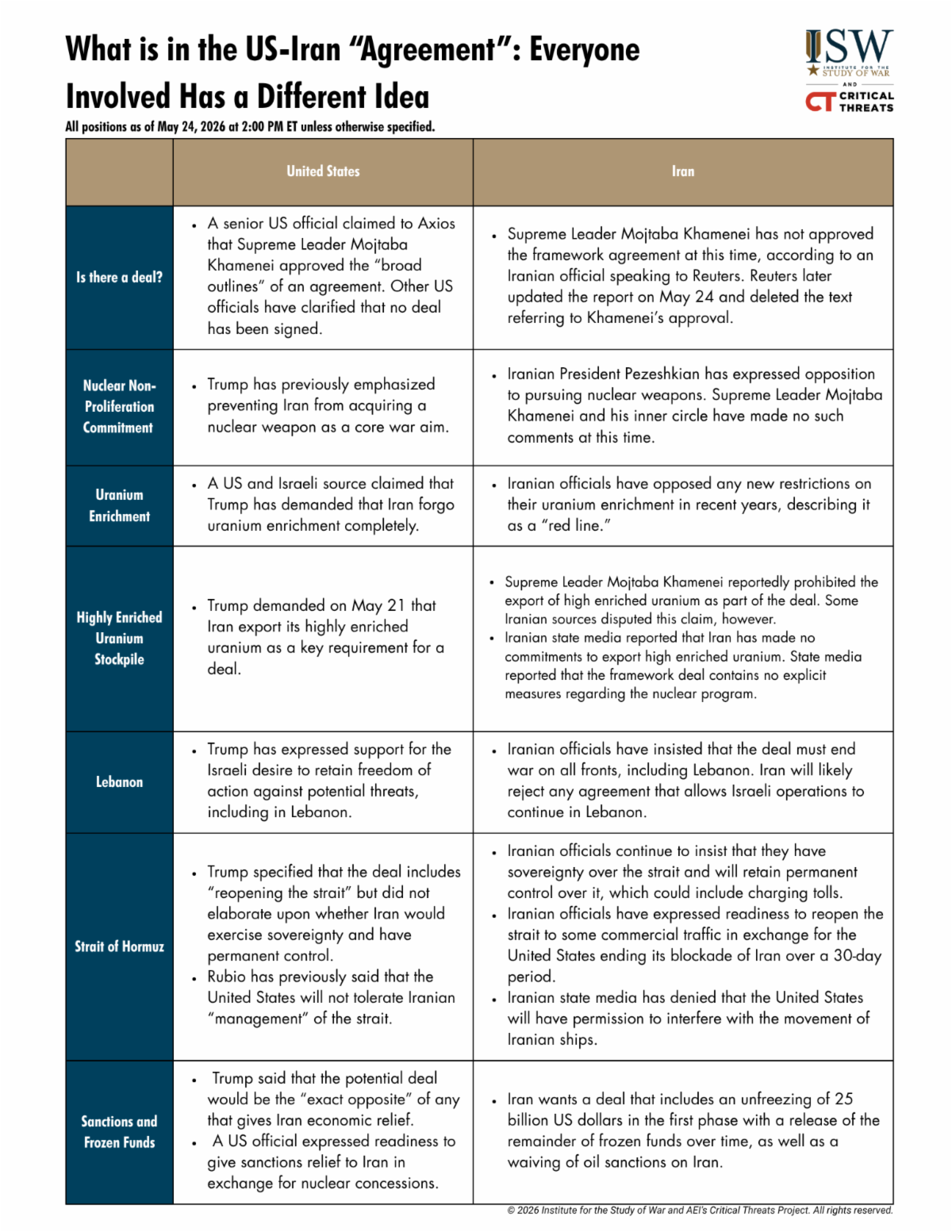
  • 미국, 이란, 그리고 지역 언론 보도가 서로 충돌하는 것은 가능한 미국-이란 양해각서(MOU)의 윤곽이 아직 해결되지 않았으며, 최종 합의를 나타내지 않을 수 있음을 시사합니다.
  • 이란 관리, 이슬람 혁명 수비대(IRGC) 관련 매체, 그리고 서방 및 지역 언론에 언급하는 이란 소식통들은 가능한 MOU가 미국의 양보와 이란의 지속적인 영향력에 달려 있다고 제시하고 있습니다.
  • IRGC 관련 보도는 동결 자산, 제재 완화, 해상 봉쇄, 레바논, 그리고 호르무즈 해협을 주요 미해결 문제로 꼽았습니다. 이는 핵 프로그램에 대한 회담 전에 합의의 첫 번째 단계에서 제기된 모든 문제입니다.
  • 중재자들은 미해결 문제를 순차적으로 처리하고 호르무즈 해협에 대한 기술적 합의를 개발함으로써 미국-이란 MOU를 향한 동력을 유지하려 하는 것으로 보입니다. 그러나 이란 보도는 이란이 핵심 요구 사항을 연기하려는 노력을 거부했음을 시사합니다.
  • 이란은 미국보다 더 강력한 입장에서 협상하고 있다고 믿는 듯하며, 이에 따라 이란에 유리한 방향으로 지역 질서를 재편하려 하고 있습니다.
  • 이란은 가능한 MOU에서 의미 있는 핵 양보를 공개적으로 수락하지 않았으며, 이란은 초안이 이란이 군사 및 경제적 압력으로부터 구제받은 후에 핵 회담을 연기한다고 생각합니다.
  • 이란 관리들은 미국-이란 MOU가 레바논을 포함하여 “모든 전선”에서 전쟁을 종식시켜야 한다고 밝혔습니다. 그러나 미국은 이스라엘에 대한 위협을 막기 위해 헤즈볼라에 대한 이스라엘의 지속적인 작전을 지지합니다.
  • 이스라엘 관리들은 미국에 이스라엘 방위군(IDF)이 레바논에서 현재의 임시 휴전에 따라 작전을 계속할 수 있도록 허용해 달라고 요청한 것으로 보이며, 트럼프 대통령은 이 입장에 동의했습니다.
  • 헤즈볼라 관리들은 IDF가 레바논에서의 활동을 완전히 중단하고 남부 레바논 영토에서 철수할 때까지 남부 레바논에서 IDF와 계속 교전하고 북부 이스라엘에 대한 공격을 감행할 것이라고 지속적으로 반복했습니다.

관련 최신 자료 및 링크:

  • 미국 국무부 – 이란 관련 페이지: 미국 국무부의 이란 관련 공식 발표 및 정책 정보를 확인할 수 있습니다. (영문)

    *주요 내용: 미국의 대이란 정책, 제재, 외교적 노력 등에 대한 최신 정보.
  • 외교협회(CFR) – 이란: 외교협회에서 제공하는 이란 관련 분석 보고서 및 뉴스, 전문가 의견 등을 통해 심층적인 이해를 도울 수 있습니다. (영문)

    *주요 내용: 이란의 국내 정치, 핵 프로그램, 지역 내 영향력, 국제 관계 등에 대한 심층 분석.
  • 알자지라 – 이란: 알자지라 방송의 이란 관련 뉴스 및 분석 기사를 통해 다양한 시각을 접할 수 있습니다. (영어/한국어)

    *주요 내용: 이란의 정치, 경제, 사회 문제, 그리고 관련 국제 뉴스.
  • BBC 코리아 – 이란: BBC 코리아에서 제공하는 이란 관련 뉴스, 분석, 다큐멘터리 등을 통해 다양한 정보를 얻을 수 있습니다. (한국어)

    *주요 내용: 이란의 주요 현안, 사회 문화, 국제 관계 등에 대한 보도.

주의: 제시된 링크는 정보 제공 목적으로, 링크된 자료의 정확성 및 최신성은 보장되지 않습니다. 관련 자료를 참고하실 때는 반드시 출처를 확인하고, 여러 정보를 종합하여 판단하시기 바랍니다.

“`

[원문]

Conflicting US, Iranian, and regional reporting indicates that the contours of a possible US-Iran memorandum of understanding (MOU) remain unresolved and may not yet represent a final agreement.

May 24, 2026

Data Cutoff: 2:00 PM ET

Ben Rezaei, Parker Hempel, William Doran, Nidal Morrison, Katherine Wells, Brian Carter, and Nicholas Carl

As the Middle East crisis evolves, ISW urgently needs your support.

Help us stay independent and impactful.

TOPLINES

Conflicting US, Iranian, and regional reporting indicates that the contours of a possible US-Iran memorandum of understanding (MOU) remain unresolved and may not yet represent a final agreement. US President Donald Trump stated on May 23 that a deal to end the war had been “largely negotiated” and awaited finalization. A senior US official stated in a briefing with reporters on May 24 that the White House does not expect an agreement on May 24 and believes Iranian leadership, including Supreme Leader Mojtaba Khamenei, may need several days to approve the deal. An unspecified senior US official told Axios that the United States is in a “very good place” but that the parties are still negotiating specific language and that “whether this becomes an agreement is still an open question.” Trump separately stated on May 24 that a possible Iran deal “isn’t even fully negotiated yet,” while stating that any agreement would not give Iran “a clear and open path to a Nuclear Weapon.” Trump later stated that negotiations are proceeding in an “orderly and constructive manner,” but added that he had instructed his representatives ”not to rush into a deal” because time is on the US side. Trump also stated that the US naval blockade ”will remain in full force and effect” until an agreement is “reached, certified, and signed.”

Iranian officials, Islamic Revolutionary Guards Corps (IRGC)-affiliated outlets, and Iranian sources speaking to Western and regional media are presenting the possible MOU as conditional on US concessions and continued Iranian leverage. An unspecified senior Iranian official told Reuters on May 24 that the Supreme National Security Council (SNSC) will convene to approve or reject the current draft and will send it to Mojtaba for final approval if the SNSC approves it. An unspecified senior Iranian source separately told CNN that recent mediated talks have made “a lot of progress” and could mark a “turning point” toward ending the war and creating a “new era of stability and prosperity” in the region. IRGC-affiliated Tasnim News Agency reported on May 24 that disputes over one or two provisions remain unresolved due to US “obstruction” and that the MOU could still fall through if the United States does not meet Iranian demands. US “obstruction” in this context probably refers to US insistence on legitimate demands that the Iranians oppose. IRGC-affiliated reporting has identified frozen assets, sanctions relief, the naval blockade, Lebanon, and the Strait of Hormuz as the main unresolved issues. This is every issue in the first stage of the agreement, before talks on the nuclear program. Tasnim reported that an informed source said Iran will not accept any understanding without the release of a “specified portion” of Iran’s blocked assets in the first step and a clear mechanism to guarantee continued access to all blocked assets. A well-informed Iranian source told an Al Jazeera journalist on May 24 that the two central issues involve the mechanism for unfreezing Iranian assets and the scope of a Lebanon ceasefire. The source added that Iran rejected a Pakistani proposal to move ahead with agreed provisions while postponing unresolved ones.

IRGC-affiliated messaging in domestic Iranian media has said that Iran will stick to its redlines, while quotes from unspecified Iranian officials in Western media have sought to portray the talks in a positive light by describing “progress.” Unspecified Iranian officials speaking to Western outlets have described progress and an internal approval process through the SNSC and Mojtaba, which suggests that some Iranian officials want to present the draft as a viable diplomatic path. IRGC-affiliated outlets, however, have emphasized red lines, US “obstruction,” blocked assets, sanctions relief, and continued Iranian control over the Strait of Hormuz.

KEY TAKEAWAYS

  • Conflicting US, Iranian, and regional reporting indicates that the contours of a possible US-Iran memorandum of understanding (MOU) remain unresolved and may not yet represent a final agreement.

  • Iranian officials, Islamic Revolutionary Guards Corps (IRGC)-affiliated outlets, and Iranian sources speaking to Western and regional media are presenting the possible MOU as conditional on US concessions and continued Iranian leverage.

  • IRGC-affiliated reporting has identified frozen assets, sanctions relief, the naval blockade, Lebanon, and the Strait of Hormuz as the main unresolved issues. This is every issue in the first stage of the agreement, before talks on the nuclear program. 

  • Mediators appear to be trying to preserve momentum toward a US-Iran MOU by sequencing unresolved issues and developing technical arrangements for the Strait of Hormuz, but Iranian reporting suggests that Iran has rejected efforts to defer its core demands.

  • Iran appears to believe that it is negotiating from a stronger position than the United States and is accordingly attempting to remake the regional order in a way that benefits Iran.

  • Iran has not publicly accepted meaningful nuclear concessions in the possible MOU, and Iran believes that the draft defers nuclear talks until after Iran secures relief from military and economic pressure.

  • Iranian officials have stated that the US-Iran MOU must end the war “on all fronts,” including in Lebanon. The United States supports continued Israeli operations against Hezbollah, however, to prevent threats to Israel.

  • Israeli officials have reportedly called on the United States to allow the Israel Defense Forces (IDF) to continue its operations in Lebanon, in accordance with the current temporary ceasefire in Lebanon, and President Trump agreed with this position.

  • Hezbollah officials have continuously reiterated that the group will continue to engage the IDF in southern Lebanon and launch attacks against northern Israel until the IDF completely halts its activity in Lebanon and withdraws from southern Lebanese territory.

Website | Jobs | Internships

Follow ISW on social media:

FacebookXYouTube | InstagramLinkedIn | Threads | Bluesky

© 2026 Institute for the Study of War and AEI’s Critical Threats Project. All rights reserved.

Donate online or by sending a check to the Institute for the Study of War at 1400 16th Street NW, Suite #515, Washington, DC 20036. Please consider including the Institute for the Study of War in your estate plans.

ISW is a tax-exempt organization under section 501(c)(3) of the Internal Revenue Code. Donations are tax-deductible to the extent permitted by law.

ISW is a non-partisan, non-profit, public policy research organization. ISW advances an informed understanding of military affairs through reliable research, trusted analysis, and innovative education. We are committed to improving the nation’s ability to execute military operations and respond to emerging threats in order to achieve US strategic objectives.

댓글 달기

이메일 주소는 공개되지 않습니다. 필수 필드는 *로 표시됩니다

위로 스크롤