|
Ukrainian forces reportedly conducted a mechanized counterattack in the Borova direction, possibly penetrating up to five kilometers into the Russian defenses. Geolocated footage published on May 22 shows Russian forces striking at least one Ukrainian armored vehicle north of Nove (southeast of Borova). A Russian milblogger claimed that the footage shows a part of the Ukrainian mechanized assault, which reportedly involved at least 15 armored vehicles near Maliivka, Lozove, and Vovchyi Yar (all southeast of Borova). A Kremlin-affiliated Russian milblogger claimed on May 23 that footage released by Russian military sources suggests that Ukrainian vehicles may have penetrated up to five kilometers into Russian-controlled territory before Russian forces struck the Ukrainian vehicles. Russian milbloggers claimed that Ukrainian forces attacked the forward positions of the Russian 20th Combined Arms Army (CAA, Moscow Military District [MMD]), including its 3rd and 144th motorized rifle divisions, while Russian forces were regrouping in the area. Russian milbloggers acknowledged that Ukrainian forces operate in Andriivka, Ridkodub, Vovchyi Yar, and southwestern Karpivka (all southeast of Borova). A Russian milblogger claimed on May 21 that Russian officials’ exaggerated claims of success in Kupyansk are allowing Ukrainian forces to exploit weak points in Russia’s defensive line that the Russian military command has neglected. Russian milbloggers assessed that Russian forces may struggle to prevent further Ukrainian advances south of Borova.
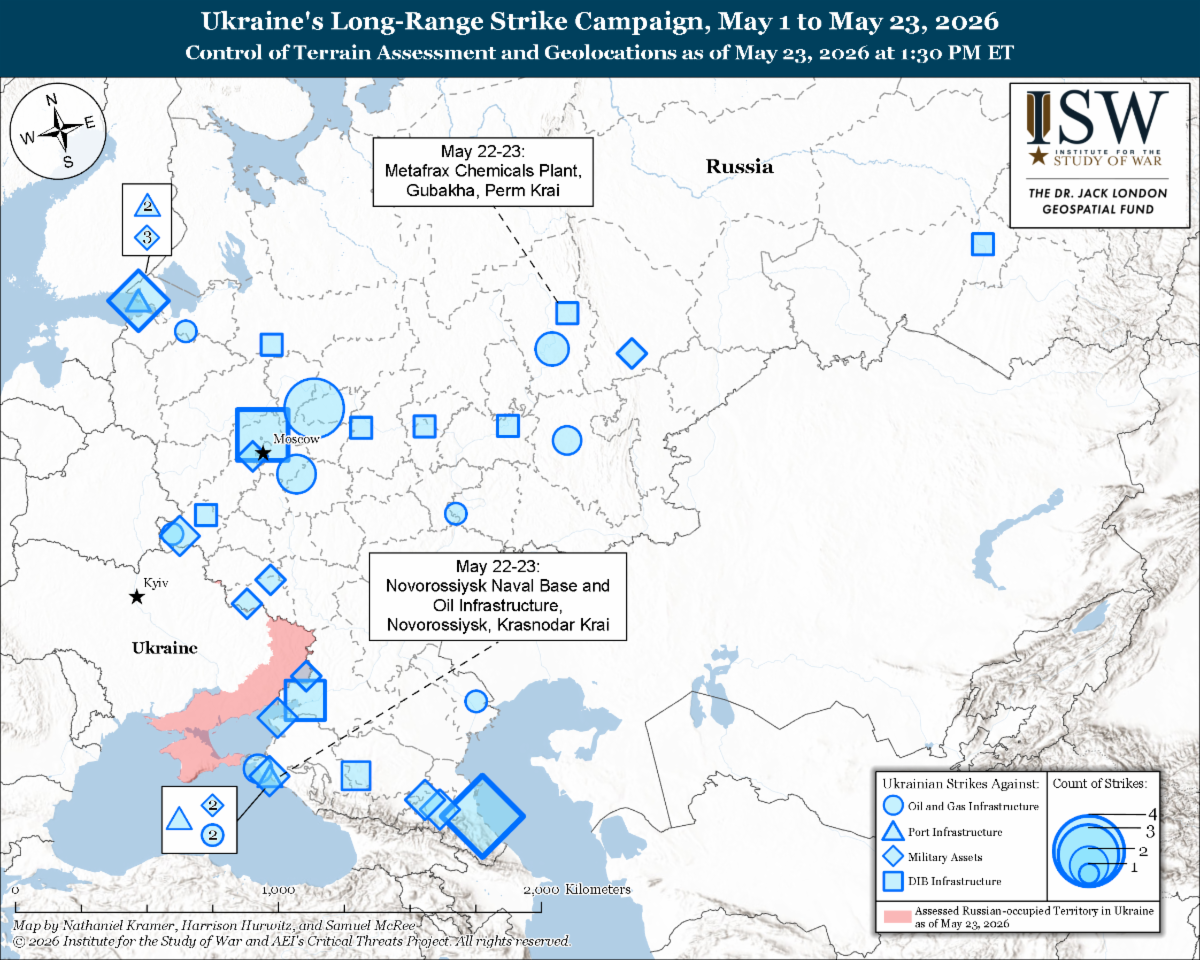
Ukraine’s long-range strike campaign continues to exploit degraded and overstretched Russian air defenses, targeting Russian oil infrastructure and military assets on the night of May 22 to 23. Ukrainian President Volodymyr Zelensky reported that Ukrainian forces struck the Metafrax Chemicals plant in Perm Krai – more than 1,700 kilometers from the frontline – forcing the facility to stop production. Zelensky stated that Metafrax Chemicals is an important part of the Russian chemical industry and supplies products to Russia’s military-industrial complex. The Ukrainian General Staff reported that Ukrainian forces struck the Sheskharis oil terminal and Grushova oil depot in Novorossiysk, Krasnodar Krai (approximately 340 kilometers from the frontline), causing fires at both facilities. The Ukrainian General Staff noted that Sheskharis is one of the largest Russian oil terminals on the Black Sea and is part of the Transneft pipeline network with a throughput capacity of up to 75 million tons of oil per year, and has a tank farm with a volume of about 1.28 million cubic meters. The Ukrainian General Staff also noted that the Grushova oil terminal is a key part of the Sheskharis complex and one of the largest oil depots in southern Russia with a carrying capacity of around 1.2 to 1.4 million cubic meters. The Ukrainian General Staff reported that Ukrainian forces also struck a Russian shadow fleet crude oil tanker, Chrysalis, in the Black Sea. Ukrainian Unmanned Systems Forces (USF) Commander Major Robert “Magyar” Brovdi reported that Ukrainian forces struck a Russian Project 1239 hoverborne guided-missile corvette and a Kalibr cruise missile-equipped Project 11356 frigate Admiral Essen at the Novorossiysk Naval Base. Ukraine has been engaged in a concerted campaign against Russian air defense assets (SEAD/DEAD) in occupied Crimea, which is further enabling Ukrainian forces to exploit degraded and overstretched Russian air defenses to strike Russian oil infrastructure and military targets in occupied Crimea and southwestern Russia. Ukraine’s continuous strikes on the Russian Black Sea Fleet (BSF) vessels demonstrate that Ukrainian drones continue to pose a significant threat to the BSF even after the Russian military command withdrew several vessels from BSF headquarters in occupied Sevastopol to Novorossiysk to protect them from Ukrainian strikes.
|