|
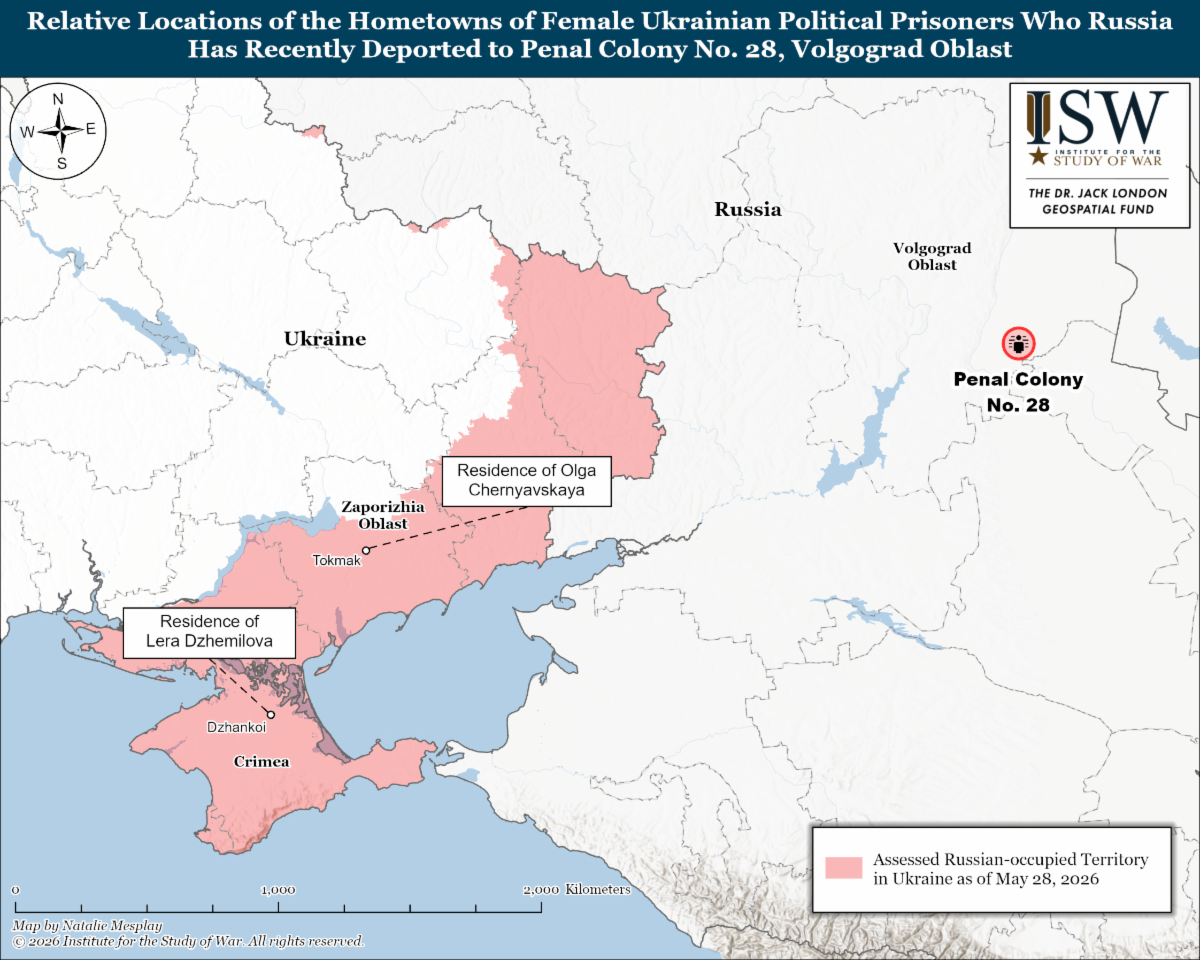
Russia continues to pursue a policy of deporting Ukrainian prisoners, including female political detainees, to penal colonies in Russia. Occupied Crimea-based human rights monitoring group Crimean Tribunal reported on May 18, citing a source within the Russian Federal Penitentiary Service (FSIN), that Russia is transferring Crimean Tatar political prisoner Lera Dzhemilova to Penal Colony No. 28 in Volgograd Oblast. Crimean Tribunal noted that Olga Chernyavskaya, a political prisoner from occupied Zaporizhia Oblast, is currently serving her sentence at Colony No. 28. The Crimea occupation Supreme Court sentenced Dzhemilova to 15 years in prison on treason charges in August 2025 on the allegation that she transferred information to Ukrainian intelligence. Russia first began the practice of deporting political prisoners, often Crimean Tatars, from occupied Crimea to prisons deep within Russia following the annexation of Crimea in 2014, and has scaled up the practice since 2022. The charges that Russia uses to justify the detention and deportation of political prisoners, especially Crimean Tatars, are fabricated or overblown treason, terrorism, or espionage charges. This policy likely violates human rights and humanitarian law, including the Fourth Geneva Convention’s prohibitions on the transfer of civilians from occupied territory. Ukrainian General Prosecutor Ruslan Kravchenko announced on May 21 that he submitted evidence to the International Criminal Court detailing Russia’s additional deportation of over 1,800 Ukrainian prisoners from occupied Kherson and Mykolaiv oblasts in November 2022 — emphasizing that the illegal deportation of prisoners is occurring beyond the context of Crimean political detainees.
The Russian government continues to fund University Shifts — a federal initiative that temporarily transfers Ukrainian teenagers to Russia to attend university classes with the goal of exposing youth to Russian values and forging long-term ties with the Russian state. Russian Prime Minister Mikhail Mishustin signed an order on May 19 allocating over 155 million rubles ($2 million) to University Shifts for 2026. The order states that the funding will provide for at least 2,300 schoolchildren from occupied Donetsk, Luhansk, Kherson, and Zaporizhia oblasts to attend Russia’s “leading pedagogical universities” across Russia, including in Samara, Tula, Volgograd, and Perm. Mishustin emphasized that University Shifts pays special attention to exposing teenagers to Russian “educational and cultural events.” Russian President Vladimir Putin ordered the creation of University Shifts in Summer 2022, and it has since facilitated the transfer of tens of thousands of Ukrainian teenagers to Russian universities for career guidance and cultural integration opportunities. University Shifts also represents a Russian government-directed effort at long-term Russification, as it exposes Ukrainian youth to the Russian educational system and encourages them to forge long-term ties with Russia at the expense of their Ukrainian identities.
Russian social and ethnic affairs policy in occupied Ukraine continues to be solely premised on Russification and the eradication of any distinct Ukrainian identities. A conference on “the implementation of state national policy” took place in occupied Donetsk City on May 23 in accordance with the official designation of 2026 as “the Year of the Unity of the Peoples of Russia." Donetsk People’s Republic (DNR) Head Denis Pushilin addressed the conference at a plenary session framed around the claim that occupied Donbas is the “stronghold of [Russian] civic unity.” Several Russian milbloggers, including the prominent Rybar Kremlin-aligned media project, praised the conference and Pushilin’s speech, claiming that they emphasize the development of “Russian statehood” and Russian national identity in occupied Donetsk Oblast. The conference comes six months after Russian President Vladimir Putin signed a decree in November 2025 officially approving Russia’s “State National Policy” strategy, which is aimed at “strengthening the unity of the multinational people of the Russian Federation, all Russian civic identity, civil unity and patriotism, [and] interethnic and religious harmony” in order to ensure Russia’s national interests and safeguard Russia’s national security. The 2026 State National Policy, which will remain in force until 2036, codifies the Russification of occupied areas as a matter of Russian state policy. The reflection of prominent milbloggers on the successful formation of “Russian national identity” in occupied Donetsk Oblast suggests that Russification measures are having tangible effects on identity formation and presentation in occupied areas.
|