|
The PRC has not blocked Taiwanese government officials, including Minister Without Portfolio Yang Jen-ni, from participating in Asia-Pacific Economic Cooperation (APEC) meetings in the PRC, despite its general policy against Taiwanese officials participating in international forums. Taiwan sent Yang, who is also the head of the Taiwan Office of Trade Negotiations, to Suzhou to attend an APEC ministerial meeting from May 22 to 23. Yang is the most senior sitting Taiwanese official to visit the PRC on official business since the PRC cut off official exchanges with Taiwan in 2016 in response to the election of former Democratic Progressive Party (DPP) President Tsai Ing-wen. The PRC insists that cross-strait relations must be based on the “1992 Consensus,” which Tsai, current President William Lai Ching-te, and the DPP do not recognize. The 1992 Consensus is an alleged verbal agreement between semi-official representatives of the CCP and the Kuomintang (KMT), Taiwan’s then-ruling party, that says that Taiwan is part of “China,” though the two sides did not agree on whether “China” is rightfully represented by the PRC or the Republic of China (ROC). Taiwan sent Director General of the Ministry of Foreign Affairs (MOFA) Department of International Organizations Jonathan Sun to APEC Senior Officials meetings earlier this year. Taiwan has participated in APEC under the name “Chinese Taipei” since it joined the organization in 1991. APEC is an organization of “economies” and does not require participants to be sovereign states.
A US decision to suspend an arms sale to Taiwan would likely undermine Taiwanese confidence in the United States’ commitment to Taiwan’s defense. US President Donald Trump stated that US arms sales to Taiwan were under consideration and suggested they could be used as a “negotiating chip” with the PRC. Reuters reported on May 23 that an unnamed source in the White House stated that Trump would make a decision “soon” on the potential arms package. The arms sale under consideration totals to 14 billion US dollars and includes Patriot surface-to-air missile systems, National Advanced Surface-to-Air Missile Systems (NASAMS), and interceptor munitions for these systems. These systems would aid Taiwan’s efforts to develop an integrated air and missile defense (IAMD) network known as the “T-dome,” which President Lai has outlined as a key priority of his administration. A robust IAMD network is critical for Taiwan’s ability to withstand PRC precision strikes preceding a PLA amphibious invasion.
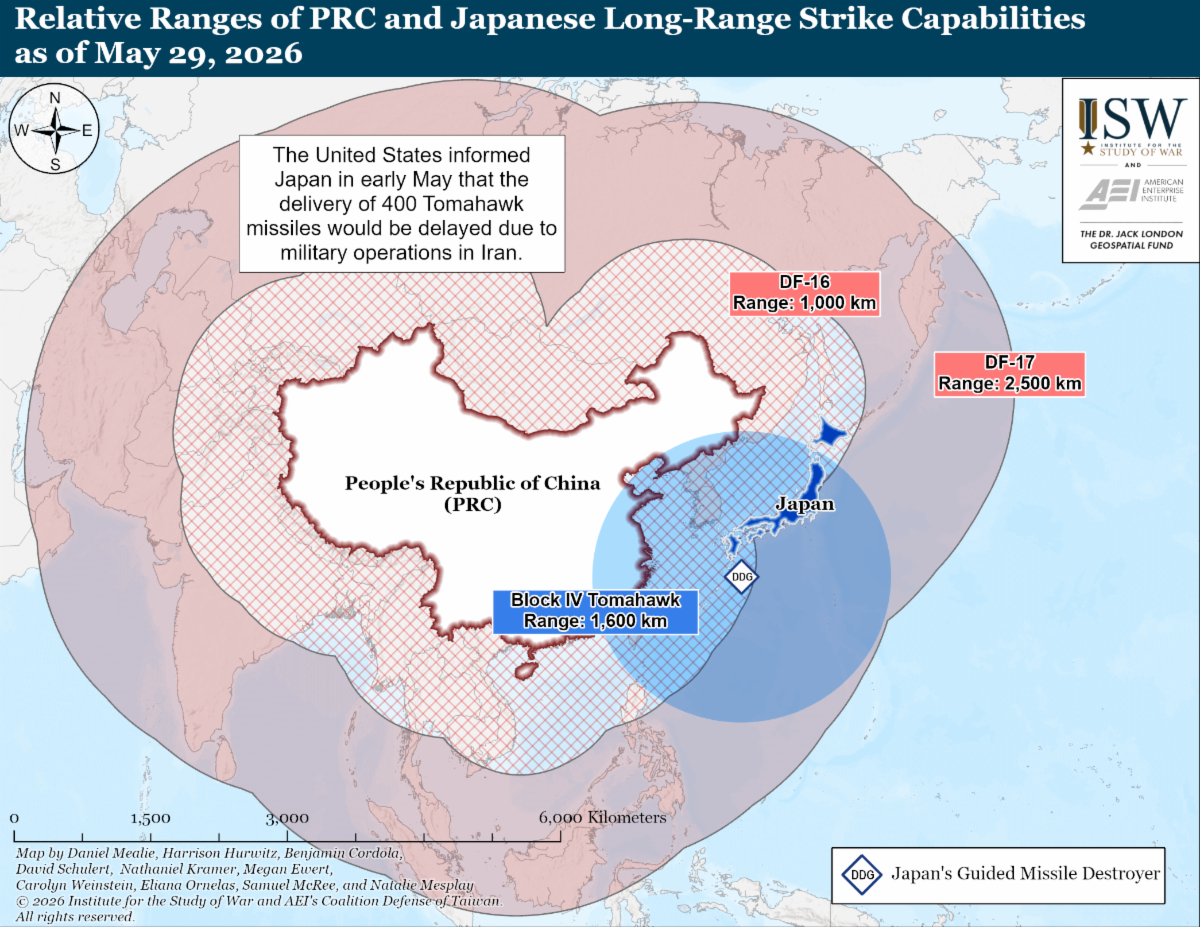
Delays in US Tomahawk missile shipments to Japan may pose a threat to Japan’s evolving defense concept. The PRC may weaponize arms delivery delays in information operations to undermine the US-Japan relationship, despite continued US support for Japan’s defense reforms. The United States warned Japan that it may delay a planned delivery of four hundred Tomahawk missiles due to the war in Iran. Tomahawk deliveries were initially planned in two shipments to be completed by 2028, but the delay could reportedly push this timeline back by two years.
|