|
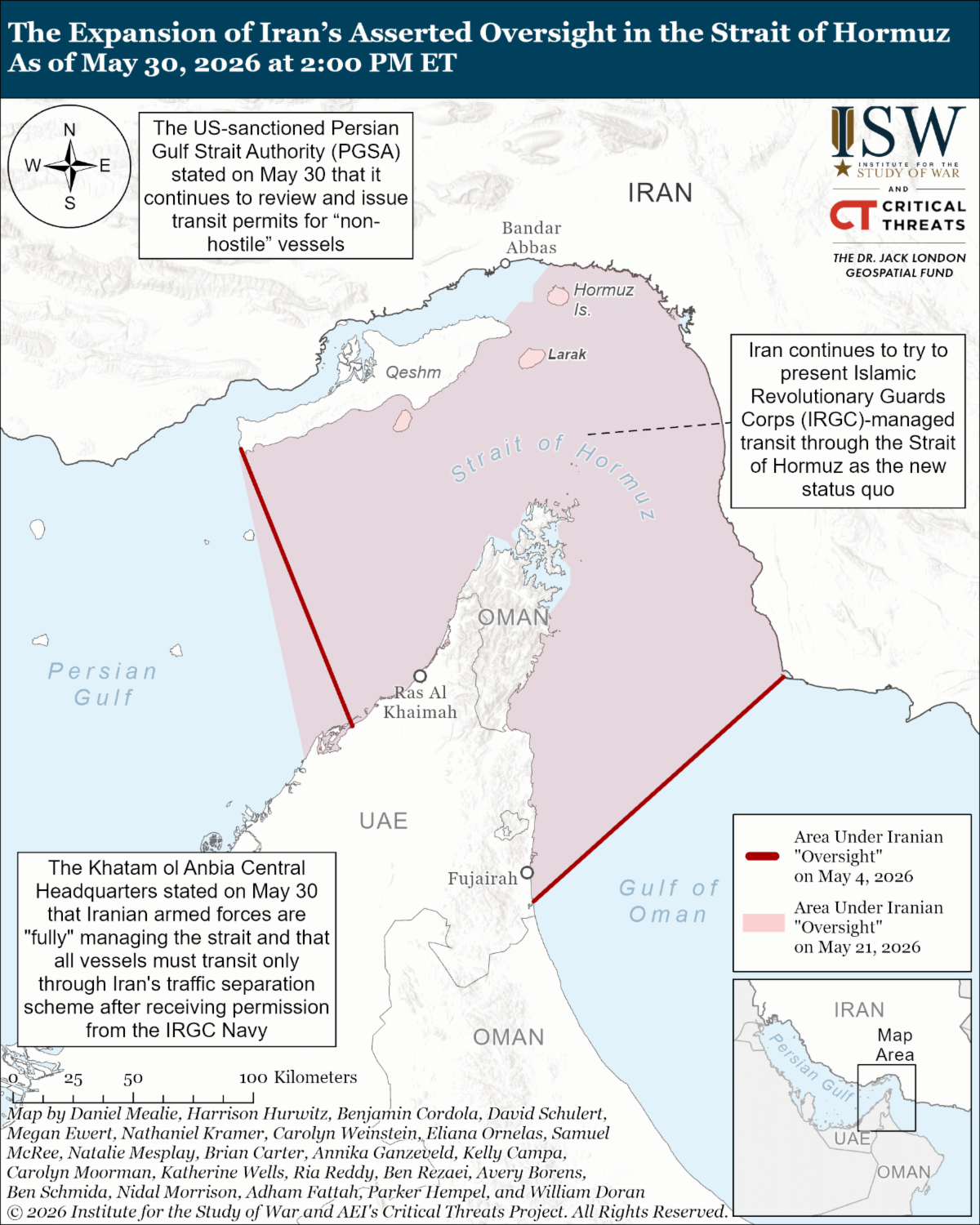
Iran continues to try to frame the Islamic Revolutionary Guards Corps (IRGC) “management” of transit through the Strait of Hormuz as the new status quo. The United States and international community must continue to reject Iranian efforts to try to establish this new status quo, as it is detrimental to international commercial interests and sets a dangerous precedent for freedom of navigation in international waterways. The IRGC Navy has begun publishing daily roll-ups of the number of vessels that use Iran’s illegal traffic separation scheme. The IRGC Navy reported that 20 vessels passed through Iran’s traffic separation scheme on May 30. Iran has repeatedly used force, including attacks on commercial vessels and naval mines, to force vessels to use Iran’s illegal and unrecognized traffic separation scheme. The IRGC Navy also claimed that it provided “safe passage” to some vessels for “humanitarian reasons,” likely to try to portray the IRGC Navy as a reasonable actor despite its deployment of mines, as well as attacks and harassment of vessels in the Strait of Hormuz. The Khatam ol Anbia Central Headquarters separately stated on May 30 that Iranian armed forces are “fully” managing the strait and that all vessels must transit only through Iran’s traffic separation scheme after receiving permission from the IRGC Navy. The headquarters warned that Iranian armed forces will target any military vessel that intervenes in Iran’s management of the strait or disrupts maritime traffic, likely in response to a May 29 US CENTCOM notice that the US Navy will conduct military operations north of the Musandam Peninsula in the Strait of Hormuz and target vessels “engaged in, or supporting, mine-laying activities.”
Neither the United States nor Iran has indicated that the two sides have narrowed gaps on key issues in the US-Iran negotiations, such as economic relief for Iran. An unspecified senior Trump administration official told the New York Times on May 29 that the Trump administration believes it is close to an agreement but that the United States and Iran have still not resolved certain issues, including the unfreezing of Iranian assets. Trump announced that “no money will be exchanged” in a social media post on May 29, likely referring to frozen Iranian assets. Iranian officials have repeatedly demanded the release of frozen assets as a “precondition” for talks about nuclear issues. An Iranian negotiating team member close to Parliament Speaker Mohammad Bagher Ghalibaf asserted on May 30 that Iran’s “irreversible” access to $12 billion USD in frozen assets is one of Iran’s “main” conditions for any possible agreement. Iranian state media, citing “unofficial details of a possible US-Iran memorandum of understanding,” separately claimed that the United States would give Iran full access to $12 billion USD in frozen assets within 60 days. Ghalibaf recently led an Iranian delegation to Qatar to try to secure the “immediate” and “unconditional” release of $12 billion USD, but Qatar rejected Iran’s request, according to anti-regime media on May 29.
Iran likely seeks unrestricted access to its frozen assets to reduce the effect of US sanctions and the naval blockade and support its military reconstitution. US sanctions and the naval blockade have hindered Iran’s ability to raise revenue that the regime could use to reconstitute its military capabilities. Iranian Foreign Affairs Ministry Spokesperson Esmail Baghaei stated on May 25 that assets released under a potential agreement with the United States would go toward Iran’s defense and military sectors, including Iran’s missile and drone programs. ISW-CTP previously assessed that granting Iran economic relief by unfreezing funds or removing sanctions would likely decrease Iranian military reconstitution timelines.
|