|
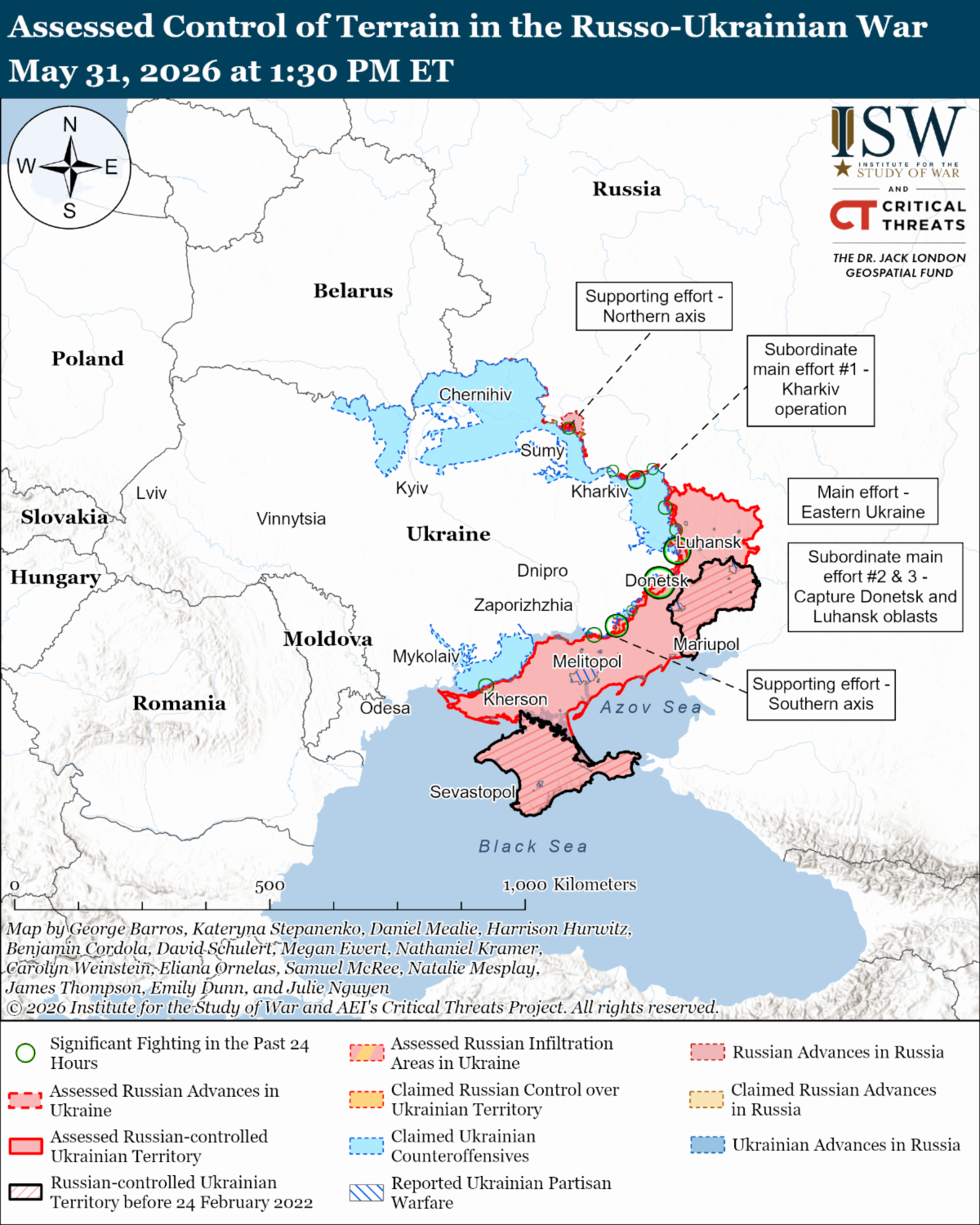
Ukraine’s mid-range strike campaign against Russian ground lines of communication (GLOCs) is disrupting Russian logistics across the theater, from occupied Luhansk Oblast to Crimea. The Ukrainian 3rd Army Corps reported on May 31 that Ukrainian forces have achieved drone-enabled fire control over Luhansk City, Starobilsk, Alchevsk, Bryanka, and Kadiivka (all roughly 50 to 90 kilometers from the frontline) as part of Ukraine’s broader operational strike campaign against Russian GLOCs in Luhansk Oblast aimed at preventing Russian forces from conducting logistics operations in rear areas. The Ukrainian 3rd Army Corps reported that Ukrainian forces regularly strike Russian GLOCs, armor and ammunition depots in the area and recently reached the Izvaryne checkpoint on the international border, over 205 kilometers from Ukrainian drone operators’ positions. Ukrainian forces have significantly intensified their mid-range strike campaign against Russian GLOCs across the theater over the last several months, which has been generating cascading effects on the battlefield and inhibiting Russian advances. These strikes have been creating logistics problems for Russian forces throughout southern Ukraine in recent weeks and are now also affecting Russian logistics in occupied Luhansk Oblast. Geolocated footage published on May 30 and 31 shows Ukrainian forces conducting strikes against Russian military equipment along the Debaltseve-Luhansk City highway, the H-32 Alchevsk-Kadiivka highway, the H-20 Kostyantynivka-Donetsk City highway, and the M-14 Mariupol-Berdyansk-Melitopol-Henichesk highway in occupied Luhansk and Donetsk oblasts.
Ukraine may also be expanding its drone strike campaign against Russian training grounds in occupied Ukraine. Ukrainian Unmanned Systems Forces (USF) Commander Major Robert “Magyar” Brovdi and the Ukrainian General Staff reported on May 30 that Ukrainian forces struck the Tryokhizbenko Training Ground of the Russian 3rd Army – likely the Russian 3rd Combined Arms Army (CAA, Southern Military District [SMD]) but possibly the 3rd Army Corps (AC, under the operational control of the Southern Grouping of Forces) — near Kryakivka, Luhansk Oblast (about 70 kilometers from the frontline). Magyar reported that Ukrainian forces also struck the Primorsky Posad Training Ground of the Russian 36th CAA (Eastern Military District [EMD]) in occupied Zaporizhia Oblast, where elements of the Russian 64th Separate Motorized Rifle Brigade (35th CAA, EMD) were training. Brovdi stated that preliminary information shows that the 64th Separate Motorized Rifle Brigade suffered at least 31 casualties, including at least 9 killed in action (KIA), at the Primorsky Posad Training Ground but that losses are likely much higher. Russian forces were able to leverage improved drone reconnaissance capabilities in the near rear in late 2024 into 2025 to conduct several precision missile strikes against Ukrainian training grounds as part of Russia’s wider battlefield air interdiction (BAI) campaign. Ukraine may be trying to replicate these strikes against training grounds with drones in order to endanger Russian troop concentrations in the operational rear.
Russian officials continue to accuse Ukraine of striking the Russian-occupied Zaporizhzhia Nuclear Power Plant (ZNPP). ZNPP occupation officials claimed on May 30 and 31 that Ukraine conducted two strikes against ZNPP, hitting the Unit 6 turbine hall on May 30 and a transport shop on May 31. The Ukrainian Ministry of Foreign Affairs (MFA) and Ukraine’s Southern Defense Forces refuted both accusations and stated that these Russian accusations are an attempt to divert attention away from Russia’s illegal occupation of the plant. The Ukrainian MFA noted that Russia launches a new wave of such accusations ahead of each International Atomic Energy Agency (IAEA) meeting. The IAEA reported on May 31 that its representatives at the plant observed damage to the turbine hall consistent with a drone strike but did not attribute the damage to a Ukrainian or Russian drone. Russian Security Council Deputy Chairperson Dmitry Medvedev used the purported Ukrainian strike to threaten escalatory retaliatory strikes, claiming that Russia will conduct “symmetrical” strikes against Ukrainian or NATO nuclear power plants if strikes destroy the ZNPP. Russia has systemically threatened and damaged Ukrainian NPPs throughout the course of the war. Russia has also heavily militarized the ZNPP by storing military equipment next to the ZNPP’s nuclear reactors, stationing military personnel at and around the ZNPP, and launching drones from the ZNPP’s grounds. Russian officials frequently make unsubstantiated accusations of Ukrainian strikes on ZNPP and civilian targets to justify escalatory behavior and intensified long-range strikes against Ukraine. Russian officials may use purported strikes to justify a new massive long-range strike against Ukraine in the near future, which Ukrainian President Volodymyr Zelensky warned of on May 29 and 30.
|