[ISW] 이란 업데이트 특별 보고서, 2026년 6월 1일

“`html

핵심 내용:

  • 이란 정권의 협상 중단: ISW-CTP가 계속해서 평가하는 바에 따르면, 이란 정권은 이슬람 혁명 수비대(IRGC) 사령관인 아흐마드 바히디 소장과 그의 측근에 의해 지배되고 있으며, 6월 1일에 미국-이란 협상을 중단했습니다. 바히디와 그의 측근은 이란이 외교적 합의에서 미국에 양보하지도 않고, 미국과 전면적인 갈등을 겪지도 않는 현재 상황이 자신들의 목표 달성에 유리하다고 판단하는 것으로 보입니다. IRGC와 관련된 타스님 통신은 6월 1일에 이란 정권이 레바논에서 헤즈볼라에 대한 이스라엘의 작전에 대한 대응으로 협상을 중단했다고 발표했습니다.

  • 미국-이란 협상 중단의 배경: 이란 정권이 협상을 중단하고 레바논 문제를 강조하는 것은 거의 확실하게 도널드 트럼프 미국 대통령이 최근 미국-이란 양해 각서(MoU) 초안에 대한 수정을 가한 데 대한 반응입니다.

  • 레바논 문제 집중의 목적: 이란 정권은 협상의 또 다른 주요 난관인 문제 대신 레바논 문제에 집중하여 레바논에서 헤즈볼라에 대한 이스라엘의 작전을 억제하려 하는 것으로 보입니다. 이는 헤즈볼라를 보존하려는 정권의 더 광범위한 목표의 일환입니다. 또한 이란 정권은 미국-이란 회담의 붕괴에 대해 이스라엘과 레바논에서의 작전을 허위로 비난함으로써 미국과 이스라엘 사이에 균열을 만들고자 할 것입니다. 바히디와 그의 측근은 또한 현 상태가 호르무즈 해협에 대한 이란의 통제력을 강화하고 이란 핵 프로그램을 유지하는 등 다른 여러 목표를 달성하는 데 도움이 될 것이라고 판단할 것입니다.

  • 협상 중단의 의미: 협상 중단은 바히디와 그의 측근이 이란의 의사 결정을 주도하고 있으며, 특히 국회의장인 모하마드 바게르 갈리바프 등 합의 지지자들을 제압했음을 시사합니다.

  • 최근 군사적 충돌: 지난 48시간 동안 이란과 미국 사이에 제한적인 교전이 있었습니다. 이슬람 혁명 수비대(IRGC)와 관련된 매체는 5월 31일에 이란 방공망이 “이란 영해” 상공에서 미국 MQ-1 프레데터 드론을 격추했다고 발표했습니다. 미국 중부 사령부(CENTCOM)는 이에 대응하여 케섬 섬과 호르무즈간주 고룩에 있는 이란 목표물에 대한 방어 공격을 가했습니다. IRGC는 5월 31일에 쿠웨이트 주둔 미군에 미사일 2발을 발사하여 미국의 공격에 보복했습니다.

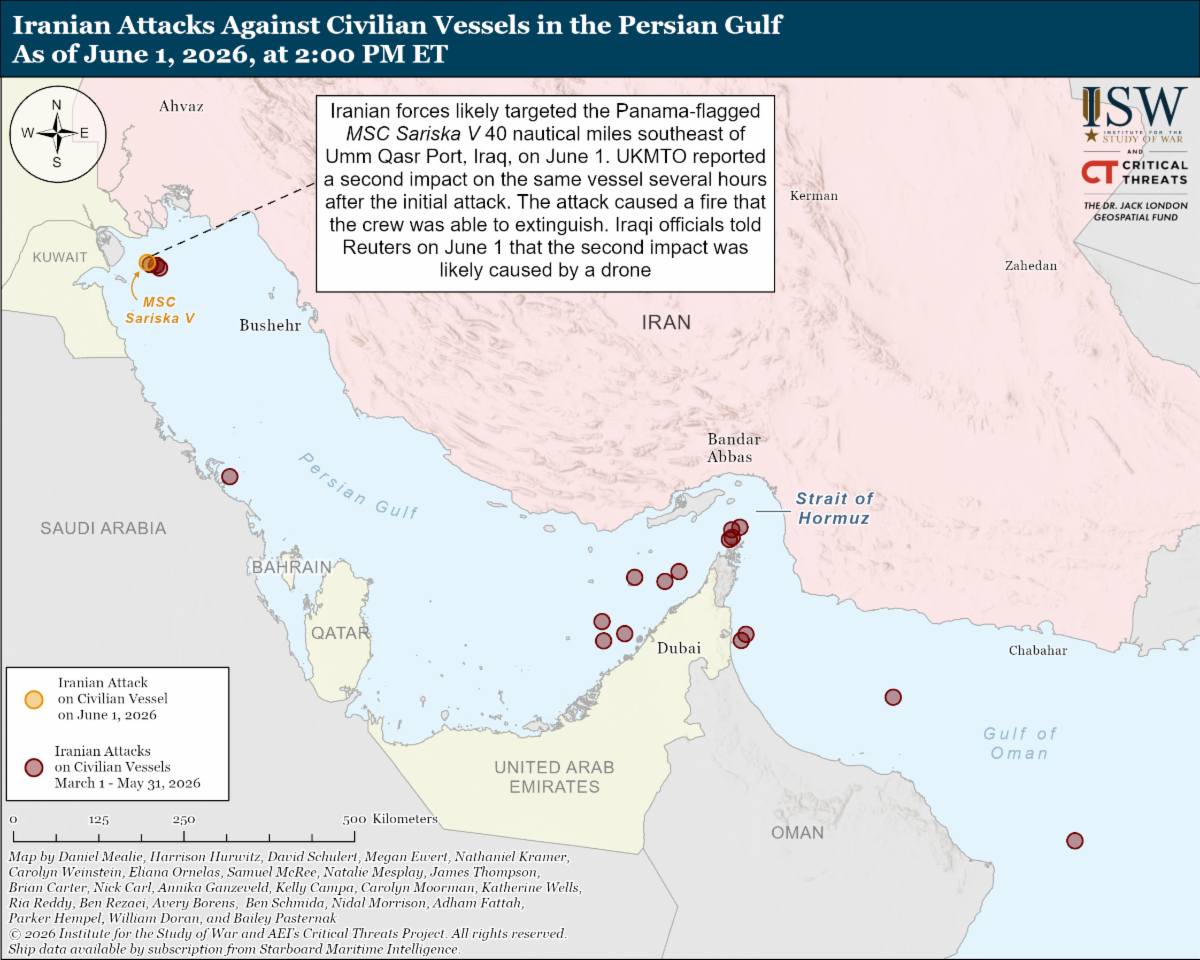
  • 민간 화물선 공격 의심: 이란군은 6월 1일에 이라크 해안에서 민간 화물선을 공격했을 가능성이 있습니다. 영국 해상 무역 작전은 6월 1일에 특정되지 않은 발사체가 이라크 움 카스르 항구에서 남동쪽으로 약 40해리 떨어진 페르시아만 북부를 통과하는 화물선을 강타했다고 보고했습니다.

최신 자료 및 관련 링크:

참고: 위 링크들은 현재 시점에서 관련 정보를 제공하는 자료를 중심으로 선정되었습니다. 상황 변화에 따라 정보의 정확성은 달라질 수 있으며, 더 최신 정보를 얻기 위해서는 지속적인 검색과 확인이 필요합니다. “핵심 내용”의 영어 표현은 “Key Takeaways”입니다.

“`

[원문]

The Iranian regime, which ISW-CTP continues to assess is dominated by Islamic Revolutionary Guards Corps (IRGC) Commander Major General Ahmad Vahidi and his inner circle, suspended US-Iran negotiation

June 1, 2026

Data Cutoff: 2:00 PM ET

Ria Reddy, Parker Hempel, Will Doran, Avery Borens, and Annika Ganzeveld

TOPLINES

The Iranian regime, which ISW-CTP continues to assess is dominated by Islamic Revolutionary Guards Corps (IRGC) Commander Major General Ahmad Vahidi and his inner circle, suspended US-Iran negotiations on June 1. Vahidi and his inner circle likely calculate that the status quo, in which Iran has neither made concessions to the United States in a diplomatic agreement nor is engaged in a full-scale conflict with the United States, is a favorable situation that advances their objectives. IRGC-affiliated Tasnim News Agency announced on June 1 that the regime has suspended negotiations, ostensibly in response to Israeli operations against Hezbollah in Lebanon. The fact that IRGC-affiliated media announced the suspension of negotiations suggests that the decision to suspend negotiations was driven by the IRGC, and presumably by Vahidi. Iranian officials have consistently demanded throughout negotiations that the US-Iran ceasefire must include Hezbollah, but Iranian officials significantly increased their emphasis on this demand after Tasnim announced the suspension of negotiations. Supreme Leader Adviser Mohammad Mokhber, for example, stated on June 1 during a meeting with Hezbollah’s representative to Tehran that any ceasefire that excludes Hezbollah is “irrelevant.”

The Iranian regime’s decision to suspend negotiations and emphasize the Lebanon issue is almost certainly a response to US President Donald Trump’s recent amendments to the draft US-Iran memorandum of understanding (MoU). Trump requested several amendments, including changes to the draft’s text about Iran’s highly enriched uranium (HEU) and the Strait of Hormuz. An Iranian official close to Iran’s negotiating team stated on June 1 that Iran has “concerns” about Trump’s amendments and reiterated that Iran will not transfer its HEU to the United States and that Iran must “manage” the Strait of Hormuz. Iran likely responded to Trump’s amendments by reemphasizing its own maximalist demands, particularly its insistence that any ceasefire agreement between the United States and Iran must include Lebanon.

The Iranian regime has likely focused on the Lebanon issue, as opposed to another key sticking point in negotiations, to try to curb Israeli operations against Hezbollah in Lebanon as part of the regime’s broader objective to preserve Hezbollah. Khatam ol Anbia Central Headquarters Commander Major General Ali Abdollahi Ali Abadi issued an implicit threat on June 1 to attack civilians in northern Israel if the Israel Defense Forces (IDF) conducts airstrikes targeting Beirut. Abadi’s warning comes after Israeli Prime Minister Benjamin Netanyahu ordered the IDF to conduct strikes against Hezbollah targets in Beirut and broaden the scope of IDF operations against Hezbollah in Lebanon. Iran rarely issues public warnings before conducting attacks, which suggests that Abadi’s threat sought to achieve an informational effect. The regime likely intended to pressure the United States to push Israel to limit its operations against Hezbollah by threatening to attack Israel if Israel expanded its operations in Lebanon.

KEY TAKEAWAYS

  • The Iranian regime, which ISW-CTP continues to assess is dominated by Islamic Revolutionary Guards Corps (IRGC) Commander Major General Ahmad Vahidi and his inner circle, suspended US-Iran negotiations on June 1. Vahidi and his inner circle likely calculate that the status quo, in which Iran has neither made concessions to the United States in a diplomatic agreement nor is engaged in a full-scale conflict with the United States, is a favorable situation that advances their objectives. IRGC-affiliated Tasnim News Agency announced on June 1 that the regime has suspended negotiations, ostensibly in response to Israeli operations against Hezbollah in Lebanon.

  • The Iranian regime’s decision to suspend negotiations and emphasize the Lebanon issue is almost certainly a response to US President Donald Trump’s recent amendments to the draft US-Iran memorandum of understanding (MoU).

  • The Iranian regime has likely focused on the Lebanon issue, as opposed to another key sticking point in negotiations, to try to curb Israeli operations against Hezbollah in Lebanon as part of the regime’s broader objective to preserve Hezbollah. The regime also likely seeks to drive a wedge between the United States and Israel by falsely blaming Israel and its operations in Lebanon for the collapse of the US-Iran talks. Vahidi and his inner circle also likely calculate that the status quo will help them advance several other objectives, such as solidifying Iranian control over the Strait of Hormuz and maintaining the Iranian nuclear program.

  • The suspension of negotiations further indicates that Vahidi and his inner circle are driving Iranian decision-making and have likely gained the upper hand over proponents of a deal, particularly Parliament Speaker Mohammad Bagher Ghalibaf.

  • Iran and the United States have exchanged limited fire over the past 48 hours. Islamic Revolutionary Guards Corps (IRGC)-affiliated media announced on May 31 that Iranian air defenses shot down a US MQ-1 Predator drone over “Iranian territorial waters.” US Central Command (CENTCOM) responded by launching defensive strikes against Iranian targets on Qeshm Island and in Goruk, Hormozgan Province. The IRGC retaliated against the US strikes by launching two missiles at US forces in Kuwait on May 31.

  • Iranian forces also likely attacked a civilian cargo vessel located off the coast of Iraq on June 1. United Kingdom Maritime Trade Operations reported on June 1 that an unspecified projectile struck a cargo vessel transiting the northern Persian Gulf approximately 40 nautical miles southeast of the Umm Qasr Port in Iraq.

ISW takes no US or foreign government funding.

We are powered by the support of individuals like you.

Help us stay independent and impactful.

Website | Jobs | Internships

Follow ISW on social media:

FacebookXYouTube | InstagramLinkedIn | Threads | Bluesky

© 2026 Institute for the Study of War and AEI’s Critical Threats Project. All rights reserved.

Donate online or by sending a check to the Institute for the Study of War at 1400 16th Street NW, Suite #515, Washington, DC 20036. Please consider including the Institute for the Study of War in your estate plans.

ISW is a tax-exempt organization under section 501(c)(3) of the Internal Revenue Code. Donations are tax-deductible to the extent permitted by law.

ISW is a non-partisan, non-profit, public policy research organization. ISW advances an informed understanding of military affairs through reliable research, trusted analysis, and innovative education. We are committed to improving the nation’s ability to execute military operations and respond to emerging threats in order to achieve US strategic objectives.

댓글 달기

이메일 주소는 공개되지 않습니다. 필수 필드는 *로 표시됩니다

위로 스크롤