|
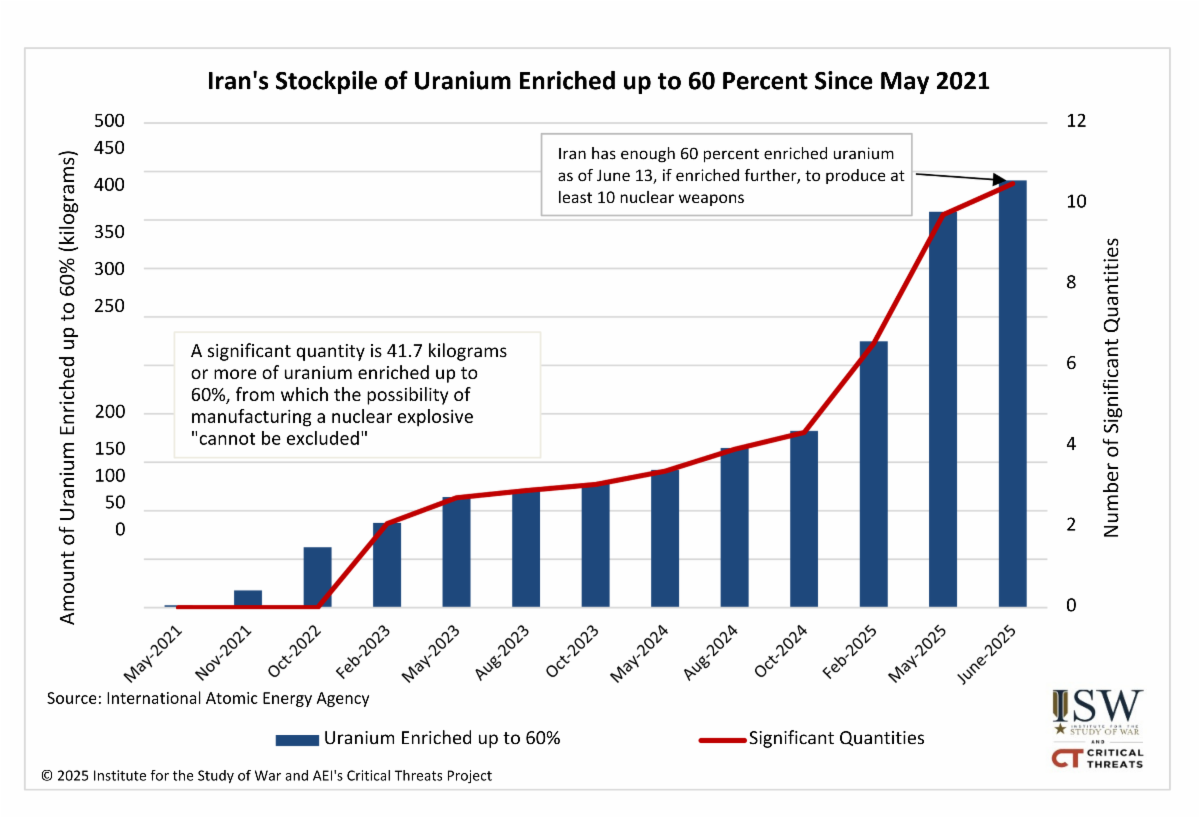
Iran possessed 440.9 kilograms of uranium enriched up to 60 percent before the start of the Israel-Iran War on June 12, according to an unreleased International Atomic Energy Agency (IAEA) report obtained by the Associated Press.The Associated Press reported on September 3 that Iran increased its stockpile of 60 percent enriched uranium by 32.5 kilograms between May 17 and June 13, citing the unreleased IAEA report. Iran’s 60 percent enriched uranium stockpile is equivalent to approximately 10.5 significant quantities, which refers to the “approximate amount of nuclear material for which the possibility of manufacturing a nuclear explosive device cannot be excluded.” Iran has enough 60 percent enriched uranium, if enriched further, to produce at least 10 nuclear weapons. Iran is unlikely to be able to access this uranium due to the damage that Israeli and US strikes caused to Iranian nuclear facilities during the war, however. The IAEA report added that Iran’s total stockpile of enriched uranium is 9,874.9 kilograms. This amount marks a 627.3 kilogram increase in Iran’s total stockpile of enriched uranium since May 17. The IAEA reported that the IAEA has not inspected any Iranian nuclear site except the Bushehr Nuclear Power Plant since the Israel-Iran War. The Iranian parliament passed a bill on June 25 that suspended all cooperation with the IAEA, and IAEA Director General Rafael Grossi confirmed on September 3 that Iran has provided the IAEA with no information on the status of Iran’s highly enriched uranium stockpile since June 13. CIA Director John Ratcliffe stated in July 2025 that the US and Israeli strikes during the war buried the “vast majority” of Iran’s enriched uranium at the Esfahan Nuclear Technology Center (ENTC) and Fordow and that it would be “extremely difficult” for Iran to extract the material. The IAEA reported on August 27 that there is no evidence that Iran has moved its stockpile of highly enriched uranium from the ENTC since the US strikes on June 21, citing satellite imagery. Grossi said that Iran and the IAEA will hold another round of talks in the coming days to discuss resuming IAEA inspections at Iranian nuclear facilities, including those that Israel and the United States struck during the war.
Iran is likely trying to prevent popular discontent by restricting Iranian media reporting about potential snapback sanctions. The E3 (the United Kingdom, France, and Germany) triggered the 30-day snapback process to reimpose UN Security Council sanctions on Iran on August 28. The Iranian Culture and Islamic Guidance Ministry reportedly issued a confidential directive to Iranian media outlets to restrict their coverage of the E3’s activation of the snapback mechanism. The directive advised media outlets to frame potential sanctions as a sign of European dependence on the United States, emphasize Iran’s ability to withstand economic pressure, and avoid portraying Iran’s future negatively. Iranian Judiciary Spokesperson Asghar Jahangir stated on September 3 that the E3’s decision to trigger the snapback mechanism was “a propaganda and psychological tool to target the people’s morale through psychological warfare.” Jahangir urged Iranian media outlets to act “intelligently” and “maintain national cohesion and unity.” Iranian media outlet Nour News separately published an op-ed on September 2 that encouraged Iranian civilians and officials to maintain “national self-confidence" and avoid “simplistic and exaggerated rhetoric” regarding the E3’s snapback decision. The Iranian regime likely seeks to control the media narrative about potential snapback sanctions to prevent reports about the negative economic impacts of sanctions from further increasing public frustration about Iran’s poor economic conditions and potentially driving economic-related unrest. The regime’s efforts to control the Iranian media space come as the Iranian rial has depreciated to near record-low levels in recent days and the Iranian economy faces exorbitant inflation.
|