|
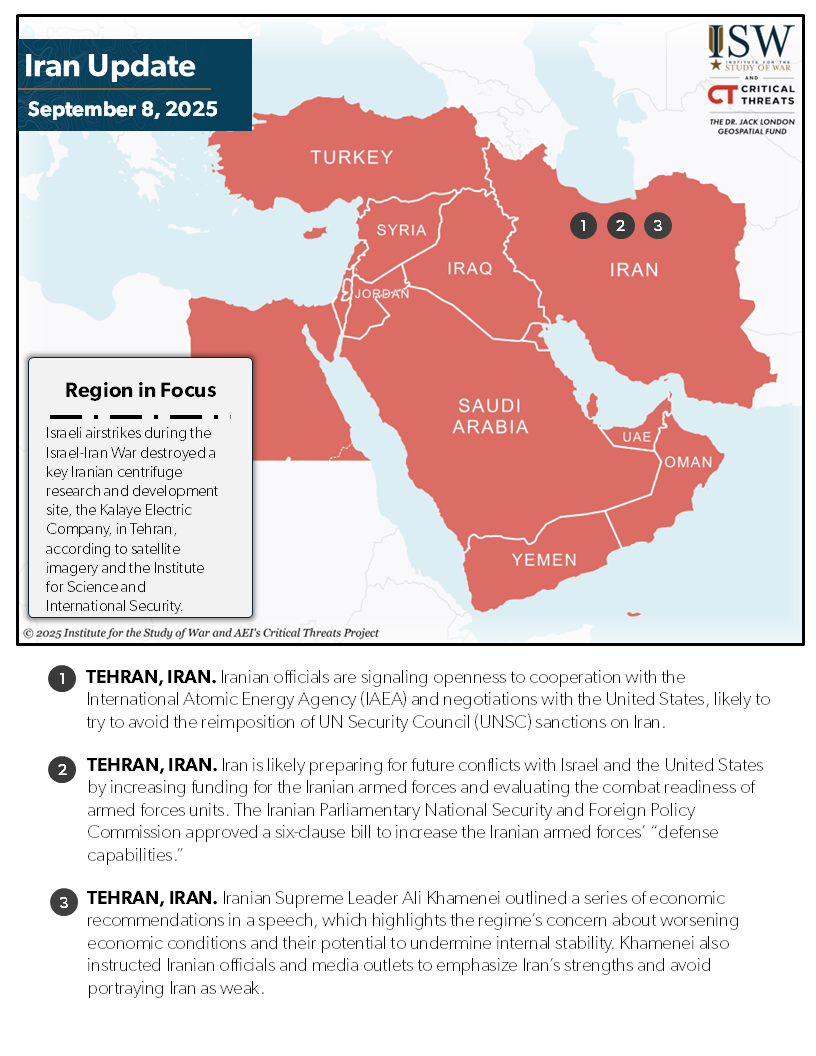
Iranian officials are signaling openness to cooperation with the International Atomic Energy Agency (IAEA) and negotiations with the United States, likely to try to avoid the reimposition of UN Security Council (UNSC) sanctions on Iran. Iranian hardline outlet Farhikhtegan, which is affiliated with Supreme Leader International Affairs Adviser Ali Akbar Velayati, reported on September 8 that the regime has decided to resume negotiations with the United States under the condition that the UNSC does not reimpose sanctions on Iran under the snapback mechanism during negotiations. The E3 (the United Kingdom, France, and Germany) triggered the 30-day snapback mechanism on August 28, which means that UNSC sanctions will automatically be reimposed on Iran on September 27 unless the UNSC extends sanctions relief for Iran. Iranian Foreign Affairs Minister Abbas Araghchi separately published an op-ed in the Guardian on September 7 in which he stated that Iran is ready to accept limits on uranium enrichment and allow extensive international oversight of its nuclear facilities in exchange for sanctions relief. Araghchi specifically directed his op-ed to the E3.
Iran is likely preparing for future conflicts with Israel and the United States by increasing funding for the Iranian armed forces and evaluating the combat readiness of armed forces units. The Iranian Parliamentary National Security and Foreign Policy Commission approved on September 7 a six-clause bill to increase the Iranian armed forces’ “defense capabilities.” The IDF destroyed Iranian air defense systems and achieved air superiority over large parts of Iran during the Israel-Iran War, and Iran likely seeks to bolster its defensive capabilities in preparation for potential future conflicts.
The Institute for Science and International Security reported on September 7 that Israeli airstrikes during the Israel-Iran War destroyed a key Iranian centrifuge research and development site, the Kalaye Electric Company, in Tehran. The Kalaye Electric Company is a subsidiary of the Atomic Energy Organization of Iran and manufactures advanced centrifuges for the Iranian nuclear program. Centrifuges are used to enrich uranium. The United States sanctioned the Kalaye Electric Company in February 2007 for its involvement in Iran’s weapons of mass destruction program. The Institute reported that centrifuge design teams developed new centrifuge models and improved existing ones at the site. Iran also reportedly previously tested advanced IR-8 centrifuges at the site. There have been no repair efforts at the site following the war, according to the Institute. US and Israeli airstrikes during the war targeted Iran’s centrifuge production facilities as well as active centrifuges, which will likely hinder Iran’s ability to enrich uranium in the near future.
|