|
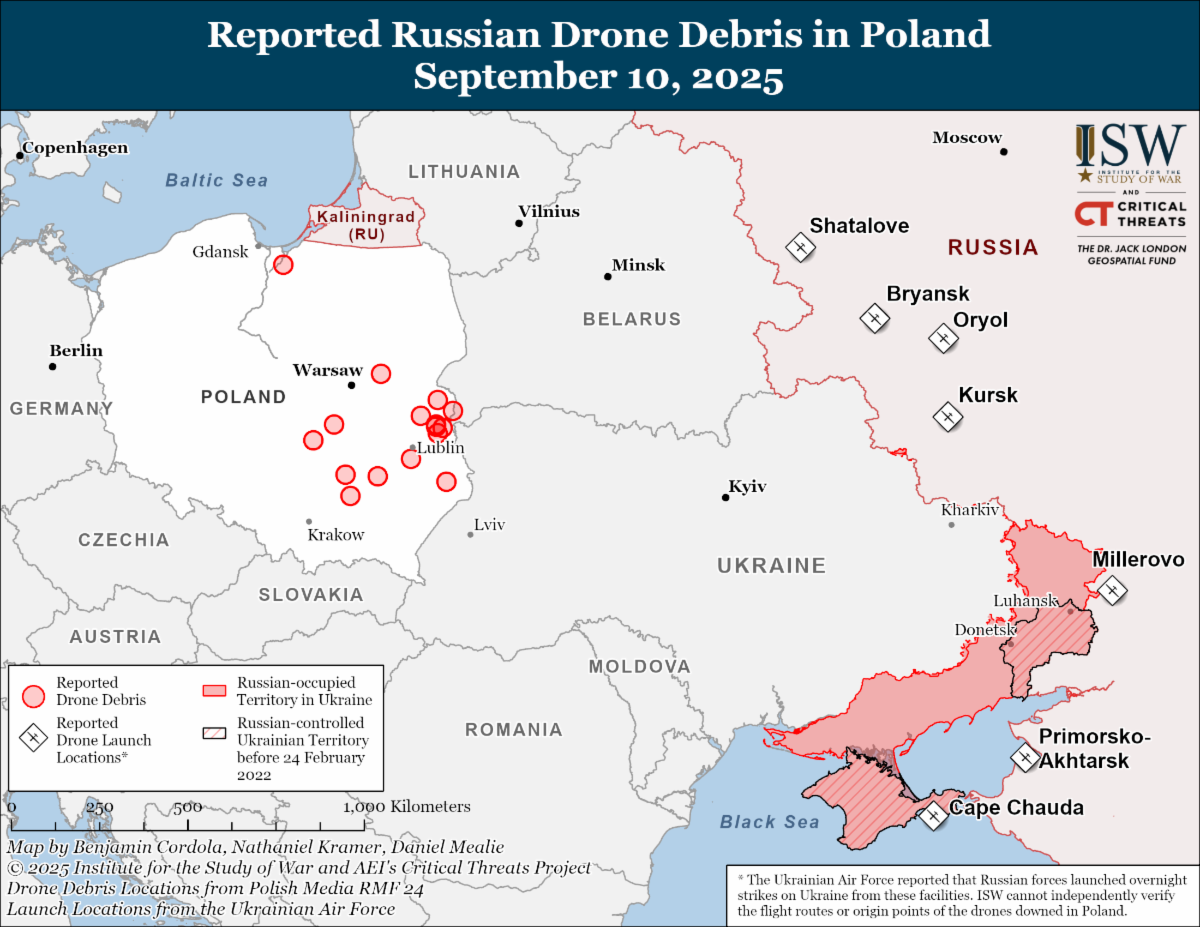
Russian drones violated Polish airspace on the night of September 9 to 10 in what NATO and European officials have suggested was an intentional Russian incursion. Polish Prime Minister Donald Tusk stated on September 10 that at least 19 drones violated Polish airspace overnight and that a significant portion of the drones entered the country from airspace over Belarus. Tusk confirmed that Poland shot down three drones and possibly downed a fourth as of the afternoon of September 10. Tusk noted that Polish authorities are still confirming the number of drones that violated Polish airspace and the number of downed drones. Tusk reported that the aerial incursion lasted about seven hours, starting at 2330 local time on September 9 until 0630 on September 10. Ukrainian President Volodymyr Zelensky stated that as many as 24 Russian drones entered Polish airspace overnight. NATO Secretary General Mark Rutte reported that NATO scrambled Polish F-16 fighter jets, Dutch F-35 fighter jets, Italian airborne early warning and control (AWACS) planes, and NATO mid-air refueling aircraft in order to intercept the drones over Poland. NATO Supreme Headquarters Allied Powers Europe (SHAPE) reported on September 10 that Polish authorities put German Patriot air defense systems on alert in response to the incursion, and Rutte confirmed that German Patriots participated in efforts to repel the drone incursion. Tusk invoked Article 4 of the NATO Treaty on the morning of September 10 in response to the incursion. Article 4 states that a NATO member state can call a meeting to consult on any issue in which the “territorial integrity, political independence, or security of any Parties is threatened” and that fellow member states are encouraged to respond to the situation. NATO states last invoked Article 4 with the start of Russia’s full-scale invasion of Ukraine in February 2022.
The large number of Russian drones that violated Polish airspace suggests that this was likely an intentional Russian effort. Tusk stated that this is the first time that a significant portion of the drones entered Polish airspace from the direction of Belarus and that the scale of the incursion was unusual. Tusk stated that previous Russian drone incursions of Polish airspace were due to “mistakes” (possibly referring to operator error), drone disorientation from electronic warfare (EW), or the result of smaller scale Russian provocations. Russian opposition outlet Verstka reported on September 10 that drones have entered Polish airspace six times during the full-scale invasion, with the first occurrence in November 2022, and that a total of at least seven drones and one missile have fallen on Polish territory during the war. The September 9-10 incursion of at least nineteen drones in a single night is notable and is roughly three times the number of projectiles that have fallen in Poland in the entire war. It is unlikely that such a number of drones could have all entered into Polish airspace by accident or as a result of a technical or operator error.
At least some of the drones that violated Polish airspace were Gerbera decoy drones, and Russia may have been preparing for an incursion of this size into Polish airspace since Summer 2025. A Polish military official stated to Reuters on September 10 that at least some of the Russian drones in Polish airspace were Gerbera drones. Ukrainian electronic and radio warfare expert Serhiy “Flash” Beskrestnov posted an image on September 10 of one of the downed drones and reported that it was a non-reconnaissance version of a Gerbera decoy drone without cameras. The Russian Gerbera drone is a decoy drone designed to mimic Shahed- and Geran-type drones in order to overwhelm Ukrainian air defenses. Beskrestnov also reported that he has documented Russian Shahed-type drones with Polish SIM cards recently. Polish journalist Marek Budzisz reported on July 10 that a report written by unspecified sources and published on July 2 stated that the Ukrainian military had recovered Russian drones with Polish and Lithuanian SIM cards and that these SIM cards could indicate Russian preparations to test strike corridors in Poland and Lithuania. Russia may have been preparing for the September 9-10 incursion for months, further indicating that the incursion was not an accident or the result of Ukrainian EW interference.
|