|
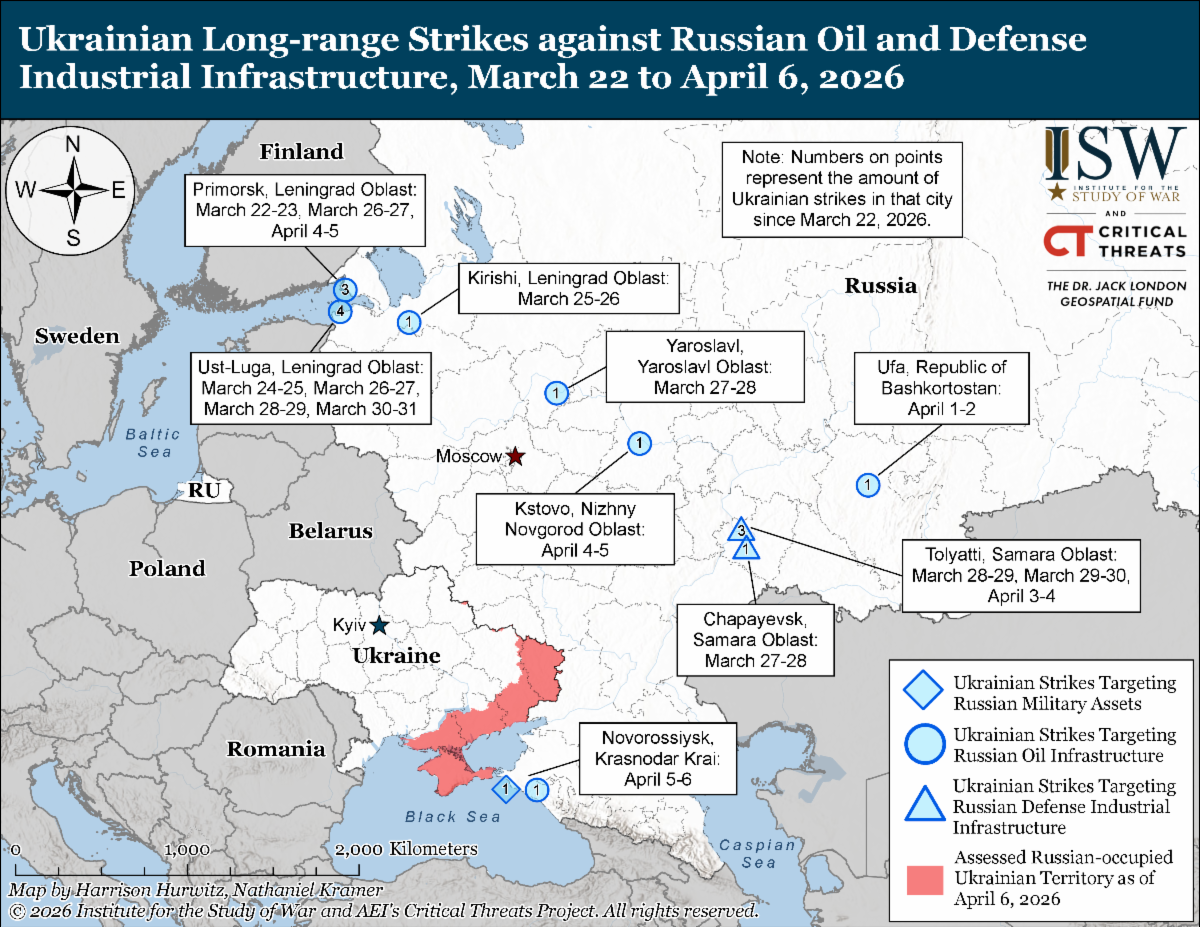
Ukraine’s expanding long-range strike campaign against Russian oil infrastructure is exploiting overstretched Russian air defenses and significantly damaging Russian oil export capabilities. The Ukrainian General Staff reported on April 6 that Ukrainian forces struck the Sheskharis oil terminal near the port of Novorossiysk, Krasnodar Krai overnight on April 5 to 6, starting a large fire. Geolocated footage published on April 6 shows fires at oil tanker berths at the port of Novorossiysk. The Russian Ministry of Defense (MoD) acknowledged on April 6 that Ukrainian forces struck oil terminals in Novorossiysk. Two industry sources told Reuters on April 6 that the fires covered the main pier belonging to Russian state-controlled petroleum company Transneft near three oil tanker berths. NASA Fire Information for Resource Management System (FIRMS) data shows heat anomalies at the Sheskharis oil terminal starting on April 5. Ukrainian Unmanned Systems Forces (USF) Commander Major Robert “Magyar” Brovdi reported that Ukrainian forces also struck the Admiral Makarov Admiral Grigorovich-class frigate in the port of Novorossiysk overnight. Geolocated footage published on April 6 shows Ukrainian drones striking a Russian Admiral Grigorovich-class frigate in the port of Novorossiysk.
Russian milbloggers continued to criticize the ineffectiveness of Russian air defense systems and highlight the impact of Ukrainian strikes. A Kremlin-affiliated Russian milblogger stated on April 6 that the constant Ukrainian strikes against Russian facilities are “stretching” Russian surface-to-air missile air defense forces “to the limit” and exhausting ammunition “at an accelerated rate” as Russia cannot simply produce “thousands” of missiles for Pantsir air defense systems “out of thin air.” The milblogger stated that these limitations render ineffective Russian information space suggestions that Russia increase surface-to-air missile and air defense system production and encouraged Russian forces to adapt the Ukrainian emphasis on mobile fire groups, interceptor drones, and acoustic reconnaissance systems. Russian milbloggers also highlighted the resources consumed by repairing damage from Ukrainian strikes, daytime Ukrainian drone strikes exhausting Russian air defense, the systematic nature of the Ukrainian long-range drone strikes, and the vulnerability of Russian warships stationed at bases within Ukrainian drone range.
The Russian military is experiencing manpower challenges and is unable to recruit enough contract soldiers to replace its frontline losses. Ukraine’s “I Want to Live” initiative reported on April 6 that the Russian Ministry of Defense (MoD) recruited fewer soldiers in the first three months of 2026 than it would need to be on track to meet its 2026 recruiting target of 409,000 contract soldiers. The initiative reported that the Russian MoD would need to recruit 1,100-1,150 soldiers a day to meet its annual recruiting target but was only able to recruit an average of 940 contract soldiers a day in the first three months of 2026. The initiative reported that the MoD plans to recruit most heavily in the Central and Volga federal districts and to continue to recruit in occupied Ukraine. The initiative noted that about 24 percent of all contract soldiers were under criminal investigation or conviction, and that nearly 40 percent of these were debtors.
|