[ISW] 이란 업데이트 특별 보고서, 2026년 4월 10일

“`html

핵심 내용 요약:

  • 이란 대표단, 파키스탄에 도착 (4월 10일): 이란 대표단은 4월 11일 예정된 협상을 앞두고 4월 10일 이슬라마바드에 도착했습니다. 미국 부통령 JD 밴스는 도널드 트럼프 대통령의 엄격한 지침에 따라 4월 10일 파키스탄으로 출발했습니다.
  • 중동 휴전 조건 준수 여부 불확실: 공개적으로 이용 가능한 상호 합의된 서면 휴전 문서가 부족하여 중동 휴전 조건이 준수되고 있는지 여부를 판단하기는 여전히 어려울 것입니다.
  • 트럼프 대통령의 경고: 도널드 트럼프 전 미국 대통령은 4월 10일 Truth Social에서 이란이 호르무즈 해협에서 “단기적인 갈취”를 하고 있으며, 이란 지도부는 “카드가 없기” 때문에 협상에 임하고 있다고 경고했습니다.
  • 핵심 쟁점에서의 입장 변화 없음: 과거 협상에서 미국과 이란 모두 핵 농축 제한, 고농축 우라늄 비축량, 미사일 프로그램, 제재 및 동결 자산 접근 등 핵심 쟁점에 대한 입장에 대해 공개적인 변화를 보이지 않았습니다. 현재 이러한 쟁점에는 호르무즈 해협도 포함됩니다.
  • 이란 협상팀의 분열: 미국-이란 휴전 회담은 명확한 임무와 통일된 입장을 가진 단일 대표단이 아닌, 경쟁하는 정치, 군사, 안보 세력으로 구성된 이란 협상팀의 분열된 성격으로 인해 복잡합니다.
  • 쿠웨이트, 이란 드론 격추: 쿠웨이트 국방부 대변인은 4월 10일 쿠웨이트군이 지난 24시간 동안 쿠웨이트 영공에서 7대의 이란 드론을 탐지하고 격추했다고 밝혔습니다.
  • 이란 지원 민병대의 공격: 이란이 지원하는 이라크 민병대는 4월 8일 바그다드 국제공항 근처에서 미국 대사관 직원을 공격하기 위해 1인칭 시점 (FPV) 드론을 사용했을 가능성이 있습니다. 이라크 당국이 공항 공격과 동일한 시설에 대한 FPV 드론 공격과 관련된 IRGC(이란 혁명 수비대) 장교를 체포한 것은 IRGC가 민병대에 지침을 제공하고 이라크에서 미국 인력에 대한 공격을 지원하고 있다는 추가 증거입니다.
  • 헤즈볼라의 공격: 헤즈볼라는 4월 9일 오후 2시(ET)부터 4월 10일 오후 2시(ET)까지 남부 레바논에서 이스라엘군을 상대로 49건의 공격을, 북부 및 남부 이스라엘에서 IDF (이스라엘 방위군) 기반 시설 및 이스라엘 지역 사회를 상대로 43건의 공격을 감행했다고 주장했습니다.
  • 이란 은행의 위기: 이란 은행은 상태가 좋지 않으며, 현재의 어려움으로 인해 은행이 위기 또는 파산으로 내몰릴 위험이 있다는 경고를 받았습니다. 이란 정부와 가까운 익명의 정치 소식통은 4월 8일 로이터 통신에 이란 관리들이 경제를 이란의 “아킬레스건”으로 보고 있으며, 경제 악화가 정권의 통치 능력을 위협할 수 있다고 우려하고 있다고 전했습니다.
  • 이란의 우라늄 시설 접근 제한 시도: 과학 및 국제 안보 연구소는 4월 9일 이란이 에스파한주 에스파한 핵 기술 센터(ENTC)에 저장된 고농축 우라늄에 도달하거나 압류하기 위한 지상 작전을 제한하거나 복잡하게 만들기 위해 터널 단지에 대한 접근을 제한하려는 의도를 가지고 있을 가능성이 있다고 보고했습니다.

관련 최신 자료 및 링크:

주의: 위에 제시된 링크의 내용이 현재 시점과 다를 수 있으므로, 최신 정보를 확인하시기 바랍니다. 특히 뉴스 기사는 시간이 지남에 따라 정보가 업데이트되거나 삭제될 수 있습니다.

“`

[원문]

The Iranian delegation arrived in Islamabad on April 10 ahead of planned negotiations on April 11.

April 10, 2026

Data Cutoff: 2:00 PM ET

Ben Rezaei, Katherine Wells, Parker Hempel, Carolyn Moorman, William Doran, Avery Borens, and Brian Carter

As the Middle East crisis evolves, ISW urgently needs your support.

Help us stay independent and impactful.

TOPLINES

The Iranian delegation arrived in Islamabad on April 10 ahead of planned negotiations on April 11. US Vice President JD Vance departed for Pakistan on April 10, operating under strict guidance from President Donald Trump. Jared Kushner and US Special Envoy to the Middle East Steve Witkoff are also part of the US negotiating team, which also reportedly includes officials from the Pentagon, National Security Council, and State Department. CBS reported that the negotiating teams are expected to remain in Pakistan even if Vance departs. A Pakistani source familiar with April 11 talks told Reuters that “everything is on track,” citing de‑escalation in Lebanon as a “good sign,” and confirmed that advance teams from both Iran and the United States are already in place in Islamabad.

It will remain difficult to determine whether the Middle East ceasefire conditions are being upheld, given the lack of mutually agreed-upon, written ceasefire documents available to the public. Iranian officials are using this ambiguity to frame the United States and its partners as aggressors who are attempting to collapse the ceasefire, which is far from clear. Iranian officials, including Iranian Parliament Speaker Mohammad Bagher Ghalibaf and Foreign Affairs Minister Abbas Araghchi, who are leading the Iranian negotiating delegation, insist that Lebanon must be included in the ceasefire and that Iran will be able to restrict shipping in the Strait of Hormuz as part of the ceasefire. Ghalibaf wrote on X on April 10 that two ”mutually agreed“ measures — a ceasefire in Lebanon and the release of Iran’s blocked assets — must be implemented before negotiations begin. There is zero public evidence that any of these measures were ever included in the ceasefire by either party. It is additionally unclear whether the ceasefire extends to Iraq, for example, where Iranian-backed groups ambushed US diplomats on April 8. President Masoud Pezeshkian told Turkish President Recep Tayyib Erdogan during a phone call on April 9 that the ceasefire depends on US commitments, while Araghchi separately stressed Lebanon’s centrality to the ceasefire in a call with Iran’s ambassador in Beirut.

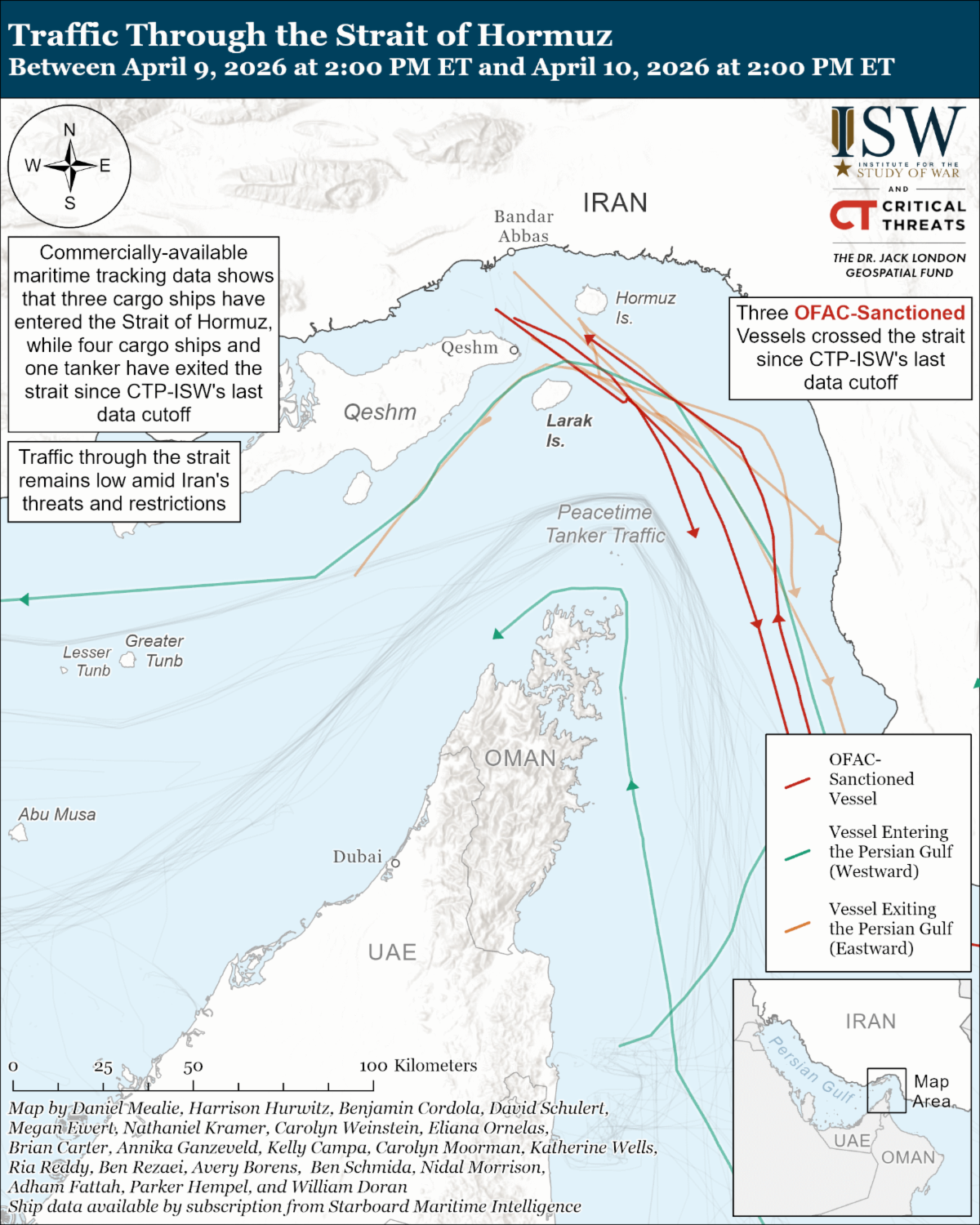
Iranian media reported on April 10 that Iranian parliamentarians are preparing to vote on a strategic Strait of Hormuz plan that would prohibit ”hostile” shipping (which would include US, Israel, and other vessels), require transit fees in rials, and mandate use of the term “Persian Gulf." This plan would force crews or countries to negotiate for safe passage through the international waterway, which would have economic impacts because it implies that Iran’s conditions in these negotiations could change at any time and for any reason. An Iranian analyst close to the regime argued that the US-Iran War has reshaped Iran’s security doctrine and deterrence posture, referring to Iran’s control of the Strait. An agreement that allows Iran to restrict shipping in the Strait, tax it, or otherwise threaten international shipping and keep energy prices high for the consumer. Some shipping firms are calling on tankers not to pay Iran‘s toll, as it is a violation of freedom of navigation. Even without a formal toll system, Iran is aware that it can coerce other powers in the future by threatening shipping through the strait.

KEY TAKEAWAYS

  • The Iranian delegation arrived in Islamabad on April 10 ahead of planned negotiations on April 11. US Vice President JD Vance departed for Pakistan on April 10, operating under strict guidance from President Donald Trump.

  • It will remain difficult to determine whether the Middle East ceasefire conditions are being upheld, given the lack of mutually agreed-upon, written ceasefire documents available to the public. 

  • US President Trump warned on Truth Social on April 10 that Iran is engaging in “short‑term extortion” in the Strait of Hormuz and said that its leadership is negotiating only because it has “no cards.”

  • Neither the US nor Iran has signaled any public shift on their stances on key issues in previous negotiations, which include nuclear enrichment limits, the highly enriched uranium stockpile, the missile program, sanctions, and access to frozen assets. Now these sticking points include the Strait of Hormuz as well. 

  • The US-Iran ceasefire talks are complicated by the fragmented nature of the Iranian negotiating team, composed of competing political, military, and security factions, rather than a unified delegation with a clear mandate and unified positions. 

  • The Kuwaiti Ministry of Defense spokesperson stated on April 10 that Kuwaiti armed forces detected and engaged seven Iranian drones in Kuwaiti airspace over the past 24 hours.

  • Iranian-backed Iraqi militias probably used first-person view (FPV) drones to ambush US Embassy personnel near the Baghdad International Airport on April 8. The Iraqi authorities’ arrest of an IRGC officer connected to militia attacks on the airport and the claimed FPV drone attack against the same facility is further evidence that the IRGC is providing guidance to the militias and supporting their attacks on US personnel in Iraq. 

  • Hezbollah claimed that it conducted 49 attacks targeting Israeli forces in southern Lebanon and 43 attacks targeting IDF infrastructure and Israeli communities in northern and southern Israel between 2:00 PM ET on April 9 and 2:00 PM ET on April 10.

  • Iranian banks are in poor condition and are warned that current challenges risk pushing banks toward crisis or bankruptcy. Unspecified political insiders close to the Iranian establishment also told Reuters on April 8 that Iranian officials viewed the economy as Iran’s “Achilles heel” and feared that economic deterioration could threaten the regime’s ability to govern.

  • The Institute for Science and International Security reported on April 9 that Iran likely aims to restrict access to the tunnel complex and delay or complicate any ground operation to reach or seize the highly enriched uranium stored at the Esfahan Nuclear Technology Center (ENTC) in Esfahan Province.

EMAIL SUBSCRIPTION OPTIONS

ISW offers customizable email subscription options. Click below to learn more and customize your preferences.

Website | Jobs | Internships

Follow ISW on social media:

FacebookXYouTube | InstagramLinkedIn | Threads | Bluesky

© 2026 Institute for the Study of War and AEI’s Critical Threats Project. All rights reserved.

Donate online or by sending a check to the Institute for the Study of War at 1400 16th Street NW, Suite #515, Washington, DC 20036. Please consider including the Institute for the Study of War in your estate plans.

ISW is a tax-exempt organization under section 501(c)(3) of the Internal Revenue Code. Donations are tax-deductible to the extent permitted by law.

ISW is a non-partisan, non-profit, public policy research organization. ISW advances an informed understanding of military affairs through reliable research, trusted analysis, and innovative education. We are committed to improving the nation’s ability to execute military operations and respond to emerging threats in order to achieve US strategic objectives.

댓글 달기

이메일 주소는 공개되지 않습니다. 필수 필드는 *로 표시됩니다

위로 스크롤