[ISW] 러시아 공세 캠페인 평가, 2025년 8월 26일

“`html

핵심 내용

핵심 내용

  • 미국은 우크라이나 전후 안보 보장의 일환으로 유럽 주도의 군사력에 지원 자산을 제공할 의향이 있는 것으로 알려졌습니다. 크렘린은 최근 몇 주 동안 우크라이나에 대한 안보 보장의 일환으로 NATO 국가의 군대 주둔을 반복적으로 거부했습니다.
  • 미국은 인도의 러시아산 원유 지속 구매로 인해 인도의 대미 수출품에 추가 25% 관세를 부과할 것입니다.
  • 최근 우크라이나의 러시아 정유 공장 공격은 러시아 전역의 휘발유 부족을 초래하여 인플레이션을 상승시키고 러시아의 거시 경제적 불안정을 더욱 야기할 가능성이 높습니다.
  • 러시아 정부는 블라디미르 푸틴 러시아 대통령이 고문 및 비인간적 또는 굴욕적인 대우 또는 처벌 방지를 위한 유럽 협약에서 탈퇴할 것을 제안했습니다.
  • 국경 지역의 러시아 주민들은 전쟁에 대해 점점 더 무관심해지고 러시아가 가까운 미래에 전쟁을 종식하는 데 동의하지 않을 것이라는 점을 받아들이고 있습니다.
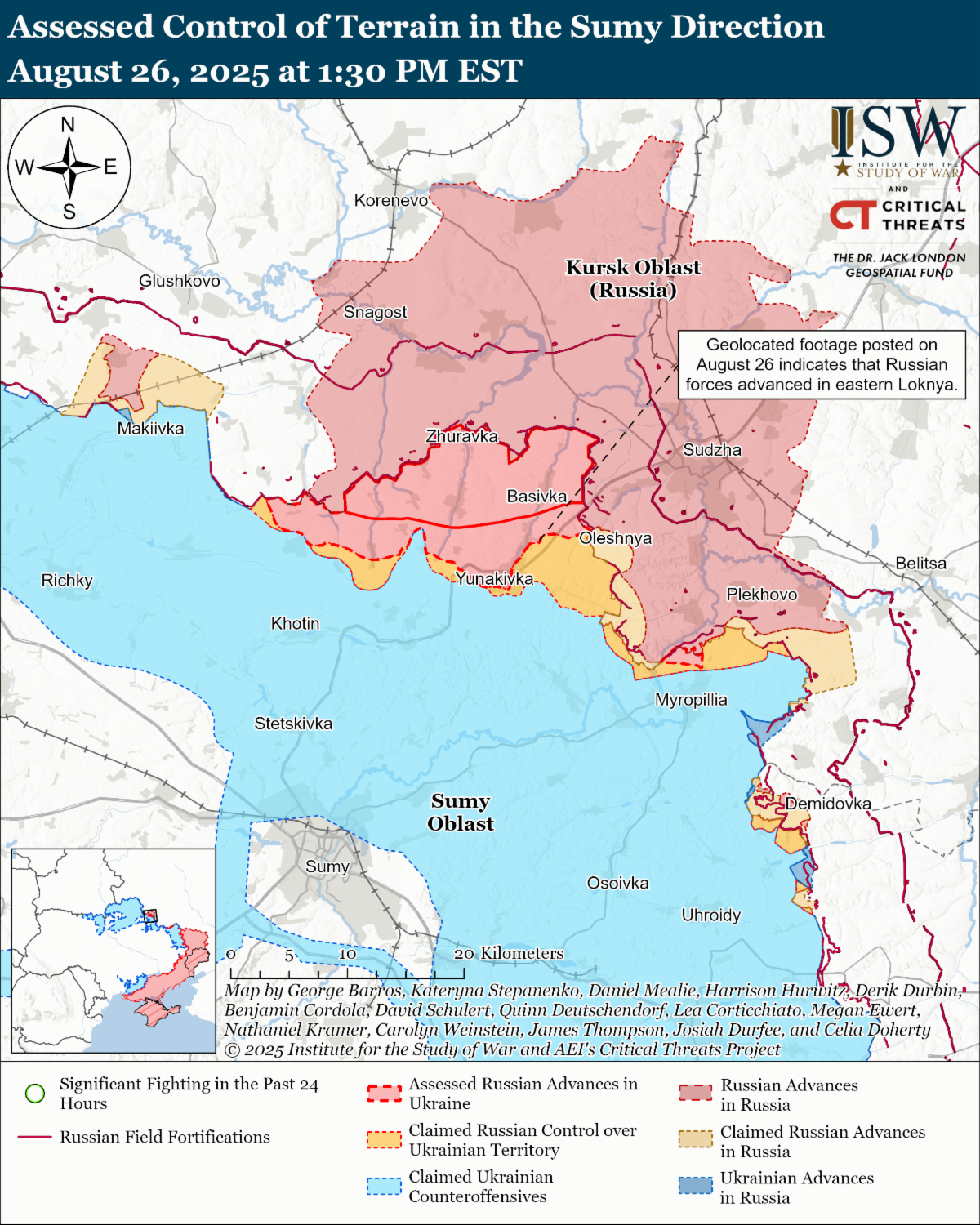
  • 최근 우크라이나군은 수미와 보로바 인근에서 진격했습니다. 러시아군은 최근 수미 인근에서 진격했습니다.

관련 최신 자료 및 링크

“`
**참고:**

* **링크 내용 확인:** 위 링크들은 현재 시점에서 유효하고 관련 정보를 포함하고 있는 것으로 판단됩니다. 하지만 웹사이트는 수시로 업데이트되므로, 링크된 페이지에서 원하는 정보를 찾을 수 없는 경우도 있을 수 있습니다.
* **영문 번역:** 위의 HTML에서 영어가 사용된 부분은 다음과 같습니다: “Key Takeaways”, “EU”, “NATO”, “CFR”, “IMF”, “ISW”. 해당 영문은 원문의 의미를 유지하면서도 한국어로 번역하지 않았습니다. (예: “EU (유럽 연합)”, “NATO (북대서양 조약 기구)”와 같이 추가적인 설명이 필요한 경우에만 번역을 고려할 수 있습니다.) 나머지 영어 문장은 이미 한국어로 번역되어 있습니다.
* **최신 정보:** 우크라이나 전쟁과 관련된 상황은 매우 빠르게 변화하므로, 위의 링크를 통해 최신 정보를 지속적으로 확인하는 것이 중요합니다.
* **추가 정보:** 위에 제시된 링크 외에도 다양한 뉴스 매체, 연구 기관, 정부 기관의 웹사이트에서 관련 정보를 얻을 수 있습니다. 예를 들어, 국내 뉴스 매체 (중앙일보, 조선일보, 한겨레 등), 외신 (BBC, CNN, AP 통신 등)에서 우크라이나 전쟁 관련 기사를 확인할 수 있습니다.
* **정확성:** 본 번역은 주어진 원본 텍스트를 최대한 정확하게 반영하려고 노력했습니다. 하지만, 내용의 복잡성으로 인해 완벽한 정확성을 보장하지는 않습니다. 더 자세한 정보를 얻기 위해서는 원본 자료와 관련 자료를 함께 참고하는 것이 좋습니다.

[원문]

The United States is reportedly willing to supply supporting assets to a European-led force grouping as part of postwar security guarantees for Ukraine. The Kremlin has repeatedly rejected the presenc

August 26, 2025

Information Cutoff: 12:30 pm ET

Jennie Olmsted, Christina Harward, Anna Harvey, Justin Young, and Frederick W. Kagan with Nate Trotter

TOPLINES

The United States is reportedly willing to supply supporting assets to a European-led force grouping as part of postwar security guarantees for Ukraine. The Kremlin has repeatedly rejected the presence of troops from NATO countries as part of any security guarantee for Ukraine in recent weeks. The Financial Times (FT) reported on August 26 that official Ukrainian and European sources stated that senior US officials told European officials recently that the United Stated would be prepared to contribute "strategic enablers," such as intelligence, surveillance, and reconnaissance (ISR); command and control (C2); and air defense assets, to support a future European-led deployment on the ground in postwar Ukraine as part of security guarantees for Ukraine. European officials reportedly stated that European states can only deploy troops to Ukraine with US support that enables, oversees, and protects the European ground troops. FT reported that officials stated that US postwar support would include US aircraft, logistics, and ground-based radar that would support and enable a European-enforced no-fly zone and air shield for Ukraine. The official sources commented that such US support is contingent on European states’ commitment to deploy "tens of thousands" of troops to Ukraine. Three of the officials reportedly stated that Ukrainian troops would defend behind a demilitarized zone that neutral peacekeeping troops would patrol. NATO states would reportedly arm and train these Ukrainian forces. A European-led "deterrence force" would reportedly operate deeper in Ukraine as a "third line of defense," and US assets would operate further in the rear.

High-ranking Kremlin officials have repeatedly rejected Western security guarantees for Ukraine and specifically the presence of troops from NATO countries as part of such guarantees, however. Russian Foreign Minister Lavrov recently stated in an interview with NBC that Western states, including the United States, should not be allowed to be responsible for Ukraine’s post-war security. Russian Ministry of Foreign Affairs (MFA) Spokesperson Maria Zakharova similarly said on August 18 that Russia "categorical[ly] reject[s]" "any scenario that envisages the appearance in Ukraine of a military contingent with the participation of NATO countries." The Kremlin would likely reject a US and European security guarantee proposal like the one US and European officials are reportedly discussing.

The United States will impose an additional 25 percent tariff on India’s exports to the United States due to India’s ongoing purchases of Russian oil. Reuters reported on August 26 that the US Department of Homeland Security confirmed that the US will impose an additional 25 percent tariff on Indian exports to the United States starting August 27, increasing total tariffs to 50 percent. India is one of the largest importers of Russian oil, and India currently imports roughly 37 percent of its oil from Russia — up from approximately two percent before Russia’s full-scale invasion of Ukraine in February 2022. Bloomberg reported on August 26 that India’s oil refiners are planning to cut back their purchases of Russian crude oil in response to the increased US tariffs, but have signaled no plans to completely end purchases from Russia. Familiar sources told Bloomberg that both India’s state-run and private processors will likely decrease purchases to between 1.4 to 1.6 million barrels per day, down from a monthly average of 1.8 million barrels per day throughout 2025 thus far. Reductions in Indian refiners’ purchases of Russian oil over a sustained period of time will likely place significant restraints on Russia’s ability to fund its war machine. ISW continues to assess that secondary sanctions will likely further impact the Russian economy by undercutting Russian oil revenues that are essential for the Kremlin’s financing of its war against Ukraine.

KEY TAKEAWAYS

  • The United States is reportedly willing to supply supporting assets to a European-led force grouping as part of postwar security guarantees for Ukraine. The Kremlin has repeatedly rejected the presence of troops from NATO countries as part of any security guarantee for Ukraine in recent weeks.

  • The United States will impose an additional 25 percent tariff on India’s exports to the United States due to India’s ongoing purchases of Russian oil.

  • Recent Ukrainian strikes on Russia’s oil refineries have contributed to gasoline shortages across Russia that will likely raise inflation and cause further macroeconomic instability in Russia.

  • The Russian government proposed that Russian President Vladimir Putin withdraw from the European Convention for the Prevention of Torture and Inhuman or Degrading Treatment or Punishment.

  • Russian residents in border areas are increasingly apathetic toward the war and accepting that Russia will not agree to end to the war in the near future.

  • Ukrainian forces recently advanced near Sumy and Borova. Russian forces recently advanced near Sumy.

NEW EMAIL SUBSCRIPTION OPTIONS

ISW has launched newly customizable email subscription options. Existing subscribers have been auto enrolled in all lists. Click below to learn more about these options and customize your preferences.

ISW is powered by the support of individuals like you.

Help us stay independent and impactful.

Website | Jobs & Internships

Follow ISW on social media:

FacebookXYouTube | InstagramLinkedIn | Threads | Bluesky

Donate online or by sending a check to the Institute for the Study of War at 1400 16th Street NW, Suite #515, Washington, DC 20036. Please consider including the Institute for the Study of War in your estate plans.

ISW is a tax-exempt organization under section 501(c)(3) of the Internal Revenue Code. Donations are tax-deductible to the extent permitted by law.

ISW is a non-partisan, non-profit, public policy research organization. ISW advances an informed understanding of military affairs through reliable research, trusted analysis, and innovative education. We are committed to improving the nation’s ability to execute military operations and respond to emerging threats in order to achieve US strategic objectives.

댓글 달기

이메일 주소는 공개되지 않습니다. 필수 필드는 *로 표시됩니다

위로 스크롤