[ISW] 러시아 공격 작전 평가, 2026년 4월 20일

“`html

핵심 내용:

  • 스웨덴 정보 평가 보고서는 러시아 경제가 직면한 심각한 문제와, 러시아가 전쟁 노력을 무기한 지속할 수 있다는 허위 주장을 위해 이러한 문제들을 은폐하려는 크렘린의 노력에 대한 ISW의 오랜 평가와 일치합니다.

    ISW (Institute for the Study of War) 보고서 (2024년 6월 5일): 러시아 경제 및 군사 능력에 대한 최신 분석을 제공하며, 러시아의 지속적인 전쟁 노력의 어려움에 대한 평가를 확인할 수 있습니다.
  • 러시아군은 반복되는 우크라이나의 공격으로부터 러시아 인프라를 방어하는 데 계속 어려움을 겪고 있습니다.

    ISW 보고서 (2024년 6월 5일): 러시아 인프라에 대한 우크라이나의 공격과 그 영향에 대한 상세한 분석을 확인할 수 있습니다.
  • 러시아군은 우크라이나 국방부 고문이자 드론 및 전자전 (EW) 전문가인 세르히 “플래시” 베스크레스토프를 암살하기 위해 장거리 자폭 드론을 사용하려 시도했습니다.

    ISW 보고서 (2024년 6월 5일): 러시아의 암살 시도와 관련된 정보를 포함할 가능성이 높으며, 관련 보도 자료나 뉴스 기사를 추가적으로 검색하여 확인할 수 있습니다.
  • 우크라이나는 걸프 국가들과의 협력을 계속 확대하고 있습니다.

    대서양 협의회 (Atlantic Council) 보고서 (2024년 5월 22일): 우크라이나와 걸프 국가 간의 협력 확대를 다루며, 경제, 안보 분야에서의 협력 관계를 심층적으로 분석합니다.
  • 우크라이나군은 최근 보로바 방향과 서부 자포리자주에서 진격했습니다. 러시아군은 최근 북부 수미주와 코스티안티니우카-드루지키우카 및 도브로필리아 전술 지역에서 진격했습니다.

    ISW 보고서 (2024년 6월 5일): 전선 상황에 대한 최신 정보를 제공하며, 해당 지역의 진격 상황을 구체적으로 확인할 수 있습니다.
  • 우크라이나군은 벨고로드주 내 러시아 군사 자산을 상대로 중거리 공격 작전을 지속하여 러시아의 물류를 차단하려 합니다. 러시아는 하룻밤 사이에 우크라이나를 향해 142대의 드론을 발사했습니다.

    ISW 보고서 (2024년 6월 5일): 벨고로드 지역에 대한 공격과 드론 공격에 대한 세부 정보를 확인할 수 있습니다.

“`
**참고:**

* 위의 링크들은 현재 시점에서 관련 정보를 제공하는 자료들을 기반으로 합니다. 상황은 빠르게 변화하므로, 최신 정보를 확인하기 위해 주기적으로 링크를 확인하고 추가적인 자료를 검색하는 것이 좋습니다.
* “ISW”는 Institute for the Study of War의 약자로, 전쟁 연구 기관입니다.
* 번역된 내용과 링크된 자료 간에 일치하는지 확인해야 합니다. 링크 내용이 최신 정보와 일치하는지, 그리고 핵심 내용에 대한 충분한 정보를 제공하는지 확인하는 것이 중요합니다.
* “Russian offensive campaign assessment”는 러시아의 공격 작전 평가를 의미합니다.
* **주의:** 링크된 자료들은 전문적인 분석을 제공하지만, 정보의 정확성을 완전히 보장하지는 않습니다. 여러 출처를 참고하여 정보를 교차 검증하는 것이 좋습니다.

[원문]

Swedish intelligence assessments are consistent with ISW’s longstanding assessments about the significant challenges the Russian economy is facing

April 20, 2026

Assessment as of: 7:00 PM ET

Data Cutoff: 11:45 AM ET

Anna Thacker, Samuel Shafiro, Jessica Sobieski, Justin Young, Diana Nasreddine, Christina Harward, Nikolai Sundstrom, Jakub Kostka, and Frederick W. Kagan

TOPLINES

Swedish intelligence assessments are consistent with ISW’s longstanding assessments about the significant challenges the Russian economy is facing and the Kremlin’s efforts to conceal these issues in order to falsely present Russia as able to sustain its war effort indefinitely. The Financial Times (FT) reported on April 20 that Sweden’s Military Intelligence and Security Service Head Lieutenant General Thomas Nilsson stated that Russia’s economy has failed to recover despite rising oil prices due to the war in the Middle East. Nilsson stated that Russia needs prices for Urals crude to remain over $100 per barrel for at least one year in order to close its budget deficit but that prices would need to remain that high for significantly longer to mitigate Russia’s other economic issues. Nilsson stated that Russia will likely struggle further to finance its war in Ukraine if oil prices stabilize and the ceasefire in the Middle East holds. Nilsson emphasized that an unsustainable growth model that cannot replace Russia’s materiel losses on the battlefield is contributing to Russia’s economic issues. Nilsson noted that defense industrial sectors outside of the drone industry are lossmaking, suffering from corruption, and dependent on loans from state-run banks. Sweden’s military intelligence analysis of Russia’s economic problems is consistent with ISW’s ongoing assessment that Russia’s prioritization of its defense industry is hurting the civilian sectors of the economy and that high battlefield losses are impacting the Russian economy.

Nilsson reported that intelligence indicates that the Kremlin systematically manipulates data to convince the West that Russia’s economy is effectively withstanding the pressure of sanctions and excessive military spending. Nilsson stated that Russian inflation is likely closer to 15 percent even as the Kremlin claims it to be 5.86 percent. Nilsson said that Russia has understated its budget deficit by $30 billion. ISW has long assessed that the true Russian inflation rate is higher than the Kremlin publicly claims and that the Kremlin has been spreading narratives that exaggerate Russia’s strength to support its demands at the negotiating table.

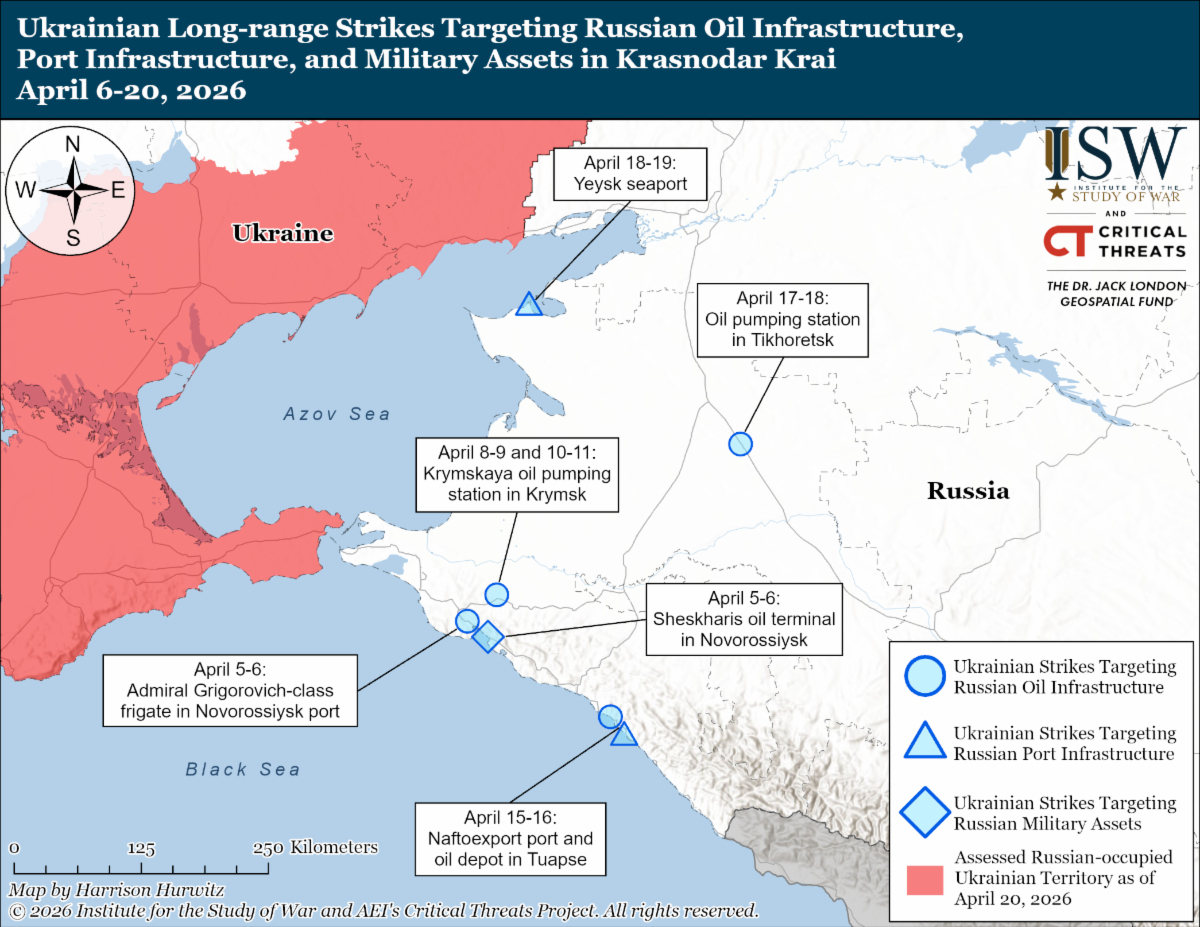
Russian forces continue to struggle to defend Russian infrastructure against repeated Ukrainian strikes. The Ukrainian General Staff reported that Ukrainian forces struck the oil tank farm at the Tuapse oil refinery in Krasnodar Krai on the night of April 19 to 20, causing a fire. Geolocated footage published on April 20 confirms large fires at the refinery. Krasnodar Krai authorities acknowledged the Ukrainian strike and resulting fires. Ukrainian forces have recently launched a wave of strikes against Russian military, energy, and port infrastructure in Krasnodar Krai, including against the Sheskharis oil terminal and an Admiral Grigorovich-class frigate near the port of Novorossiysk on April 5 to 6, the oil pumping station in Krymsk on April 8 to 9 and April 10 to 11, the Naftoexport port and oil depot in Tuapse on April 15 to 16, the oil pumping station in Tikhoretsk on April 17 to 18, and the seaport in Yeysk on April 18 to 19. Russian ultranationalist television network Tsargrad criticized Krasnodar Krai authorities for sending ”beautiful reports” that present false information about the situation to Moscow. Tsargrad complained that Russian authorities are focused on keeping the beaches open for summer tourists despite ongoing Ukrainian drone strikes and recent oil spills. Tsargrad’s criticism of Krasnodar Krai authorities comes as other regional authorities are increasing their response to recent Ukrainian strikes, with Leningrad Oblast Governor Alexander Drozdenko acknowledging the impacts of recent Ukrainian strikes against the oblast and moving to bolster regional air defenses. ISW continues to assess that Russian forces are struggling to defend against Ukrainian strikes as the infrastructure that Ukrainian forces are targeting is widely dispersed across Russia’s vast territory.

KEY TAKEAWAYS

  • Swedish intelligence assessments are consistent with ISW’s longstanding assessments about the significant challenges the Russian economy is facing and the Kremlin’s efforts to conceal these issues in order to falsely present Russia as able to sustain its war effort indefinitely.

  • Russian forces continue to struggle to defend Russian infrastructure against repeated Ukrainian strikes.

  • Russian forces attempted to use long-range one-way strike drones to assassinate Serhiy “Flash” Beskrestnov, a Ukrainian Ministry of Defense (MoD) advisor on defense technology and a drone and electronic warfare (EW) expert.

  • Ukraine continues to expand its cooperation with Gulf States.

  • Ukrainian forces recently advanced in the Borova direction and western Zaporizhia Oblast. Russian forces recently advanced in northern Sumy Oblast and in the Kostyantynivka-Druzhkivka and Dobropillya tactical areas.

  • Ukrainian forces continue their mid-range strike campaign against Russian military assets in Belgorod Oblast that aims to interdict Russian logistics. Russia launched 142 drones against Ukraine overnight.

EMAIL SUBSCRIPTION OPTIONS

ISW offers customizable email subscription options. Click below to learn more and customize your preferences.

ISW is powered by the support of individuals like you.

Help us stay independent and impactful.

Website | Jobs | Internships

Follow ISW on social media:

FacebookXYouTube | InstagramLinkedIn | Threads | Bluesky

© 2026 Institute for the Study of War and AEI’s Critical Threats Project. All rights reserved.

Donate online or by sending a check to the Institute for the Study of War at 1400 16th Street NW, Suite #515, Washington, DC 20036. Please consider including the Institute for the Study of War in your estate plans.


ISW is a tax-exempt organization under section 501(c)(3) of the Internal Revenue Code. Donations are tax-deductible to the extent permitted by law.

ISW is a non-partisan, non-profit, public policy research organization. ISW advances an informed understanding of military affairs through reliable research, trusted analysis, and innovative education. We are committed to improving the nation’s ability to execute military operations and respond to emerging threats in order to achieve US strategic objectives.

댓글 달기

이메일 주소는 공개되지 않습니다. 필수 필드는 *로 표시됩니다

위로 스크롤