|
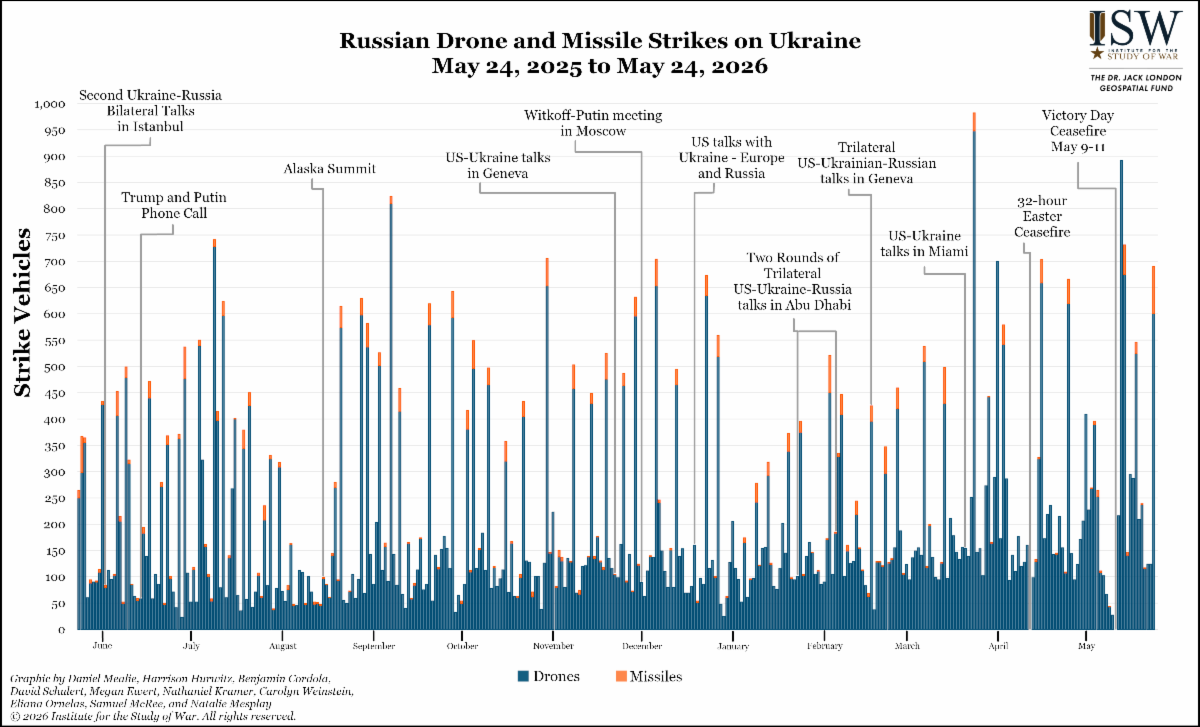
Russia conducted a devastating missile and drone strike, including with an Oreshnik intermediate-range ballistic missile (IRBM), against Ukraine, heavily targeting Kyiv City, on the night of May 23 to 24. The Ukrainian Air Force reported that Russian forces launched 90 missiles, including 36 ballistic missiles, and 600 drones against Ukraine overnight — the largest missile strike against Ukraine thus far in 2026.[1] The Ukrainian Air Force reported that Russian forces launched one IRBM (very likely meaning the Oreshnik IRBM); two Kinzhal hypersonic missiles; three Zircon hypersonic missiles; 30 Iskander-M ballistic missiles/S-300 surface-to-air missiles; 54 Kh-101/Iskander-K/Kalibr cruise missiles; and 600 Shahed, Gerbera, Italmas, and other drones. The Ukrainian Air Force reported that Ukrainian air defenses downed 55 missiles and 549 drones, that 16 missiles and 51 drones struck 54 locations, and that debris fell on 23 locations. The Ukrainian Air Force added that an additional 19 missiles likely did not reach their targets. Ukrainian President Volodymyr Zelensky reported that Russian strikes primarily targeted Kyiv City, including three missiles against a water supply facility, an Oreshnik against Bila Tserkva, and other strikes against civilian and residential infrastructure. Russia notably used an Oreshnik against Kyiv City for the first time — Russia launched Oreshniks against Dnipro City in November 2024 and Lviv City in early 2026. The footage of Russia’s Oreshnik strike against Kyiv City showed six submunition clusters of multiple independently targetable reentry vehicles (MIRV) with each cluster carrying six kinetic rods. The footage appears to show some submunitions approaching their target in a different strike pattern than how the Oreshnik submunitions struck Lviv. Russian forces may have conducted the Oreshnik strike to test and refine their nuclear weapons delivery systems, with one source reporting that the Oreshnik used kinetic energy projectiles in place of a conventional explosive payload. Ukrainian officials reported that Russian strikes killed at least four and injured at least 100 civilians, including killing at least two and injuring at least 81 in Kyiv City alone.Ukrainian officials reported that Russian strikes also targeted Poltava, Kirovohrad, Kharkiv, Kropyvnytskyi, Odesa, Sumy, Zhytomyr, and Cherkasy oblasts.
Russian strikes damaged government buildings and cultural sites in Kyiv City, as the Kremlin threatened it would if Ukraine struck Russia’s May 9 Victory Day celebrations in Moscow City, which Ukraine did not strike. Ukrainian officials reported that Russian strikes damaged the Ukrainian Ministry of Foreign Affairs building, the Cabinet of Ministers building, and the National Art Museum, and destroyed the Chornobyl Museum and Lukianivskyi market. The Kremlin previously threatened to strike “decision-making” centers in Kyiv City, including with an Oreshnik, if Ukrainian forces conducted strikes against Russia’s Victory Day celebrations, which Ukraine did not do. The Kremlin threatened to use Oreshniks in the days leading up to Victory Day, likely intended to obfuscate Russia’s weakness and its inability to reliably defend large portions of Russia’s airspace from Ukrainian deep rear strikes. The Russian strike against Kyiv City is part of Russian President Vladimir Putin’s continued effort to erase his Victory Day parade humiliation, as Putin tries to project strength after his widely criticized parade. Russia’s strike completely violates the spirit of the three-day Victory Day ceasefire, which Ukraine abided by, and demonstrates Putin’s unfaithfulness to any agreements that do not heavily favor him.
|