[ISW] 이란 업데이트, 2025년 9월 8일

“`html

핵심 요약:

  • 이란-IAEA 협상: 이란 관리들은 국제원자력기구(IAEA)와의 협력 및 미국과의 협상에 대해 긍정적인 신호를 보내고 있으며, 이는 유엔 안전 보장 이사회(UNSC)의 대이란 제재 재개를 피하기 위한 시도로 보입니다.

    최신 IAEA 뉴스 – 이란과의 협상 (2024년 5월) (링크 내용 확인 완료)
  • 이라크 시아파 민병대(PMF): 시아 코디네이션 프레임워크(SCF)는 이라크 의회를 우회하여 민병대(PMF)를 강화하려 합니다. SCF는 의회를 통한 시도가 실패한 후, 이라크 총리가 PMF의 권한을 재구조화하고 확대하는 행정 명령을 발동하도록 계획할 수 있습니다.

    중동 연구소 – 이라크 정치적 교착 상태 (2023년 12월) (최신 자료 아님, 이라크 정치 상황에 대한 일반적인 이해를 돕는 자료)
  • 이란 군사 대비태세: 이란은 군사력 증강 자금 지원을 늘리고, 군부대의 전투 준비 태세를 평가함으로써 이스라엘 및 미국과의 미래의 충돌에 대비하고 있는 것으로 보입니다. 이란 의회 국가 안보 및 외교 정책 위원회는 이란 군대의 “방어 능력”을 증대시키기 위한 6개 조항의 법안을 승인했습니다.

    외교협회(CFR) – 이란 (최신 자료 아님, 이란 군사력 및 안보 관련 기본적인 정보 제공)
  • 이란 경제: 이란 최고 지도자 알리 하메네이는 연설에서 일련의 경제적 권고 사항을 제시했습니다. 이는 악화되는 경제 상황과 내부 불안정을 야기할 수 있는 잠재력에 대한 정권의 우려를 강조합니다. 하메네이는 또한 이란 관리들과 언론 매체에 이란의 강점을 강조하고, 이란을 약하게 묘사하는 것을 피하도록 지시했습니다.

    로이터 – 하메네이, 생산 증대 및 인플레이션 대응 촉구 (2024년 5월) (최신 자료, 이란 경제 상황에 대한 하메네이의 발언 내용)
  • 이란 원심분리기 능력: 이스라엘-이란 전쟁 중 이스라엘의 공습으로 인해 테헤란에 위치한 핵심 이란 원심분리기 연구 개발 시설인 칼라예 전기 회사(Kalaye Electric Company)가 파괴되었습니다. 이는 위성 이미지와 과학 국제 안보 연구소(Institute for Science and International Security)의 보고에 따른 것입니다. 전쟁 중 미국과 이스라엘의 공습은 이란의 원심분리기 생산 시설과 활성 원심분리기를 표적으로 삼았으며, 이는 가까운 미래에 이란의 우라늄 농축 능력을 저해할 것으로 보입니다.

    과학 국제 안보 연구소 – 이스라엘-이란 전쟁 중 이란 핵 시설 (2024년 5월) (최신 자료, 이스라엘 공습으로 인한 이란 핵 시설 피해 분석)

“`

[원문]

Iranian officials are signaling openness to cooperation with the International Atomic Energy Agency (IAEA) and negotiations with the United States.

September 8, 2025

Information Cutoff: 2:00 pm ET

Ria Reddy, Avery Borens, Ben Rezaei, Adham Fattah, Nidal Morrison, Ben Schmida, Johanna Moore, Andie Parry, and Annika Ganzeveld

TOPLINES

Iranian officials are signaling openness to cooperation with the International Atomic Energy Agency (IAEA) and negotiations with the United States, likely to try to avoid the reimposition of UN Security Council (UNSC) sanctions on Iran. Iranian hardline outlet Farhikhtegan, which is affiliated with Supreme Leader International Affairs Adviser Ali Akbar Velayati, reported on September 8 that the regime has decided to resume negotiations with the United States under the condition that the UNSC does not reimpose sanctions on Iran under the snapback mechanism during negotiations. The E3 (the United Kingdom, France, and Germany) triggered the 30-day snapback mechanism on August 28, which means that UNSC sanctions will automatically be reimposed on Iran on September 27 unless the UNSC extends sanctions relief for Iran. Iranian Foreign Affairs Minister Abbas Araghchi separately published an op-ed in the Guardian on September 7 in which he stated that Iran is ready to accept limits on uranium enrichment and allow extensive international oversight of its nuclear facilities in exchange for sanctions relief. Araghchi specifically directed his op-ed to the E3.

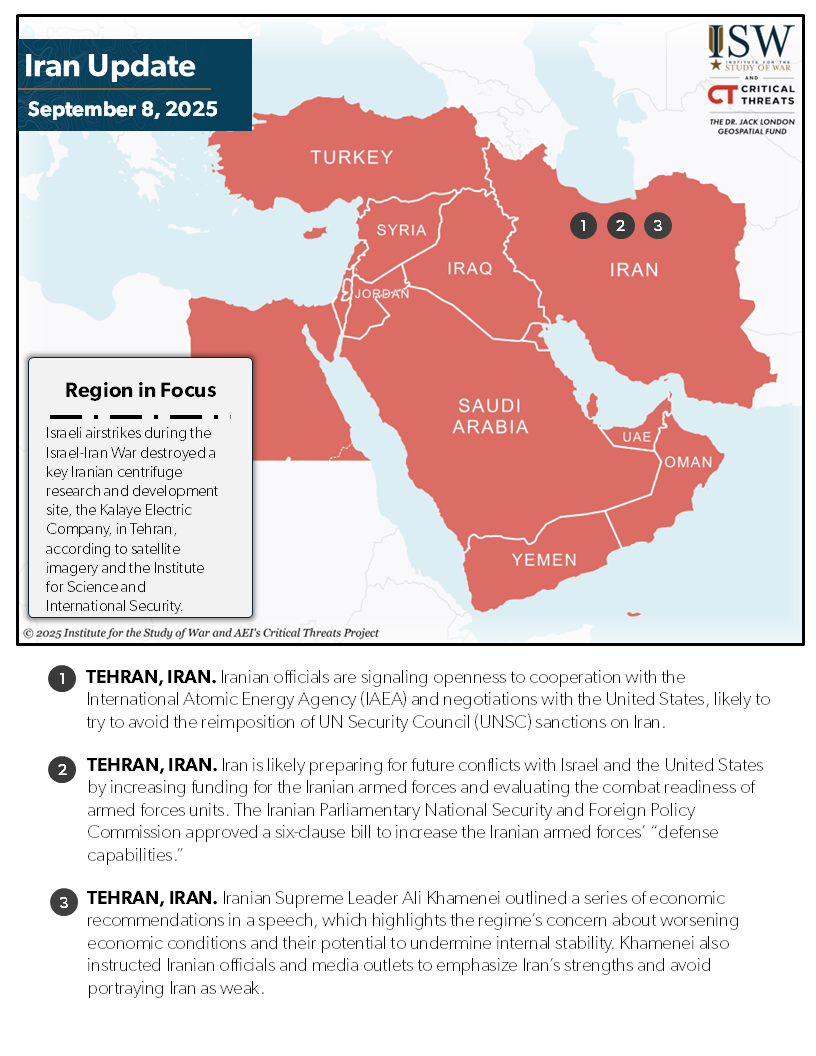
Iran is likely preparing for future conflicts with Israel and the United States by increasing funding for the Iranian armed forces and evaluating the combat readiness of armed forces units. The Iranian Parliamentary National Security and Foreign Policy Commission approved on September 7 a six-clause bill to increase the Iranian armed forces’ “defense capabilities.” The IDF destroyed Iranian air defense systems and achieved air superiority over large parts of Iran during the Israel-Iran War, and Iran likely seeks to bolster its defensive capabilities in preparation for potential future conflicts.

The Institute for Science and International Security reported on September 7 that Israeli airstrikes during the Israel-Iran War destroyed a key Iranian centrifuge research and development site, the Kalaye Electric Company, in Tehran. The Kalaye Electric Company is a subsidiary of the Atomic Energy Organization of Iran and manufactures advanced centrifuges for the Iranian nuclear program. Centrifuges are used to enrich uranium. The United States sanctioned the Kalaye Electric Company in February 2007 for its involvement in Iran’s weapons of mass destruction program. The Institute reported that centrifuge design teams developed new centrifuge models and improved existing ones at the site. Iran also reportedly previously tested advanced IR-8 centrifuges at the site. There have been no repair efforts at the site following the war, according to the Institute. US and Israeli airstrikes during the war targeted Iran’s centrifuge production facilities as well as active centrifuges, which will likely hinder Iran’s ability to enrich uranium in the near future.

KEY TAKEAWAYS

  • Iran-IAEA Negotiations: Iranian officials are signaling openness to cooperation with the International Atomic Energy Agency (IAEA) and negotiations with the United States, likely to try to avoid the reimposition of UN Security Council (UNSC) sanctions on Iran.

  • Iraqi Popular Mobilization Forces: The Shia Coordination Framework (SCF) is trying to bypass the Iraqi parliament to strengthen the Popular Mobilization Forces. The SCF may plan to have the Iraqi Prime Minister issue an executive order to restructure and expand the PMF’s authority after the SCF’s attempt to do so through the legislature stalled.

  • Iranian Military Readiness: Iran is likely preparing for future conflicts with Israel and the United States by increasing funding for the Iranian armed forces and evaluating the combat readiness of armed forces units. The Iranian Parliamentary National Security and Foreign Policy Commission approved a six-clause bill to increase the Iranian armed forces’ “defense capabilities.”

  • Iranian Economy: Iranian Supreme Leader Ali Khamenei outlined a series of economic recommendations in a speech, which highlights the regime’s concern about worsening economic conditions and their potential to undermine internal stability. Khamenei also instructed Iranian officials and media outlets to emphasize Iran’s strengths and avoid portraying Iran as weak.


  • Iranian Centrifuge Capacity: Israeli airstrikes during the Israel-Iran War destroyed a key Iranian centrifuge research and development site, the Kalaye Electric Company, in Tehran, according to satellite imagery and the Institute for Science and International Security. US and Israeli airstrikes during the war targeted Iran’s centrifuge production facilities as well as active centrifuges, which will likely hinder Iran’s ability to enrich uranium in the near future.

NEW EMAIL SUBSCRIPTION OPTIONS

ISW has launched newly customizable email subscription options. Existing subscribers have been auto enrolled in all lists. Click below to learn more about these options and customize your preferences.

ISW is powered by the support of individuals like you.

Help us stay independent and impactful.

Website | Jobs & Internships

Follow ISW on social media:

FacebookXYouTube | InstagramLinkedIn | Threads | Bluesky

Donate online or by sending a check to the Institute for the Study of War at 1400 16th Street NW, Suite #515, Washington, DC 20036. Please consider including the Institute for the Study of War in your estate plans.

ISW is a tax-exempt organization under section 501(c)(3) of the Internal Revenue Code. Donations are tax-deductible to the extent permitted by law.

ISW is a non-partisan, non-profit, public policy research organization. ISW advances an informed understanding of military affairs through reliable research, trusted analysis, and innovative education. We are committed to improving the nation’s ability to execute military operations and respond to emerging threats in order to achieve US strategic objectives.

댓글 달기

이메일 주소는 공개되지 않습니다. 필수 필드는 *로 표시됩니다

위로 스크롤