[ISW] 이란 업데이트, 2025년 10월 17일

“`html

주요 내용 요약:

  • 이란 핵 시설: 과학 국제 안보 연구소(ISIS)는 이란의 에스파한 핵 기술 센터(ENTC) 지하 시설 주변 활동을 근거로, 이란이 원심분리기나 우라늄 비축물을 회수하려는 시도를 하지 않는다고 보고했습니다. ISIS는 이란이 ENTC 터널에 대한 안전한 접근을 확보하고, 미래의 공격에 대비하여 터널 입구를 강화하려 할 수 있다고 평가했습니다.

    ISIS 웹사이트 – ISIS의 보고서 및 분석 자료를 확인하세요. (영어)

    최신 자료 및 관련 정보: 이란 핵 프로그램 관련 최신 동향은 국제원자력기구(IAEA)의 보고서를 통해 확인할 수 있습니다.

    IAEA 웹사이트 – 이란 관련 최신 보고서 (영어)

    핵심 단어: ENTC (에스파한 핵 기술 센터), 원심분리기, 우라늄, ISIS (과학 국제 안보 연구소)
  • 이란과 러시아: 이란 최고 국가 안보 위원회 비서 알리 라리자니는 러시아 대통령 블라디미르 푸틴과 회담을 가졌으며, 이는 주로 제재 회피 및 완화 노력을 논의하기 위한 것으로 보입니다. 이는 9월 27일 유엔 안전 보장 이사회가 이란에 대한 스냅백 제재를 재도입한 이후 라리자니의 첫 러시아 방문입니다. 이란은 국제 제재의 영향을 완화하기 위해 주요 파트너인 러시아에 크게 의존하고 있습니다.

    최신 자료 및 관련 정보: 이란-러시아 관계 및 제재 관련 뉴스 및 분석은 다음과 같은 언론 기관에서 확인할 수 있습니다.

    외교협회(Council on Foreign Relations) (영어) – 이란 관련 심층 분석 및 보고서

    대서양 협의회(Atlantic Council) (영어) – 이란 관련 최신 자료 및 분석

    핵심 단어: 알리 라리자니, 블라디미르 푸틴, 스냅백 제재, 제재 회피, 제재 완화
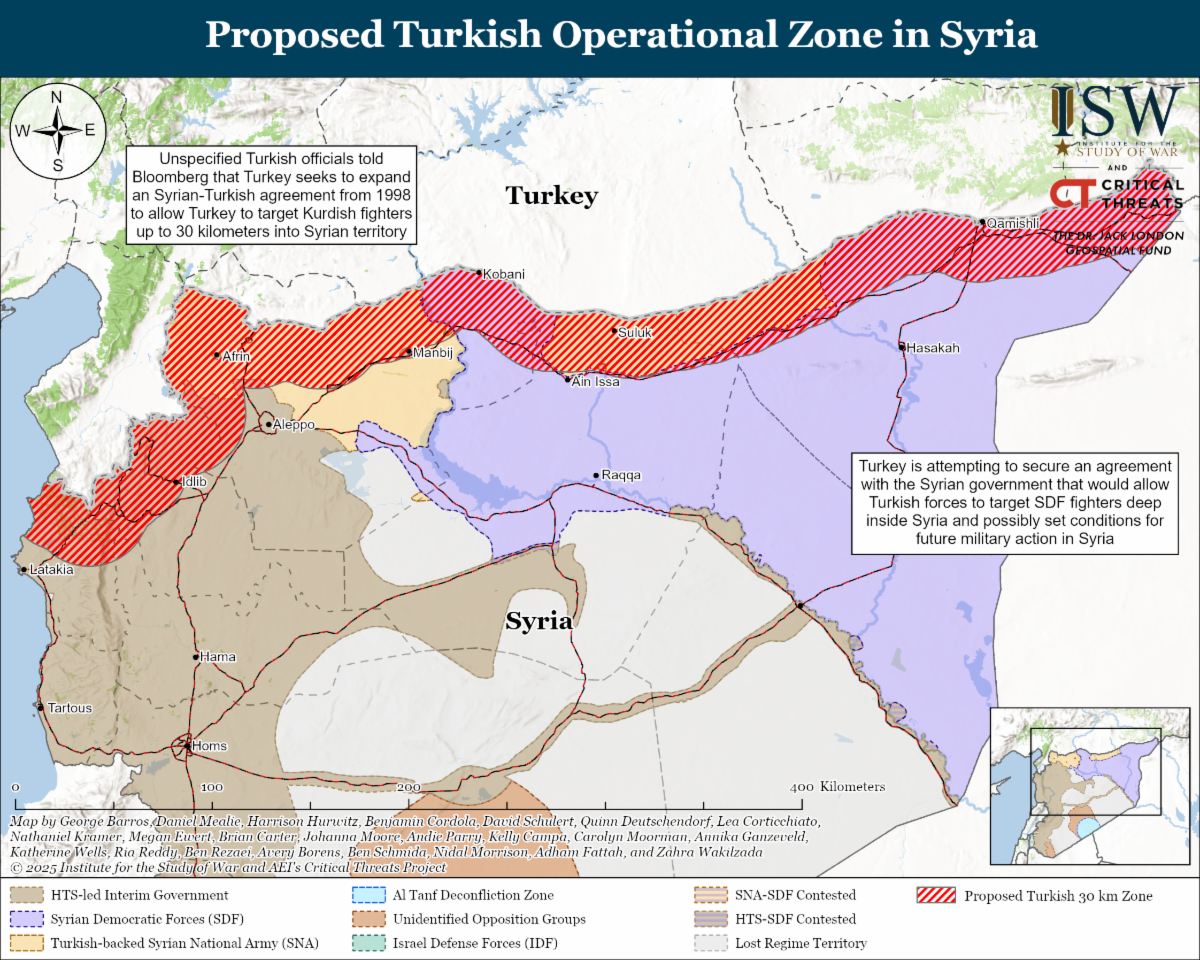
  • 시리아 북부의 터키: 터키는 시리아 정부와 협정을 체결하여 터키군이 시리아 내 30km 이내에서 시리아 민주군(SDF) 전투원을 공격할 수 있도록 하고, SDF를 겨냥한 미래 군사 작전을 위한 조건을 설정하려 시도하고 있습니다. 익명의 터키 관리들은 서방 언론에 터키와 시리아가 시리아 영토 내 최대 30km까지 쿠르드 전투원을 공격할 수 있도록 하는 방안을 논의했다고 밝혔습니다. 터키는 이 협정을 시리아 정부와 체결하기 위해 계획된 무기 인도를 활용할 수 있습니다.

    최신 자료 및 관련 정보: 터키-시리아 관계, SDF 관련 뉴스는 다음과 같은 언론에서 확인할 수 있습니다.

    로이터 통신 (영어) – 시리아 관련 최신 뉴스

    BBC 뉴스 (영어) – 터키-시리아 관련 뉴스

    핵심 단어: SDF (시리아 민주군), 터키군, 시리아, 쿠르드 전투원
  • 이라크의 종파 폭력: 최근 수니파 주권 연합 후보이자 바그다드 주 의회 의원 사파 알 마슈다니의 암살 사건에 대한 추가 정보에 따르면, 이란의 지원을 받는 이라크 전투원들이 공격을 감행했습니다. 이라크 언론은 마슈다니가 타르미야에서 토지 수용을 시도한 특정 그룹과 “분쟁”을 벌였다고 보도했습니다. 마슈다니는 바그다드 북부에서 지배력을 위협하는 것으로 인식될 수 있는 타르미야에서 이란의 지원을 받는 이라크 민병대의 철수를 지속적으로 옹호했습니다.

    최신 자료 및 관련 정보: 이라크 내 종파 갈등 및 정치적 상황에 대한 최신 정보는 다음과 같은 기관에서 확인할 수 있습니다.

    국제 위기 그룹(International Crisis Group) (영어) – 이라크 관련 심층 보고서

    알자지라 (영어) – 이라크 관련 최신 뉴스

    핵심 단어: 사파 알 마슈다니, 수니파 주권 연합, 이란, 이라크 민병대, 타르미야

“`

[원문]

Iranian Supreme National Security Council Secretary Ali Larijani met with Russian President Vladimir Putin on October 16, likely primarily to discuss sanctions evasion and mitigation efforts.

October 17, 2025

Information Cutoff: 2:00 pm ET

Adham Fattah, Ben Rezaei, Kelly Campa, Carolyn Moorman, Avery Borens, Katherine Wells, Parker Hempel, Andie Parry, and Brian Carter

TOPLINES

The Institute for Science and International Security (ISIS) reported on October 16 that Iranian activity around Esfahan Nuclear Technology Center (ENTC)’s underground facilities indicates that Iran is not attempting to retrieve centrifuges or uranium stocks. ISIS assessed that Iran may be trying to establish secure access to ENTC tunnels and reinforce tunnel entrances against future strikes. ISIS reported that satellite imagery of the tunnel entrances to the ENTC’s underground facilities showed that Iran cleared out all debris in front of the northern tunnel entrance and most of the debris in front of the middle tunnel entrance in late July and late September, respectively. ISIS reported that imagery from September 30 showed a backhoe piling rocks in front of the northern tunnel entrance, which ISIS said could be a sign that Iran is trying to reinforce the northern tunnel against possible future strikes. The ISIS report added that Iran is likely prioritizing ”slow and safe access” to the ENTC underground facilities because it may be dangerous to enter after the strikes. The United States struck the ENTC on June 22. ISIS stated that the extent of damage to the three tunnels could not be assessed at this time.

Iranian Supreme National Security Council Secretary Ali Larijani met with Russian President Vladimir Putin on October 16, likely primarily to discuss sanctions evasion and mitigation efforts. This is Larijani’s first visit to Russia since the UN Security Council reimposed snapback sanctions on Iran on September 27. Iran relies heavily upon Russia as a key partner to mitigate the impact of international sanctions. The reimposition of UN sanctions restored an arms embargo and broad UN restrictions upon Iran’s nuclear and ballistic missile programs. Larijani likely discussed ways that Russia can assist Iran in evading and mitigating the impact of sanctions. Iran and Russia have historically collaborated through networks of foreign-based front companies and shadow fleets transporting sanctioned goods, such as energy exports and arms sales. Russian Permanent Representative to the United Nations Vasily Nebenzya stated on October 1 that Russia does not recognize the “snapback as coming into force,” suggesting that Russia will continue to assist Iran evade sanctions as it did before the imposition of snapback sanctions. Larijani and Putin also likely discussed Russian military assistance that Russia could provide to Iran. Russian Foreign Affairs Minister Sergei Lavrov separately stated on October 13 that Russia would “develop military-technical cooperation with Iran” with “no restrictions.” Larijani could also have discussed military support for Iran from Russia in addition to sanctions evasion and mitigation. Iran seeks to buy Russian military equipment, though procuring it has been difficult given Russia’s prioritization of the war in Ukraine. Russian assets like the S-300 have also proven incapable of stopping Israeli or US air attack, and Russian aircraft like the MiG-29 and Su-35 are unlikely to seriously challenge the US-made F-35.

Turkey is attempting to secure an agreement with the Syrian government that would allow Turkish forces to target Syrian Democratic Forces (SDF) fighters deep inside Syria and possibly set conditions for future military operations targeting the SDF. Unspecified Turkish officials told Bloomberg on October 17 that Turkey and Syria have discussed expanding the 1998 Adana Agreement so that it allows Turkey to target Kurdish fighters up to 30 kilometers in Syrian territory. The 1998 Adana Agreement, which the Turkish government signed with the Assad regime, currently allows Turkey the right to target Kurdish fighters it deems a threat up to five kilometers into Syrian territory. Turkish President Recep Tayyip Erdogan used this agreement to justify Turkey’s right to launch a military offensive targeting the SDF in 2019, citing the Assad regime’s lack of “measures” taken to rein in Kurdish fighters near the border. Turkey has recently threatened to take military action against the SDF — which it views as an extension of the Kurdistan Workers’ Party — by the end of 2025 if the SDF does not integrate into the Syrian state by that date. Turkey’s ability to target the SDF deeper in Syrian territory would allow Turkey to set conditions for possible future military operations targeting the SDF, including by targeting key SDF tactical and operational commanders within the 30-kilometer operational zone. Turkey has previously struck SDF forces deep into Syria — much deeper than 30 kilometers — but an amendment to the 1998 Adana Agreement would enable ground pursuit and help alleviate any possible friction with the new Syrian government.

KEY TAKEAWAYS

  • Iranian Nuclear Facilities: The Institute for Science and International Security (ISIS) reported that Iranian activity around Esfahan Nuclear Technology Center (ENTC)’s underground facilities indicates that Iran is not attempting to retrieve centrifuges or uranium stocks. ISIS assessed that Iran may be trying to establish secure access to ENTC tunnels and reinforce tunnel entrances against future strikes.

  • Iran and Russia: Iranian Supreme National Security Council Secretary Ali Larijani met with Russian President Vladimir Putin, likely primarily to discuss sanctions evasion and mitigation efforts. This is Larijani’s first visit to Russia since the UN Security Council reimposed snapback sanctions on Iran on September 27. Iran relies heavily upon Russia as a key partner to mitigate the impact of international sanctions.

  • Turkey in Northern Syria: Turkey is attempting to secure an agreement with the Syrian government that would allow Turkish forces to target Syrian Democratic Forces (SDF) fighters 30 kilometers inside Syria and possibly set conditions for future military operations targeting the SDF. Unspecified Turkish officials told Western media that Turkey and Syria have discussed allowing Turkey to target Kurdish fighters up to 30 kilometers in Syrian territory. Turkey may leverage planned weapons shipments in order to secure this agreement with the Syrian government.

  • Sectarian Violence in Iraq: Additional details about the recent political assassination of Sunni Sovereignty Alliance candidate and Baghdad Provincial Council member Safaa al Mashhadani indicate that Iranian-backed Iraqi fighters conducted the attack. Iraqi media reported that Mashhadani was “in a dispute” with an unspecified group that had attempted to seize land in Tarmiyah. Mashhadani continuously advocated for the removal of Iranian-backed Iraqi militias from Tarmiyah, which these groups would have perceived as a threat to their dominance north of Baghdad.

NEW EMAIL SUBSCRIPTION OPTIONS

ISW has launched newly customizable email subscription options. Existing subscribers have been auto enrolled in all lists. Click below to learn more about these options and customize your preferences.

ISW is powered by the support of individuals like you.

Help us stay independent and impactful.

Website | Jobs | Internships

Follow ISW on social media:

FacebookXYouTube | InstagramLinkedIn | Threads | Bluesky

Donate online or by sending a check to the Institute for the Study of War at 1400 16th Street NW, Suite #515, Washington, DC 20036. Please consider including the Institute for the Study of War in your estate plans.

ISW is a tax-exempt organization under section 501(c)(3) of the Internal Revenue Code. Donations are tax-deductible to the extent permitted by law.

ISW is a non-partisan, non-profit, public policy research organization. ISW advances an informed understanding of military affairs through reliable research, trusted analysis, and innovative education. We are committed to improving the nation’s ability to execute military operations and respond to emerging threats in order to achieve US strategic objectives.

댓글 달기

이메일 주소는 공개되지 않습니다. 필수 필드는 *로 표시됩니다

위로 스크롤