|
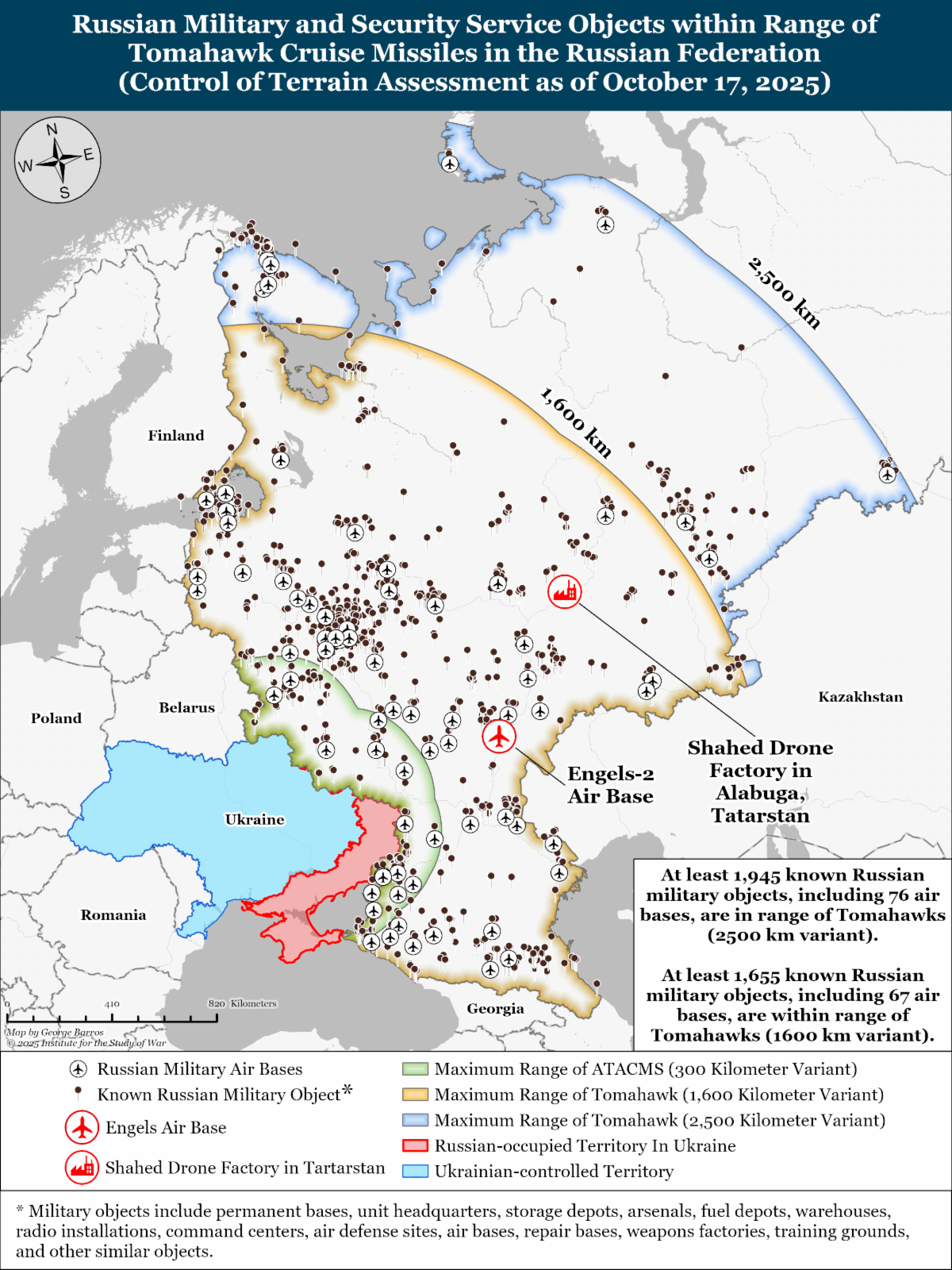
Ukrainian President Volodymyr Zelensky and US President Donald Trump met at the White House on October 17 and discussed ongoing US support for Ukraine and efforts to the war. Trump expressed confidence in his ability to end the war and assessed that both Zelensky and Russian President Vladimir Putin want to end the war in Ukraine. Zelensky reiterated that he remains open to a bilateral or trilateral meeting with Putin. Zelensky reiterated during the meeting and the following press conference that Ukraine is interested in acquiring US-made Tomahawk missiles to use against Russia in tandem with Ukrainian-made long-range strike drones. Zelensky noted that striking legitimate Russian military targets requires missiles in combination with “thousands of drones” and that Ukraine does not yet have enough missiles. Missiles can carry larger payloads and fly at faster speeds than long-range strike drones, increasing their chances of penetrating Russia’s air defense umbrella and causing more damage to higher-value, better-defended military objects. ISW previously noted that US Tomahawk missiles’ long-range capabilities and sizable payload would enable the Ukrainian military to inflict substantial damage on key Russian military assets located deep within Russian territory, including the Shahed drone factory in Yelabuga, Republic of Tatarstan, and the Engels-2 Air Base in Saratov Oblast, from which Russia sorties the strategic bombers that fire air-launched cruise missiles at Ukraine. Ukraine can likely significantly degrade Russia’s military capabilities by targeting a vulnerable subset of key rear support areas, such as Yelabuga and Engels, that sustain and support Russia’s frontline operations and long-range strike campaign against Ukraine.
The Kremlin continues to employ a dual-handed rhetorical strategy, leveraging economic proposals and veiled military threats in an effort to simultaneously pursue normalizing US-Russian relations and deterring US support for Ukraine. Russian Direct Investment Fund (RDIF) CEO and key Kremlin negotiator Kirill Dmitriev used a series of English-language X (formerly Twitter) posts on October 16 and 17 to promote a possible joint US-Russian economic venture, likely in an attempt to persuade the Trump administration that normalization of US-Russian relations would economically and politically benefit the United States and Russia without engaging in peace talks with Ukraine. Dmitriev functions largely as a persuasive agent that the Kremlin leverages to strengthen relations with the Trump administration, and Dmitriev’s use of the proposal likely aimed to generate media attention and underscore existing Kremlin narratives that bilateral economic cooperation is preferable to a negotiated peace in Ukraine. Russian Foreign Intelligence Service (SVR) Head Sergei Naryshkin reiterated on October 17 that Russia would perceive the provision of US-made Tomahawk missiles to Ukraine as a “hostile move” that would threaten global security. Naryshkin repeated consistent Kremlin accusations that European states advocating for the provision of Tomahawks to Ukraine are a “war party” that opposes lasting and just peace. Russian President Vladimir Putin and other Kremlin mouthpieces have repeatedly portrayed the possible provision of Tomahawk missiles as a significant “escalation” in an effort to deter support for Ukraine. The Kremlin has consistently relied on veiled and explicit threats, including nuclear saber rattling, and began offering economic incentives to deter Western aid to Ukraine. ISW continues to assess that the US provisioning of Tomahawk missiles would not engender a significant escalation in Russia’s war against Ukraine, and instead that the provisioning of long-range Tomahawk missiles to Ukraine would mirror Russia’s own use of commensurate Russian long-range cruise missiles against Ukraine.
The Kremlin is reducing its financial incentives used to recruit volunteer soldiers, likely as part of the Kremlin’s efforts to restructure force generation efforts and centralize control over Russian recruits in an effort to sustain its protracted war in Ukraine. Ukraine’s Center for Countering Disinformation reported on October 17 that Russian federal subjects (regions) are reducing and canceling one-time enlistment bonus payments for new contract military service recruits. Ukraine’s Center for Countering Disinformation reported that the Russian authorities in the Republic of Mari El recently lowered their regional one-time enlistment bonus for new recruits from three million rubles (roughly $31,600) to 800,000 rubles (roughly $9,800); in the Republic of Chuvashia from 2.5 million (roughly $26,300) to 800,000 rubles; and in Samara Oblast from 3.6 million (roughly $37,900) to 400,000 rubles (roughly $4,900). Ukraine’s Center for Countering Disinformation noted that regional governments are also reducing payments in Yamalo-Nenets Autonomous Okrug, Nizhny Novgorod Oblast, and the Republic of Bashkortostan and that the St. Petersburg officials retroactively canceled the governor’s one-time payment of 1.6 million rubles (roughly $16,800). St. Petersburg-based outlet Fontanka reported on October 16 that it obtained information that St. Petersburg canceled already-promised one-time payments for volunteers and that servicemembers in BARS (Russian Army Combat Reserve) reported issues receiving their enlistment payments. The BARS servicemembers stated that officials told them that the St. Petersburg government issued a decree on August 26, 2025, stating that the regional government would not pay the 1.6 million rubles designated for one-time enlistment bonuses starting August 1 — retroactively depriving new recruits of bonuses promised when they signed their contracts. One source stated that the regional government retroactively terminated the payments, and regional officials told Fontanka that the decree is classified “for official use only,” but that the regional government only canceled one-time payments for volunteer servicemembers (dobrovoltsi). Regional officials stated that servicemembers who sign regular military service contracts (referring to contracts with the Russian Ministry of Defense (MoD) will continue to receive one-time payments.
|