[ISW] 이란 업데이트 특별 보고서, 2026년 3월 25일

“`html

핵심 내용 요약:

  • 미국의 대이란 제안: 미국은 3월 24일 파키스탄을 통해 이란에 15개 조항의 제안을 전달했습니다. 이 제안에는 이란의 핵 프로그램 해체, 우라늄 농축 중단, 농축 우라늄 비축분 인도, 미사일 능력 제한, 저항의 축에 대한 지원 중단, 호르무즈 해협의 항해의 자유 보장 등이 포함되어 있습니다. 트럼프 행정부는 아직 이란의 공식적인 답변을 받지 못한 것으로 알려졌으며, 백악관은 3월 25일, 분쟁 종식을 위한 합의에 동의하지 않을 경우 이란에 대한 추가 군사 행동을 위협했습니다.
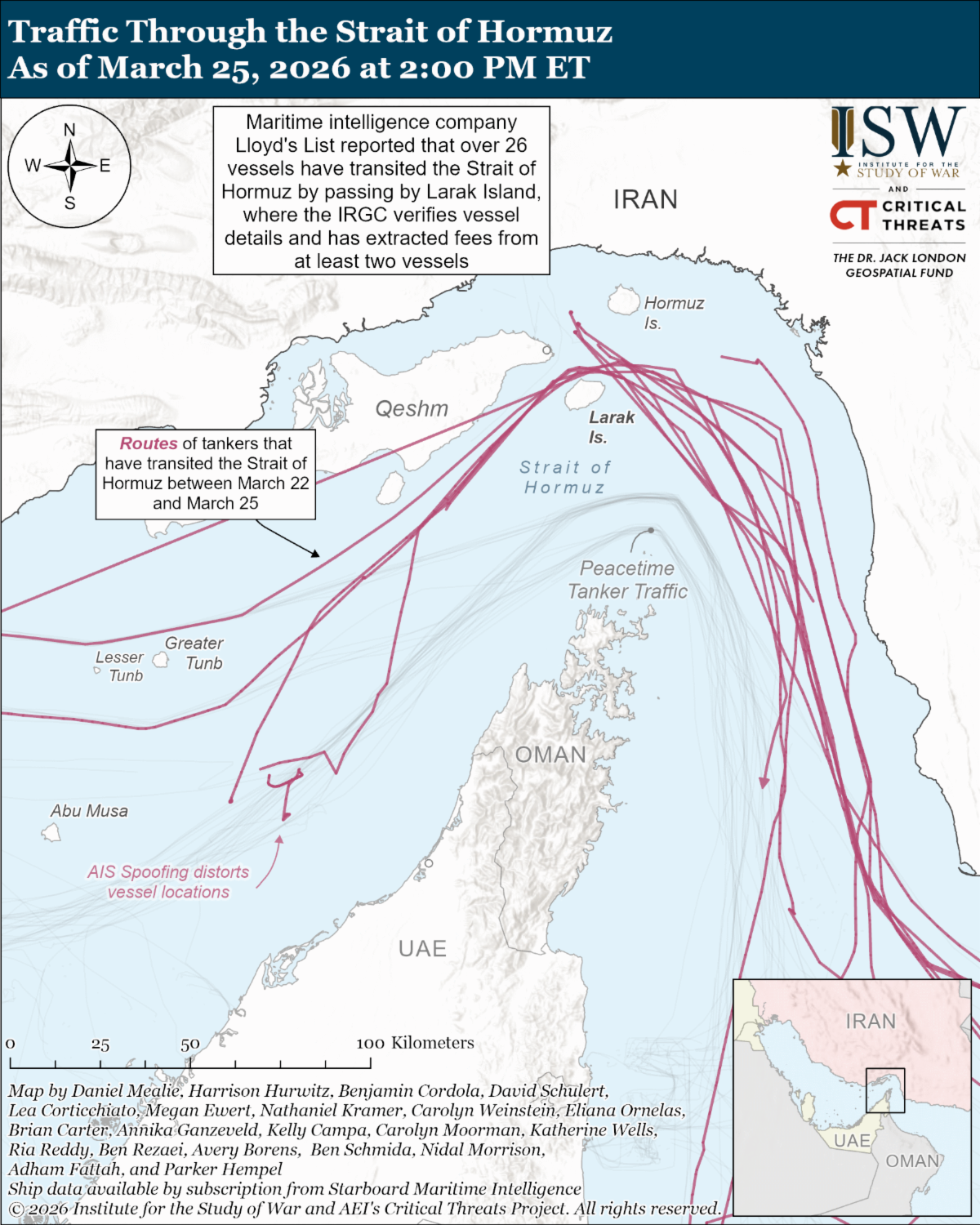
  • 이란의 호르무즈 해협 통항 관련 조치: 이란은 3월 22일 국제해사기구(IMO) 회원국에 보낸 서한에서 “비적대적” 선박은 이란과 협의할 경우 호르무즈 해협을 통과할 수 있다고 밝혔습니다. 미국, 이스라엘 또는 기타 “침략 가담자”와 관련된 선박은 안전한 통항이 허용되지 않으며, 선박 운영자는 해협 통과 전에 이란 혁명수비대(IRGC)와 연계된 중개인에게 연락해야 합니다.
  • 드론 관련 정황: 3월 25일 한 드론 운영 전문가가 3월 24일 이라크 이슬람 저항군이 게시한 드론 영상이 광섬유 기반 일인칭 시점(FPV) 드론과 일치한다고 밝혔습니다. ISW-CTP는 이라크 이슬람 저항군의 영상 진위 여부를 확인할 수 없지만, 만약 영상이 진짜라면 이란이 광섬유 FPV 드론을 제조하고 운영하며 이 기술을 지역 대리인 및 파트너에게 이전할 수 있는 능력은 중동에서 미국의 이익에 심각한 위협이 될 수 있습니다.
  • 이란 방위 산업 시설 공격 증가: ISW-CTP는 이전에 집계한 데이터 마감일 이후 이란 방위 산업 시설을 겨냥한 합동 공격이 증가했음을 기록했습니다. 이는 베냐민 네타냐후 이스라엘 총리가 이스라엘 방위군(IDF)에게 향후 48시간 동안 이란의 무기 산업을 최대한 파괴하라고 명령했다는 보도와 동시에 발생했습니다.

관련 최신 자료 및 링크:

주의사항: 링크된 정보는 각 언론사의 보도에 따라 변경될 수 있으며, 최신 정보를 확인하시기 바랍니다. 일부 링크는 유료 구독이 필요할 수 있습니다.

“`

[원문]

The United States presented a 15-point proposal to Iran via Pakistan on March 24.

March 25, 2026

Data Cutoff: 2:00 PM ET

Carolyn Moorman, Ben Rezaei, Ria Reddy, Nidal Morrison, Adham Fattah, Benjamin Schmida, Parker Hempel, Avery Borens, Kelly Campa, and Annika Ganzeveld

As the Middle East crisis evolves, ISW urgently needs your support.

Help us stay independent and impactful.

TOPLINES

The United States presented a 15-point proposal to Iran via Pakistan on March 24. Pakistani Army Commander Asim Munir, who has reportedly served as the “key interlocutor” between the United States and Iran, delivered the proposal to Iran. Munir also contacted Iranian Parliament Speaker Mohammad Bagher Ghalibaf and offered to host talks between the United States and Iran. The 15-point proposal reportedly includes provisions requiring Iran to dismantle its nuclear program, end uranium enrichment, hand over its enriched uranium stockpile, grant full International Atomic Energy Agency (IAEA) access to Iranian nuclear facilities, limit its missile capabilities, cease support for the Axis of Resistance, and ensure freedom of navigation through the Strait of Hormuz. Three unspecified sources familiar with the details of the proposal told Israeli media on March 24 that US Special Envoy to the Middle East Steve Witkoff and Jared Kushner are trying to establish a month-long ceasefire during which the United States and Iran would negotiate the 15-point proposal. Iran separately proposed five conditions for a ceasefire, including the complete cessation of US and Israeli attacks, establishment of a mechanism to prevent renewed conflict, compensation for wartime damages, an end to attacks on the Axis of Resistance, and international recognition of Iran’s authority over the Strait of Hormuz. Unspecified Iranian officials told Iranian media that no direct negotiations are currently taking place between the United States and Iran and that Iran will set the timing and conditions for ending the war. An Axios correspondent reported on March 25 that the Trump administration has not yet received a formal Iranian response to the US proposal for negotiations, citing an unspecified US official. The White House threatened on March 25 to conduct further military action against Iran if the regime does not agree to a deal to end the conflict.

A longtime observer of drone operations suggested on March 25 that drone footage posted by the Islamic Resistance in Iraq on March 24 is consistent with a fiber-optic first-person view (FPV) drone. ISW-CTP is unable to authenticate the Islamic Resistance in Iraq’s video, however. The Islamic Resistance in Iraq, which is a coalition of Iranian-backed Iraqi militias, claimed that it attacked the former US Victory Base at Baghdad International Airport and posted drone footage of the attack. The United States transferred control of the Victory Base to the Iraqi federal government in 2011, but Iranian-backed Iraqi militias have continuously claimed attacks targeting the base since the start of the war. The drone footage shows that the Islamic Resistance in Iraq targeted a helicopter and a US radar system. ISW-CTP has not observed any evidence to support the Islamic Resistance in Iraq’s claim that it attacked the Victory Base around March 24. Iraqi media reported two separate drone attacks targeting Baghdad International Airport on March 22 but did not provide enough information for ISW-CTP to assess whether the video that the Islamic Resistance in Iraq posted on March 24 was from one of those attacks. Likely Iranian-backed Iraqi militia front group Saraya Awliya al Dam posted footage on March 17 that open-source intelligence (OSINT) analysts also assessed to be from a fiber-optic FPV reconnaissance drone flying inside the parameter of the US Embassy in Baghdad. ISW-CTP assessed on March 17 that the group’s decision to advertise its possession of such a weapon represented a threat aimed at the United States.

If the Islamic Resistance in Iraq’s video is authentic, Iran’s ability to manufacture and operate fiber-optic FPV drones and transfer this technology to its regional proxies and partners would pose a significant challenge to US interests in the Middle East. Fiber-optic FPV drones are immune to jamming and can be used for intelligence, surveillance, and reconnaissance, or outfitted with strike capabilities to conduct precise targeting. The drones have small ranges and generally carry small payloads but can impose financial costs when used to target expensive assets. Russia and Ukraine have extensively used FPV drones in their war. Russia has given drone components to Iran, and Iran reportedly possesses FPV drones, but it had been unclear until this point that Iran had begun to transfer this technology to its partners in Iraq.

KEY TAKEAWAYS

  • The United States presented a 15-point proposal to Iran via Pakistan on March 24. The 15-point proposal reportedly includes provisions requiring Iran to dismantle its nuclear program, end uranium enrichment, hand over its enriched uranium stockpile, limit its missile capabilities, cease support for the Axis of Resistance, and ensure freedom of navigation through the Strait of Hormuz, among other demands. The Trump administration has reportedly not yet received a formal Iranian response to the US proposal. The White House threatened on March 25 to conduct further military action against Iran if the regime does not agree to a deal to end the conflict.

  • Iran sent a letter to International Maritime Organization member states on March 22 stating that “non-hostile” ships can pass through the Strait of Hormuz if they coordinate with Iran. Ships associated with the United States, Israel, or other “participants in the aggression” are not eligible for safe passage. Vessel operators are required to contact intermediaries with connections to the IRGC before transiting through the strait.

  • A longtime observer of drone operations suggested on March 25 that drone footage posted by the Islamic Resistance in Iraq on March 24 is consistent with a fiber-optic first-person view (FPV) drone. ISW-CTP is unable to authenticate the Islamic Resistance in Iraq’s video. Iran’s ability to manufacture and operate fiber-optic FPV drones and transfer this technology to its regional proxies and partners would pose a significant challenge to US interests in the Middle East, if the footage is authentic.

  • ISW-CTP has recorded an uptick in combined force strikes targeting Iranian defense industrial sites since its last data cutoff. This uptick comes amid a report that Israeli Prime Minister Benjamin Netanyahu ordered the Israel Defense Forces (IDF) to destroy as much of Iran’s arms industry as possible over the next 48 hours.

EMAIL SUBSCRIPTION OPTIONS

ISW offers customizable email subscription options. Click below to learn more and customize your preferences.

Website | Jobs | Internships

Follow ISW on social media:

FacebookXYouTube | InstagramLinkedIn | Threads | Bluesky

© 2026 Institute for the Study of War and AEI’s Critical Threats Project. All rights reserved.

Donate online or by sending a check to the Institute for the Study of War at 1400 16th Street NW, Suite #515, Washington, DC 20036. Please consider including the Institute for the Study of War in your estate plans.

ISW is a tax-exempt organization under section 501(c)(3) of the Internal Revenue Code. Donations are tax-deductible to the extent permitted by law.

ISW is a non-partisan, non-profit, public policy research organization. ISW advances an informed understanding of military affairs through reliable research, trusted analysis, and innovative education. We are committed to improving the nation’s ability to execute military operations and respond to emerging threats in order to achieve US strategic objectives.

댓글 달기

이메일 주소는 공개되지 않습니다. 필수 필드는 *로 표시됩니다

위로 스크롤