[ISW] 이란 업데이트 특별 보고서, 2026년 4월 11일

“`html

주요 내용 요약:

  • 이란과 미국의 상반된 입장:
    • 이란은 미국과의 전쟁 위협을 종식시키는 포괄적인 합의를 추구하지만, 미국은 현재의 전쟁에 초점을 맞춘 더 좁은 범위의 합의를 원합니다.
    • 미국 대표단은 호르무즈 해협 주변의 긴장 완화 메커니즘과 억류자 문제 등 특정 사안에 집중하는 협상을 진행하는 것으로 보입니다. (미국 부통령 JD Vance, 중동 특사 Steve Witkoff, Jared Kushner 등이 대표단에 포함)
  • 이란의 해상 봉쇄 및 경제적 압박:
    • 이란은 호르무즈 해협에 설치한 것으로 추정되는 해상 기뢰를 이용하여 선박들이 이란 영해를 통과하도록 유도하고, 통행료를 갈취하는 불법 행위를 저지르고 있습니다.
    • 이란은 이러한 행위가 글로벌 경제를 교란하여 미국으로부터 양보를 얻어낼 수 있다고 계산하고 있습니다.
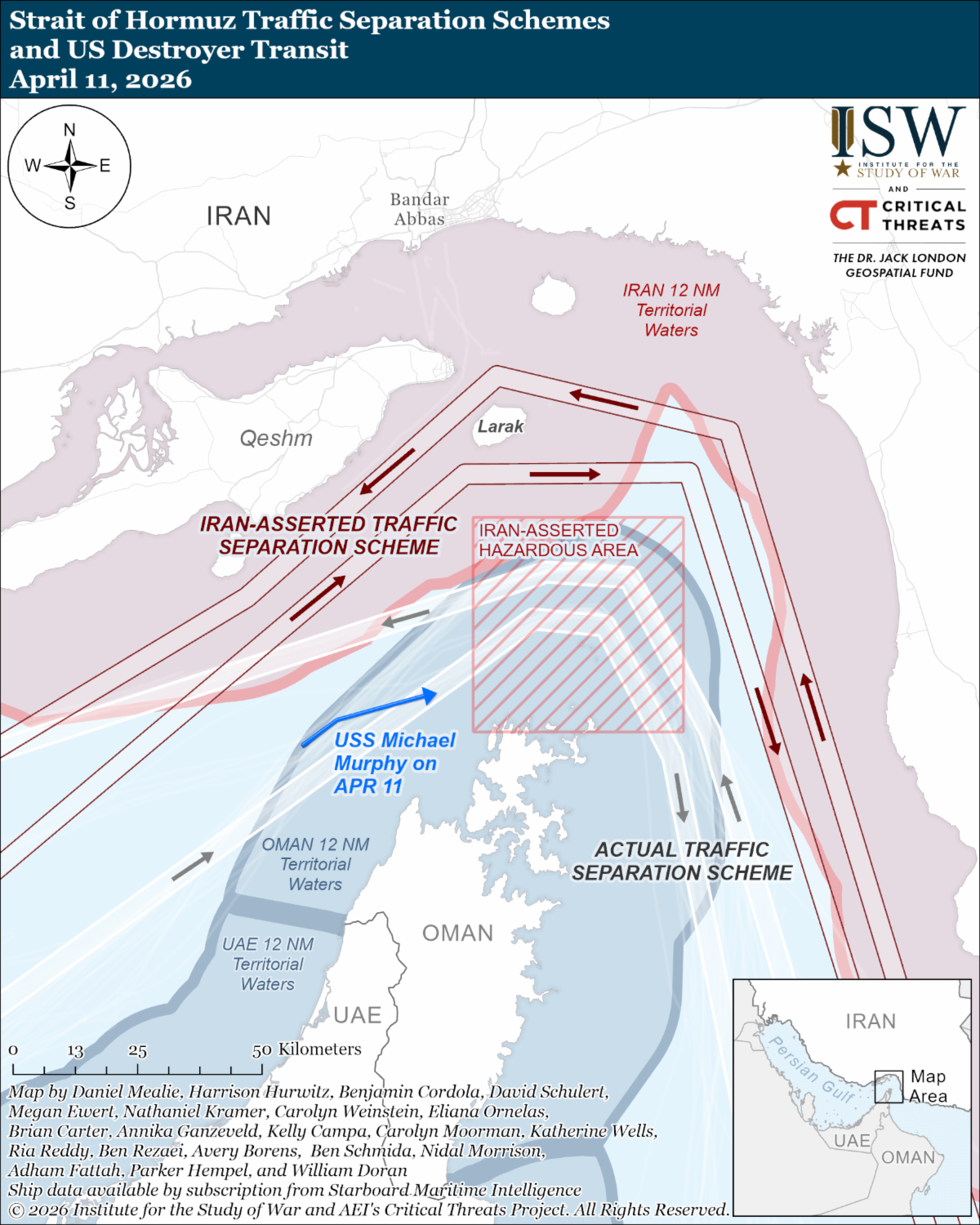
    • 이란은 호르무즈 해협의 특정 구역을 “위험 구역”으로 지정하여 상선들의 안전을 위협하고 있습니다.
  • 휴전을 이용한 이란의 군사력 재건:
    • 현재의 휴전은 이란에게 미사일 부대를 재정비하고, 미-이스라엘의 지속적인 작전으로 인한 피해를 복구할 기회를 제공합니다.
    • 미-이스라엘의 지속적인 작전은 이란의 미사일 발사대 건설을 방해하고, 지휘 통제를 교란하며, 군사 부대의 공격 의지를 약화시키는 효과를 가져왔습니다.
  • 최고 지도자 측근의 부상:
    • 이란 최고 지도자 모즈타바 하메네이가 2월 28일 테헤란주 최고 지도자 관저 공격으로 얼굴과 다리에 심각한 부상을 입고 회복 중입니다.
  • 중국의 이란 지원:
    • 중국은 휴전 기간 동안 이란의 훼손된 방공 능력을 복구하는 데 도움을 주고 있을 수 있습니다.
    • 최근 미국 정보 평가에 따르면, 중국은 향후 몇 주 안에 이란에 휴대용 대공 미사일 시스템(MANPADS)을 제공할 예정입니다.

관련 자료 및 링크 (최신 정보 확인 필요):

  • 호르무즈 해협 관련 긴장:
    • Council on Foreign Relations – Iran (CFR의 이란 관련 페이지: 이란과 관련된 외교, 안보, 경제적 상황에 대한 분석을 제공합니다. 호르무즈 해협의 긴장 상황, 미국의 대이란 정책, 이란의 핵 프로그램 등 관련 정보를 얻을 수 있습니다.)
    • Al Jazeera – Strait of Hormuz (알자지라의 호르무즈 해협 관련 페이지: 호르무즈 해협의 지정학적 중요성, 관련 분쟁 및 뉴스, 해상 교통의 위험 요소 등에 대한 보도를 제공합니다.)
    • Reuters – Iran calls on shipping to avoid parts of Strait of Hormuz due to mine threat (로이터의 기사: 2024년 4월 25일, 이란이 호르무즈 해협의 일부 지역에 기뢰 위협을 이유로 선박의 통행을 피하도록 촉구했다는 내용)
  • 미사일 부대 재건 및 중국의 지원:
    • International Institute for Strategic Studies (IISS) – Iran’s missile threat (IISS의 이란 미사일 위협 분석: 이란의 미사일 능력, 개발 현황, 위협 평가 등 관련 보고서를 제공합니다. 이란의 미사일 부대 재건과 관련된 정보를 얻을 수 있습니다.)
    • U.S. Department of State – Iran (미국 국무부의 이란 관련 페이지: 미국의 대이란 정책, 이란과의 외교 관계, 제재 및 관련 성명 등을 확인할 수 있습니다. 중국의 이란 지원 관련 공식 입장 및 정보도 확인해볼 수 있습니다.)

주의: 상기 링크의 내용은 시간이 지남에 따라 변경될 수 있으므로, 최신 정보를 확인하시기 바랍니다. 특히 각 언론사 및 기관의 공식 웹사이트에서 관련 뉴스와 보고서를 참고하는 것이 중요합니다.

“`

[원문]

Iran and the United States have fundamentally different interpretations of the ongoing negotiations, which will generate friction.

April 11, 2026

Data Cutoff: 2:00 PM ET

Parker Hempel, Katherine Wells, Ben Rezaei, Kelly Campa, Carolyn Moorman, and Brian Carter

As the Middle East crisis evolves, ISW urgently needs your support.

Help us stay independent and impactful.

TOPLINES

Iran and the United States have fundamentally different interpretations of the ongoing negotiations, which will generate friction. Iran seeks an all-encompassing agreement that will end the threat of war with the United States, while the United States seeks a much narrower agreement centered on the current war. The US delegation, led by US Vice President JD Vance and including US Special Envoy to the Middle East Steve Witkoff and Jared Kushner, appears to be pursuing a narrow, issue-specific negotiation focused on de-escalatory mechanisms around the Strait of Hormuz, and reportedly secondary matters like detainees. The Iranian delegation is explicitly framing the talks as leverage for a broader reset in the US-Iran relationship. Iranian demands include sovereignty claims over the Strait of Hormuz, compensation for war damages, the release of frozen Iranian assets, and a region-wide ceasefire across the “Axis of Resistance,” which creates an imbalance in expectations that sets the talks up for deadlock. Two people briefed on negotiations told the Financial Times that the April 11 negotiations have reached a ”stalemate” over the main sticking point — the status of the Strait of Hormuz.

The composition of Iran’s at least 70-person delegation, headed by Iranian Parliament Speaker Mohammad Bagher Ghalibaf and Foreign Affairs Minister Abbas Araghchi, underscores Iran’s wide-ranging negotiating intentions. The large and heavily securitized team blends diplomats, parliamentarians, Islamic Revolutionary Guards Corps (IRGC)-adjacent figures, and high-level economic technocrats, indicating that Iran is pressing a long list of demands across a range of issue areas. The inclusion of the Central Bank Governor Abdolnaser Hemmati and economic specialists points to a focus on sanctions architecture, frozen assets, and alternative financial mechanisms, suggesting preparation for prolonged economic and strategic bargaining rather than confidence-building compromise.

The unusually large size of the Iranian delegation likely also reflects internal divisions and deep mutual distrust among regime power centers, rather than a unified negotiating strategy. There was reportedly infighting between the regime factions before the negotiations. Ghalibaf and Araghchi reportedly clashed with IRGC Commander Major General Ahmad Vahidi over Vahidi’s effort to insert longtime IRGC affiliate and Supreme National Security Council Secretary Mohammad Bagher Zolghadr into the talks, despite Zolghadr’s lack of experience with diplomatic negotiations. An IRGC-affiliated media outlet reported on their English language X account that Zolghadr was in the delegation in Islamabad, along with Defense Council Secretary IRGC Rear Admiral Ali Akbar Ahmadian, but Iranian Persian-language media did not disclose if Zolghadr was present. The presence of overlapping political, security, and economic actors suggests a need for constant internal monitoring.

KEY TAKEAWAYS

  • Iran and the United States have fundamentally different interpretations of the ongoing negotiations, which will generate friction. Iran seeks an all-encompassing agreement that will end the threat of war with the United States, while the United States seeks a much narrower agreement centered on the current war. The US delegation, led by US Vice President JD Vance and including US Special Envoy to the Middle East Steve Witkoff and Jared Kushner, appears to be pursuing a narrow, issue-specific negotiation focused on de-escalatory mechanisms around the Strait of Hormuz, and reportedly secondary matters like detainees.

  • Iran is using the existence of an unknown number of naval mines it laid in the Strait of Hormuz to force ships to use Iranian territorial waters to traverse the Strait, which enables Iran to shakedown these ships for fees while the ships are in Iranian territorial waters. This protection racket is illegal under the United Nations Convention on the Law of the Sea. Iran likely designed its threatening behavior and its shakedowns to disrupt the global economy, which Iran calculates will enable it to extract concessions from the United States.Iran warned merchant ships that mines could exist in a “hazardous area” that covers 1,394 sq km of the Strait, including the normal traffic separation scheme (shipping lanes) that ships use to transit the Strait.

  • The current ceasefire will provide Iran an opportunity to reorganize its missile force and recover from the temporary disruption wrought to the missile force during constant US and Israeli operations. Consistent US and Israeli operations over Iran had suppressed Iran’s missile force by preventing Iran from digging out launchers, disrupting command-and-control, and creating pervasive fear in military units that made them unwilling or unable to conduct attacks, as ISW-CTP has previously assessed.

  • Iranian Supreme Leader Mojtaba Khamenei continues to recover from severe facial and leg injuries that he sustained in the February 28 strike on the supreme leader’s compound in Tehran Province. Three unspecified individuals close to Mojtaba’s inner circle told Reuters on April 11 that the strike disfigured Mojtaba’s face and injured one or both of his legs.

  • The People’s Republic of China (PRC) may be helping Iran to reconstitute some of its degraded air defense capabilities during the current ceasefire. The PRC is preparing to deliver man-portable air-defense systems (MANPADS) to Iran within the coming weeks, according to three sources familiar with recent US intelligence assessments.

EMAIL SUBSCRIPTION OPTIONS

ISW offers customizable email subscription options. Click below to learn more and customize your preferences.

Website | Jobs | Internships

Follow ISW on social media:

FacebookXYouTube | InstagramLinkedIn | Threads | Bluesky

© 2026 Institute for the Study of War and AEI’s Critical Threats Project. All rights reserved.

Donate online or by sending a check to the Institute for the Study of War at 1400 16th Street NW, Suite #515, Washington, DC 20036. Please consider including the Institute for the Study of War in your estate plans.

ISW is a tax-exempt organization under section 501(c)(3) of the Internal Revenue Code. Donations are tax-deductible to the extent permitted by law.

ISW is a non-partisan, non-profit, public policy research organization. ISW advances an informed understanding of military affairs through reliable research, trusted analysis, and innovative education. We are committed to improving the nation’s ability to execute military operations and respond to emerging threats in order to achieve US strategic objectives.

댓글 달기

이메일 주소는 공개되지 않습니다. 필수 필드는 *로 표시됩니다

위로 스크롤