[ISW] 러시아 공격 작전 평가, 2026년 4월 4일

“`html

핵심 내용:

  • 크렘린은 최근 몇 주 동안 러시아 국내에서 강화된 검열 노력에 대해 모스크바가 예상하거나 준비했던 것보다 더 강한 반발에 직면하고 있습니다.
  • 우크라이나군은 4월 3일부터 4일까지 러시아 및 점령된 우크라이나 내 군사 자산에 대한 중거리 공격 작전을 지속했습니다.
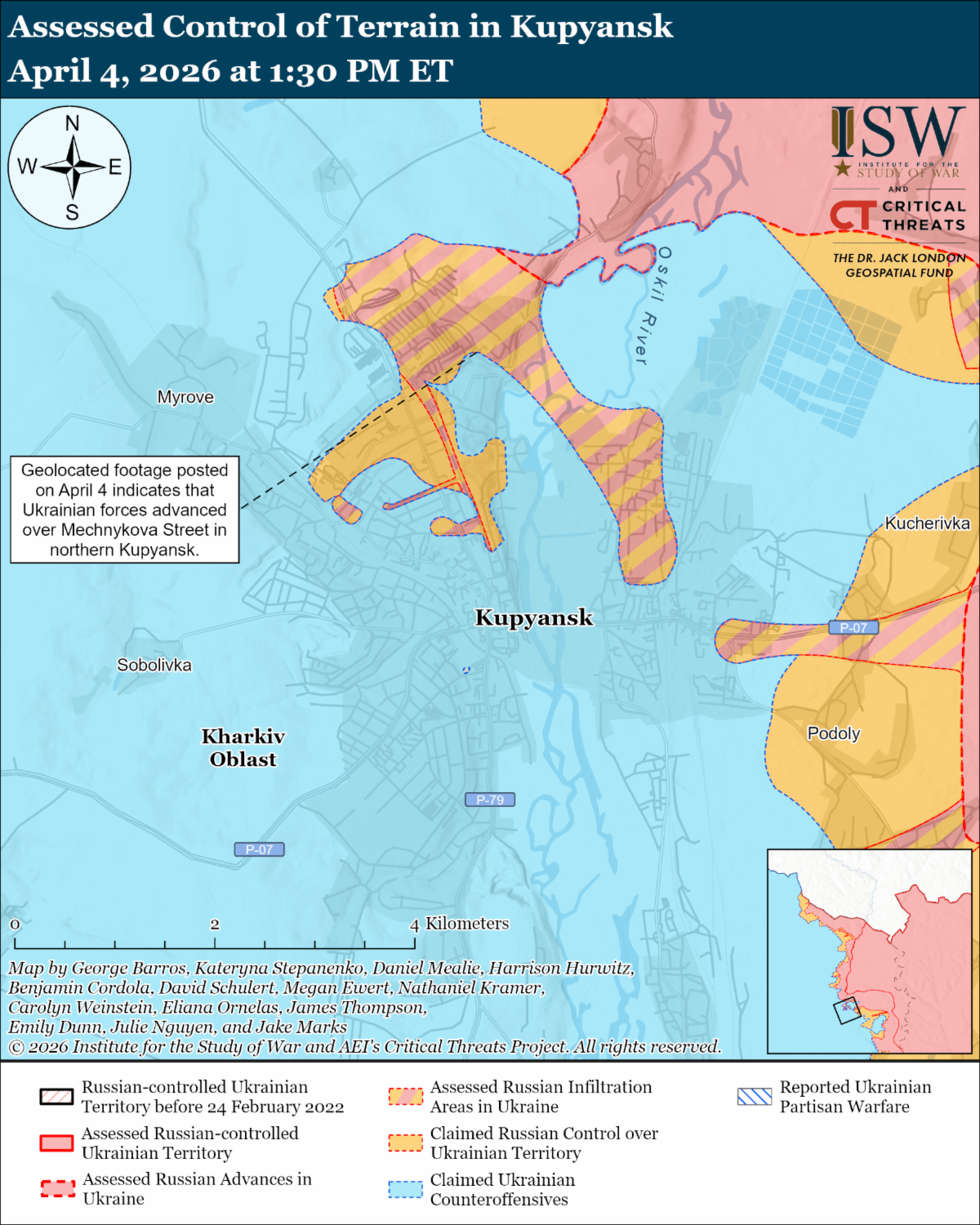
  • 우크라이나군은 하르키우주 북부와 쿠피얀스크 및 올렉산드리우카 방향으로 진격했습니다.
  • 우크라이나군은 사마라주에 있는 적어도 한 곳의 러시아 화학 공장을 공격했습니다. 러시아군은 우크라이나를 향해 286대의 드론을 발사했습니다.

최신 관련 자료 및 링크:

다음은 위의 핵심 내용과 관련된 최신 정보 및 자료에 대한 링크입니다.

  1. 러시아 국내 반발 관련:

    Council on Foreign Relations – Russia’s Information War in Ukraine: Where Things Stand (미국 외교 협회 – 우크라이나 전쟁에서 러시아의 정보전: 현재 상황) (영어)

    • 이 기사는 러시아 내 검열과 여론 통제에 대한 다양한 상황을 논의합니다.
  2. 우크라이나군의 공격 작전:

    Institute for the Study of War – Ukraine Conflict Updates (전쟁 연구소 – 우크라이나 분쟁 업데이트) (영어)

    • ISW는 매일 우크라이나 전선 상황을 자세히 분석하여 전반적인 전황과 각 지역별 교전 상황을 보여줍니다.
    • 매일 업데이트 되므로 최신 정보를 얻을 수 있습니다.
  3. 하르키우 지역 진격 관련:

    Reuters – Ukraine says it holds positions in northeast as fighting rages in east (로이터 – 우크라이나, 동부에서 격렬한 전투가 벌어지는 가운데 북동부에서 진지 유지) (영어)

    • 이 기사는 하르키우 지역의 전선 상황을 상세하게 보도하며, 우크라이나군의 진격 상황을 다룹니다.
  4. 러시아 화학 공장 공격 및 드론 공격 관련:

    BBC News – Ukraine war live: Drone strikes reported in Russia after Kyiv attacks (BBC 뉴스 – 우크라이나 전쟁 라이브: 키이우 공격 후 러시아에서 드론 공격 보고) (영어)

    • BBC 뉴스에서 우크라이나 전쟁과 관련된 실시간 정보를 제공하며, 화학 공장 공격 및 드론 공격과 관련된 최신 정보도 확인할 수 있습니다.

“`
**참고:**

* 위의 링크들은 현재 시점 기준으로 유효하며, 관련 내용이 포함되어 있는지 확인했습니다.
* 각 링크의 내용은 영어로 작성되어 있지만, 필요한 경우 번역기를 사용하여 내용을 이해할 수 있습니다.
* 최신 정보를 얻기 위해서는 주기적으로 위의 링크들을 확인하는 것이 좋습니다.
* 전황은 유동적이므로, 최신 정보를 지속적으로 업데이트하는 것이 중요합니다.

[원문]

The Kremlin continues to face harsher backlash from Russia’s domestic populace about its intensified censorship efforts in recent weeks than Moscow likely expected or was prepared for.

April 4, 2026

Data Cutoff: 12:30 PM ET

Jessica Sobieski, Diana Nasreddine, Justin Young, Christina Harward, Anna Thacker, and Karolina Hird

TOPLINES

The Kremlin continues to face harsher backlash from Russia’s domestic populace about its intensified censorship efforts in recent weeks than Moscow likely expected or was prepared for. Polling from the Kremlin-linked Public Opinion Forum (FOM) from March 27 to 29 found that Russian President Vladimir Putin’s trust rating fell by five percentage points from 76 percent to 71 percent since March 22 – the highest decrease since 2019. Weekly FOM polling shows Putin’s trust rating consistently falling since February 8, 2026, just before the Kremlin significantly throttled Telegram on February 9 and 10. Russian opposition source Vazhnye Istorii noted on April 3 that several pro-Kremlin Russian propagandists and pro-war milbloggers are increasingly expressing frustration with Kremlin efforts to block Telegram, including by complaining that the Kremlin is wasting money on the censorship efforts despite rising prices and is leaving Russian forces without battlefield communication systems. Russian officials have struggled to manage backlash from the Russian information space over intensified censorship efforts, especially from the ultranationalist milblogger community. Russian officials have made contradictory statements concerning the Kremlin’s policy toward Telegram in recent weeks, suggesting that the Kremlin lacked a cohesive management strategy regarding the implementation of censorship measures and indicating that Russian officials are facing backlash potentially far greater than they originally estimated.

Ukrainian forces continued their mid-range strike campaign against military assets in Russia and occupied Ukraine on April 3 to 4. Ukrainian Unmanned Systems Forces (USF) Commander Major Robert “Magyar” Brovdi reported that Ukrainian forces struck two Russian Shahed drone preparation points and hubs at the Khalino Air Base near Kursk City (roughly 100 kilometers from the frontline) and in Navlya, Bryansk Oblast (roughly 70 kilometers from the frontline) on April 4. Brovdi reported that Ukrainian forces struck multiple targets in occupied Luhansk Oblast, including deployment points of elements of the Russian 3rd Combined Arms Army (CAA, formerly 2nd Luhansk People’s Republic Army Corps [LNR AC], Southern Military District [SMD]) near Shulhynka (roughly 75 kilometers from the frontline) and Bilovodsk (roughly 120 kilometers from the frontline); command posts and troop concentrations near Shulhynka and Bilovodsk; a ZU-23-2 towed anti-aircraft gun near occupied Lozivskyi (roughly 75 kilometers from the frontline); and a fuel tanker near Novosimeikine (roughly 135 kilometers from the frontline). Geolocated footage published on April 4 confirms strikes near Shchotove, Lozivskyi, and Novosimeikine. Ukraine’s Security Service (SBU) reported on April 4 that Ukrainian drones struck the Alchevsk Metallurgical Plant in occupied Alchevsk, Luhansk Oblast (roughly 65 kilometers from the frontline) for the second time in a month, forcing the plant to halt operations. The Ukrainian General Staff reported that Ukrainian forces struck Russian railway trains carrying fuel near Shchotove (roughly 100 kilometers from the frontline) and Stanytsya Luhanska (roughly 110 kilometers from the frontline) in occupied Luhansk Oblast on April 3 and overnight on April 3 to 4.

KEY TAKEAWAYS

  • The Kremlin continues to face harsher backlash from Russia’s domestic populace about its intensified censorship efforts in recent weeks than Moscow likely expected or was prepared for.

  • Ukrainian forces continued their mid-range strike campaign against military assets in Russia and occupied Ukraine on April 3 to 4.  

  • Ukrainian forces advanced in northern Kharkiv Oblast and in the Kupyansk and Oleksandrivka directions.


  • Ukrainian forces struck at least one Russian chemical plant in Samara Oblast. Russian forces launched 286 drones against Ukraine.

EMAIL SUBSCRIPTION OPTIONS

ISW offers customizable email subscription options. Click below to learn more and customize your preferences.

ISW is powered by the support of individuals like you.

Help us stay independent and impactful.

Website | Jobs | Internships

Follow ISW on social media:

FacebookXYouTube | InstagramLinkedIn | Threads | Bluesky

© 2026 Institute for the Study of War and AEI’s Critical Threats Project. All rights reserved.

Donate online or by sending a check to the Institute for the Study of War at 1400 16th Street NW, Suite #515, Washington, DC 20036. Please consider including the Institute for the Study of War in your estate plans.


ISW is a tax-exempt organization under section 501(c)(3) of the Internal Revenue Code. Donations are tax-deductible to the extent permitted by law.

ISW is a non-partisan, non-profit, public policy research organization. ISW advances an informed understanding of military affairs through reliable research, trusted analysis, and innovative education. We are committed to improving the nation’s ability to execute military operations and respond to emerging threats in order to achieve US strategic objectives.

댓글 달기

이메일 주소는 공개되지 않습니다. 필수 필드는 *로 표시됩니다

위로 스크롤