[ISW] 이란 업데이트 특별 보고서, 2026년 4월 9일

“`html

핵심 내용 요약:

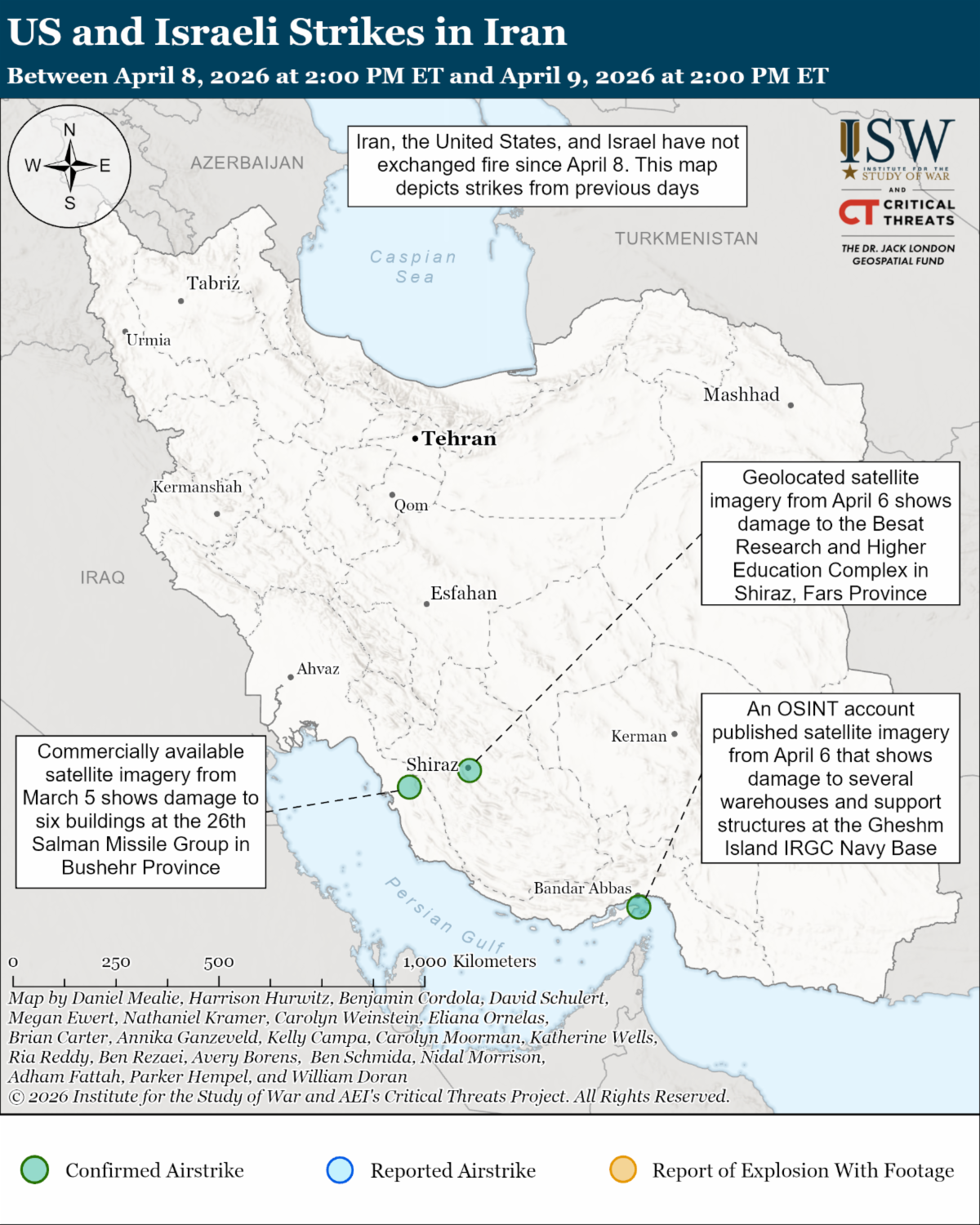
  • ISW-CTP가 마지막 데이터를 집계한 4월 8일 이후, 이란, 미국, 이스라엘은 서로 간에 교전을 벌이지 않았습니다. 그러나 걸프 국가들은 계속해서 드론 공격을 받고 있다고 보고하고 있습니다.
  • 4월 8일, 미국 정부는 이란이 미국과의 협상의 기반이 될 “새로운” 및 “수정된” 제안을 미국에 제출했다고 밝혔습니다. 4월 7일, 도널드 트럼프 미국 대통령은 이 제안이 “협상의 실질적인 기반”이라고 언급했습니다. 월스트리트 저널은 익명의 중재자들을 인용하여 4월 8일에 이란이 핵 농축, 중동 내 미군 철수, 전쟁 배상 등 여러 요구 사항을 완화했다고 보도했습니다.
  • 이란은 호르무즈 해협을 통과하는 해상 교통에 대한 통제를 시도하기 위해 여러 조치를 취하고 있으며, 이는 유가를 높게 유지하는 결과를 낳고 있습니다. 이란은 높은 유가를 활용하여 미국에 경제적 압력을 가하고, 협상 과정에서 양보를 얻어내려는 의도로 보입니다.
  • 이란 관리는 레바논이 휴전 프레임워크의 일부라고 계속 주장하고 있습니다. 그러나 이스라엘 관리는 레바논에서 휴전을 준수하지 않고, 헤즈볼라에 대한 공격을 계속할 것이라고 밝혔습니다. 헤즈볼라는 이스라엘 북부와 레바논 남부의 이스라엘군 및 거점에 대한 공격을 재개했습니다. 4월 8일, 베냐민 네타냐후 이스라엘 총리는 이스라엘 관료들에게 “가능한 한 빨리” 레바논 정부와 직접 협상하여 헤즈볼라 무장 해제를 논의하도록 지시했습니다.

관련 최신 자료 및 링크:

  • 미국 외교 협회(Council on Foreign Relations): 이란 – 이란 관련 최신 뉴스, 분석 및 자료 제공. (영문)

    • 이 링크는 이란과 관련된 외교 및 국제 관계에 대한 정보를 제공합니다. 해당 링크의 내용은 최신 뉴스, 분석, 보고서 등을 포함하며, 이란의 정책, 지역 내 영향력, 핵 프로그램 등에 대한 깊이 있는 정보를 얻을 수 있습니다.
  • 미국 국무부: 이란 – 미국 국무부의 이란 관련 공식 발표, 성명, 정책 문서. (영문)

    • 이 링크는 미국 국무부의 이란 관련 공식 문서로, 미국의 대(對) 이란 정책, 외교적 노력, 제재, 인권 문제 등에 대한 최신 정보를 제공합니다.
  • 알자지라: 이란 – 이란 관련 보도, 분석, 인터뷰 등. (영문)

    • 알자지라는 이란 관련 뉴스, 심층 분석, 현장 보고서 등을 제공하는 국제 뉴스 채널입니다. 해당 링크를 통해 이란의 정치, 경제, 사회, 문화 등 다양한 측면에 대한 정보를 얻을 수 있습니다.
  • 로이터 통신: 중동/이란 – 이란 관련 최신 뉴스 및 속보. (영문)

    • 로이터 통신은 전 세계의 뉴스 및 속보를 제공하는 권위 있는 언론사입니다. 이 링크를 통해 이란, 중동 지역의 최신 뉴스와 분석을 접할 수 있습니다.
  • BBC News: Iran – BBC의 이란 관련 뉴스, 분석, 보도. (영문)

    • BBC는 이란과 관련된 뉴스, 심층 분석, 보도 등을 제공하는 또 다른 신뢰할 수 있는 매체입니다. 이 링크를 통해 이란의 최신 동향에 대한 정보를 얻을 수 있습니다.

(참고: 위 링크들은 현재 시점 기준으로 유효하며, 관련 내용의 최신성을 위해 주기적으로 업데이트될 수 있습니다. 링크에 접속하여 내용을 확인해주시기 바랍니다.)

“`

[원문]

Iran, the United States, and Israel have not exchanged fire since ISW-CTP’s last data cutoff on April 8

April 9, 2026

Data Cutoff: 2:00 PM ET

Nidal Morrison, Ben Rezaei, Avery Borens, Katherine Wells, Adham Fattah, Parker Hempel, Carolyn Moorman, Ria Reddy, and Annika Ganzeveld

As the Middle East crisis evolves, ISW urgently needs your support.

Help us stay independent and impactful.

TOPLINES

Iran, the United States, and Israel have not exchanged fire since ISW-CTP’s last data cutoff on April 8. Gulf states continue to report drone attacks against them, however. Bahrain’s Defense Ministry stated on April 9 that it has intercepted seven Iranian drones since April 8. The Kuwaiti Armed Forces announced on April 9 that an unspecified number of drones entered Kuwaiti airspace and that one of these drones targeted a Kuwaiti National Guard site.

Iran is taking several steps to try to exert control over maritime traffic through the Strait of Hormuz, which have the net effect of keeping oil prices high. Iran likely aims to use high oil prices to exert economic pressure on the United States and extract concessions from the United States during negotiations. An unnamed senior Iranian source told Russian state media on April 9 that Iran will not allow more than 15 vessels per day to transit through the Strait of Hormuz during the ceasefire. The Iranian Ports and Maritime Organization published a graphic on April 8 instructing ships to follow designated entry and exit routes in coordination with the Islamic Revolutionary Guards Corps (IRGC) Navy to transit the strait. These routes move international maritime traffic into Iranian-controlled waters. The graphic warns that ships risk hitting mines outside of these routes. Unspecified US officials previously told Western media on March 23 that there are at least a dozen Iranian mines in the strait. Iranian Supreme Leader Mojtaba Khamenei released a statement on April 9 in which he said that Iran will take the management of the Strait of Hormuz to a “new phase. This statement is consistent with other Iranian officials’ statements in recent weeks that Iran intends to use the strait as a point of leverage even after the war ends. Commercial maritime tracking data showed that three cargo ships and one oil tanker entered the strait, while six cargo ships and four oil tankers exited the strait between 2:00 PM ET on April 8 and 2:00 PM ET on April 9.

The US Government stated on April 8 that Iran submitted a “new” and “modified” proposal to the United States that will serve as the basis for the US-Iran talks. US President Donald Trump stated on April 7 that this proposal is a “workable basis on which to negotiate.” Iranian media previously published a version of its 10-point proposal, which included long-standing and maximalist Iranian demands. The proposal called for guarantees against future strikes on Iran, Iranian control of the Strait of Hormuz, recognition of Iran’s right to uranium enrichment, and the lifting of all US primary and secondary sanctions. It also demanded the termination of United Nations and International Atomic Energy Agency resolutions against Iran, the withdrawal of US forces from the region, war reparations, and a ceasefire across all fronts, including Lebanon.  Unspecified mediators told The Wall Street Journal on April 8 that Iran has softened several of its demands, including its demands related to nuclear enrichment, the withdrawal of US forces from the Middle East, and war reparations. The Wall Street Journal also highlighted disagreements over the scope of the ceasefire, noting that the United States does not consider Lebanon part of the agreement despite Iran including it in its proposal. Iranian President Masoud Pezeshkian stated on April 9 that Israeli strikes on Lebanon render negotiations “meaningless.” Iranian Parliament Speaker Mohammad Bagher Ghalibaf separately insisted that Lebanon is part of the ceasefire framework.

KEY TAKEAWAYS

  • Iran, the United States, and Israel have not exchanged fire since ISW-CTP’s last data cutoff on April 8. Gulf states continue to report drone attacks against them, however.

  • The US Government stated on April 8 that Iran submitted a “new” and “modified” proposal to the United States that will serve as the basis for the US-Iran talks. US President Donald Trump stated on April 7 that this proposal is a “workable basis on which to negotiate.” Unspecified mediators told the Wall Street Journal on April 8 that Iran has softened several of its demands, including its demands related to nuclear enrichment, the withdrawal of US forces from the Middle East, and war reparations.

  • Iran is taking several steps to try to exert control over maritime traffic through the Strait of Hormuz, which have the net effect of keeping oil prices high. Iran likely aims to use high oil prices to exert economic pressure on the United States and extract concessions from the United States during negotiations.

  • Iranian officials continue to insist that Lebanon is part of the ceasefire framework. Israeli officials have stated that Israel will not observe a ceasefire in Lebanon and will continue to strike Hezbollah, however. Hezbollah has resumed attacks on Israeli forces and positions in northern Israel and southern Lebanon. Israeli Prime Minister Benjamin Netanyahu instructed Israeli officials on April 8 to conduct direct negotiations with the Lebanese government “as soon as possible to discuss Hezbollah disarmament.

EMAIL SUBSCRIPTION OPTIONS

ISW offers customizable email subscription options. Click below to learn more and customize your preferences.

Website | Jobs | Internships

Follow ISW on social media:

FacebookXYouTube | InstagramLinkedIn | Threads | Bluesky

© 2026 Institute for the Study of War and AEI’s Critical Threats Project. All rights reserved.

Donate online or by sending a check to the Institute for the Study of War at 1400 16th Street NW, Suite #515, Washington, DC 20036. Please consider including the Institute for the Study of War in your estate plans.

ISW is a tax-exempt organization under section 501(c)(3) of the Internal Revenue Code. Donations are tax-deductible to the extent permitted by law.

ISW is a non-partisan, non-profit, public policy research organization. ISW advances an informed understanding of military affairs through reliable research, trusted analysis, and innovative education. We are committed to improving the nation’s ability to execute military operations and respond to emerging threats in order to achieve US strategic objectives.

댓글 달기

이메일 주소는 공개되지 않습니다. 필수 필드는 *로 표시됩니다

위로 스크롤