[ISW] 이란 업데이트 특별 보고서, 2026년 4월 16일

“`html

주요 내용 요약:

  • 미국-이란 협상의 주요 난관은 이란의 우라늄 농축 및 고농축 우라늄 비축량 문제로 알려져 있습니다. 이란 혁명수비대(IRGC)는 통상 민간 지도부가 담당하는 협상에서 과도한 역할을 하는 것으로 보입니다.
  • 이란은 호르무즈 해협 및 핵 프로그램에 대한 입장을 굽히지 않은 것으로 보입니다. 이란 측은 양보를 통해 협상 진전을 보이려고 시도했지만, 실제로는 해협에 대한 지배력을 활용하여 양보를 얻어내면서 동시에 수로 접근 통제권을 주장하고 있습니다.
  • 4월 16일, 도널드 트럼프 미국 대통령은 미국이 이란과 합의에 “매우 근접”했다고 밝혔습니다. 트럼프 대통령은 이란이 “거의 모든 것에 동의”했으며, 농축 우라늄 비축량을 넘겨주기로 했다고 덧붙였습니다. 하지만 이란은 트럼프 대통령의 발언을 공식적으로 확인하지 않았습니다.
  • 미국은 봉쇄를 통해 이란 군대의 물자 지원 및 군사적 역량을 제재하고 있습니다. 봉쇄는 또한 이란에 경제적 타격을 지속적으로 가하고 있습니다.
  • 이란 미사일 부대는 현재 휴전을 활용하여 전술 및 작전 수준의 부대를 재구성하고 있지만, 전략적 수준에서 미사일 부대를 유지하는 산업 시설 및 기타 구성 요소를 재건하는 것은 매우 어려울 것입니다.
  • 도널드 트럼프 미국 대통령은 레바논과 이스라엘이 4월 16일 오후 5시(동부 표준시)부터 10일간의 휴전에 합의했다고 발표했습니다. 네타냐후 이스라엘 총리는 레바논이 헤즈볼라의 무장을 해제하고 이스라엘과 “항구적인 평화 협정”을 체결해야 한다고 밝혔습니다.

참고: 이 요약은 제공된 정보에 기반하며, 최신 상황과 다를 수 있습니다.

관련 최신 자료 및 링크:

참고: 위에 제시된 링크는 정보 제공 목적으로 제공되며, 링크된 웹사이트의 내용에 대한 책임은 해당 웹사이트에 있습니다. 링크의 내용이 변경될 수 있으므로, 최신 정보를 확인하시기 바랍니다.

“`

[원문]

The main sticking point in current US-Iran negotiations is reportedly Iran’s enrichment of uranium and its highly enriched uranium stockpile.

April 16, 2026

Data Cutoff: 2:00 PM ET

Katherine Wells, Parker Hempel, Carolyn Moorman, Ben Rezaei, Ben Schmida, Adham Fattah, Nidal Morrison, Kelly Campa, Ria Reddy, and Brian Carter

As the Middle East crisis evolves, ISW urgently needs your support.

Help us stay independent and impactful.

TOPLINES

Iran is leveraging its position over the Strait of Hormuz to extract concessions while maintaining its claim to control access to the waterway. Reuters reported on April 15 that Iran has proposed allowing ships to transit through the Omani side of the Strait of Hormuz without interference if the United States agrees to conditions that prevent renewed conflict and meet Iranian demands. Iran has linked increased maritime access to broader negotiations, including demands to unfreeze Iranian funds, and a permanent end to US and Israeli strikes both in this war and for posterity. The implication of Iran’s “concession” is that it could threaten ships to discourage them from transiting the Omani side of the Strait unless the United States grants Iran significant concessions. Agreeing to Iranian demands along these lines would show Iran that it can coerce the United States using the Strait of Hormuz both now and in the future.

The main sticking point in current US-Iran negotiations is reportedly Iran’s enrichment of uranium and its highly enriched uranium stockpile. The United States has proposed a 20-year pause to enrichment, while the Iranians offered a 3- to 5-year pause, according to Iranian sources speaking to Reuters. The United States wants Iran to remove all of the highly enriched uranium from Iran, whereas Iran has proposed down-blending it or only moving part of its highly enriched uranium to another country, but not all of it, according to Iranian sources speaking to Western media in recent days. Iran could still enrich the remaining stockpile relatively quickly if it retained some highly enriched uranium, and it could use a 5-year pause to improve centrifuges and build or repair them. A Western diplomat told Reuters on April 16 that the nuclear issue “remains a core obstacle.” An unspecified source also told Reuters that a Pakistani mediator had made a breakthrough on “sticky issues,” but the negotiating parties have not resolved issues over Iran’s nuclear ‌program. An Iranian source told Reuters on April 16 that Iran is not ready to send all of its highly enriched uranium stockpile abroad, but it could send “part of it” to a third-party country. The source claimed that Iran needed to retain some of the stockpile because Iran needs the remaining stockpile for medical purposes at a research reactor in Tehran. This research reactor runs on only a few tens of kilograms (kg) of 20 percent enriched uranium instead of 10,000kg of Iran’s total enriched uranium stockpile, according to nuclear expert David Albright. Only a small portion—roughly 400kg—of the 10,000kg Albright references is highly enriched uranium (60%). US objectives appear to remain at zero enrichment on Iranian soil, however. Israeli Prime Minister Netanyahu stated on April 15 that Israeli and US objectives in Iran are identical and include the removal of Iranian highly enriched uranium, the “dismantling” of Iran’s nuclear enrichment capabilities, and “reinstating” a nuclear deal.

Iran appears not to have compromised on its stance over the Strait of Hormuz and its nuclear program, despite Iranian sources attempting to illustrate that Iran has compromised and the two sides have made progress in negotiations, however. Islamic Revolutionary Guards Corps (IRGC) affiliated media on April 16 denied all recent Reuters reporting citing Iranian sources. The same IRGC-affiliated outlet had cast doubt on progress in future US-Iran talks, due to Iran‘s distrust of the United States and US “excessive demands” earlier on April 16. These conflicting reports on Iranian stances in these negotiations corroborate CTP-ISW’s continued observation that the Iranian negotiating council is not unified. This disunity will make it harder for Iran to make decisions and implement decisions throughout this negotiating process.

KEY TAKEAWAYS

  • The main sticking point in current US-Iran negotiations is reportedly Iran’s enrichment of uranium and its highly enriched uranium stockpile. The IRGC appears to be playing an outsized role in Iranian decision-making in these negotiations, traditionally meant for civilian leadership.

  • Iran appears to have not compromised on its stance over the Strait of Hormuz and its nuclear program, despite Iranian sources attempting to illustrate that Iran has compromised and the two sides have made progress in negotiations, however. Iran is leveraging its position over the Strait of Hormuz to extract concessions while maintaining its claim to control access to the waterway.

  • US President Donald Trump stated on April 16 that the United States is “very close” to reaching a deal with Iran. Trump stated that Iran “has agreed to almost everything” and added that Iran has agreed to hand over its enriched uranium stockpile. Iran has not publicly confirmed Trump’s remarks at the time of this writing. 

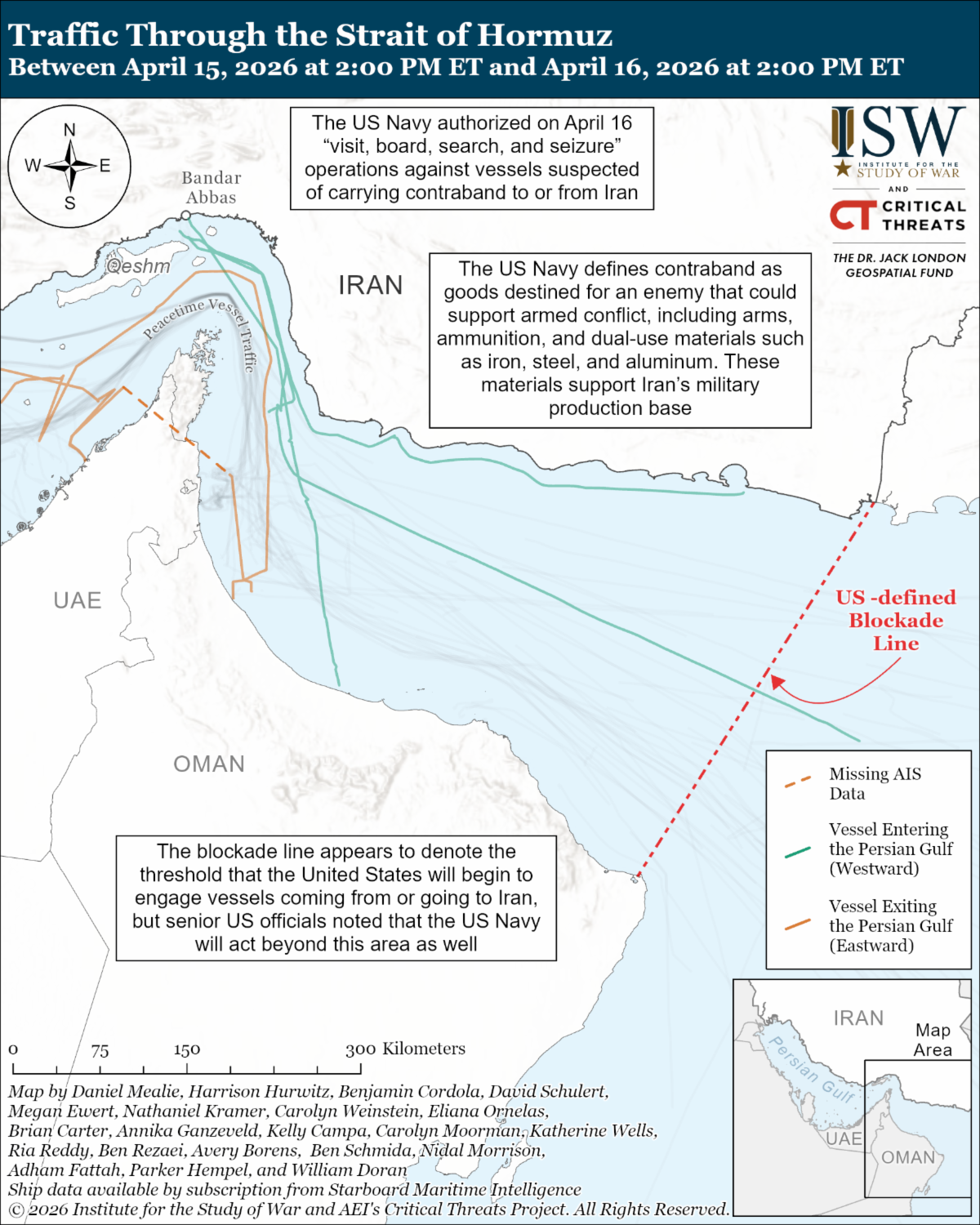
  • The United States is targeting materiel support to Iran’s armed forces and military capabilities through the blockade. The blockade also continues to impose economic costs on Iran.

  • The Iranian missile force is exploiting the current ceasefire to reconstitute its tactical and operational-level units, but rebuilding the industrial facilities and other components that sustain the missile force at the strategic level will be extremely challenging.

  • US President Donald Trump announced that Lebanon and Israel have agreed to a 10-day ceasefire beginning at 5:00 PM ET on April 16. Netanyahu stated that Lebanon must disarm Hezbollah and establish a ”lasting peace agreement” with Israel.

EMAIL SUBSCRIPTION OPTIONS

ISW offers customizable email subscription options. Click below to learn more and customize your preferences.

Website | Jobs | Internships

Follow ISW on social media:

FacebookXYouTube | InstagramLinkedIn | Threads | Bluesky

© 2026 Institute for the Study of War and AEI’s Critical Threats Project. All rights reserved.

Donate online or by sending a check to the Institute for the Study of War at 1400 16th Street NW, Suite #515, Washington, DC 20036. Please consider including the Institute for the Study of War in your estate plans.

ISW is a tax-exempt organization under section 501(c)(3) of the Internal Revenue Code. Donations are tax-deductible to the extent permitted by law.

ISW is a non-partisan, non-profit, public policy research organization. ISW advances an informed understanding of military affairs through reliable research, trusted analysis, and innovative education. We are committed to improving the nation’s ability to execute military operations and respond to emerging threats in order to achieve US strategic objectives.

댓글 달기

이메일 주소는 공개되지 않습니다. 필수 필드는 *로 표시됩니다

위로 스크롤